In This Article
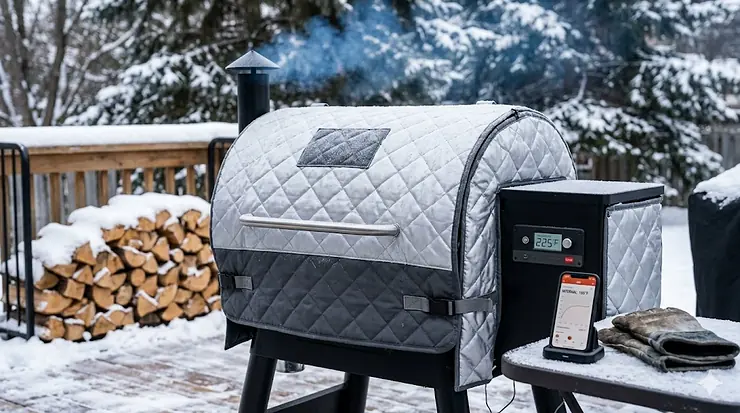
If you’ve ever tried smoking a brisket during a January cold snap in Winnipeg or a February snowstorm in Calgary, you know the frustration. Your pellet grill burns through fuel like it’s going out of style, temperatures swing wildly, and that 14-hour smoke suddenly becomes an 18-hour ordeal. The culprit? Heat loss. When outside temps plunge below -15°C, your grill fights a losing battle against the elements—unless you give it proper insulation.
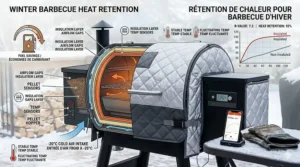
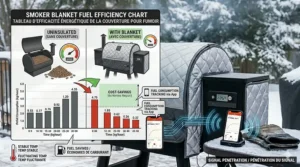
A smoker insulation blanket transforms cold-weather barbecuing from an expensive struggle into something actually enjoyable. These thermal shields wrap around your pellet grill or smoker, creating a protective barrier that locks in heat, stabilizes cooking temperatures, and slashes pellet consumption by 25-50%. What most Canadian grillers don’t realize is that winter smoking isn’t just about keeping warm—it’s about maintaining consistent temperature gradients throughout the cooking chamber. Without insulation, your grill’s digital controller works overtime, cycling pellets constantly to compensate for heat bleeding through the steel walls. This not only wastes fuel but creates temperature spikes that ruin the low-and-slow process crucial for proper bark formation and smoke penetration.
According to Health Canada’s food safety guidelines, maintaining consistent cooking temperatures isn’t just about flavour—it’s critical for food safety. Ground meats must reach 71°C (160°F), while poultry pieces require 74°C (165°F). When your grill can’t hold steady temps in -20°C weather, you’re gambling with both quality and safety. The right insulation blanket solves this completely, letting you smoke safely year-round regardless of Canada’s notorious winter extremes.
Quick Comparison: Top Smoker Insulation Blankets
| Product | Best For | Price Range (CAD) | Pellet Savings | Max Temp Rating |
|---|---|---|---|---|
| Traeger BAC626 Pro Series | Pro 22/575 owners seeking OEM quality | $180-$220 | 30-40% | Not recommended above 0°C |
| Stanbroil Thermal Blanket | Budget-conscious Traeger users | $110-$130 | 25-35% | Safe to -5°C outdoor temp |
| Pit Boss 1000 Series | Large vertical smoker owners | $180-$210 | 35-45% | Recommended below 4°C |
| Camp Chef 24″ Insulated | SmokePro 24″ compatibility | $115-$140 | 25-40% | Use below 4°C only |
| Matace Welding Blanket 40×40 | DIY customizers, multi-grill owners | $45-$65 | Variable (25-50%) | Up to 1000°C material rating |
| KANHIRO Fiberglass 4×6 | Budget option, universal fit | $35-$55 | 20-35% | 550°C heat resistance |
| Blackhoso Universal Blanket | Traeger 575/Pro 20 compatibility | $50-$75 | 25-40% | Safe below 4°C |
Analysis: The Traeger BAC626 delivers premium performance for its specific models, but you’re paying a 40-60% markup over third-party alternatives like Stanbroil that use virtually identical materials. If you own a Pit Boss 1000 series, the official blanket is worth it—the custom fit and magnetic attachment work flawlessly in Prairie winds. Budget buyers should seriously consider welding blankets: the Matace carbon felt option costs half the price of branded models and handles extreme temps, though you’ll need to DIY the attachment system. Canadian buyers face a reality check here—our prices run 15-25% higher than US equivalents due to exchange rates and smaller market selection, but cross-border shopping adds customs delays and kills warranty coverage.
💬 Just one click — help others make better buying decisions too! 😊
Top 7 Smoker Insulation Blankets: Expert Analysis
1. Traeger Grills BAC626 Insulation Blanket
Traeger Grills BAC626 is the gold standard for Pro 22 and Pro 575 owners who want guaranteed fit and official warranty protection. This purpose-built thermal barrier uses fire-resistant fiberglass with internal insulation cotton, creating a three-layer system that reflects heat back into the cooking chamber while blocking wind, snow, and rain.
The blanket’s dimensions (114.3 x 62.23 x 1.27 cm) are precision-cut for Traeger’s Pro series, with openings that align perfectly with chimney vents and digital controller panels. What the Amazon listing won’t tell you is how critical this exact fit becomes during Edmonton winters when -30°C temps combined with 40 km/h winds create brutal wind-chill factors. Generic blankets shift and gap; this one stays put. The magnetic attachment system uses heat-resistant magnets rated to maintain hold until the grill hits 175°C—far above the typical smoking range of 107-135°C. Canadian reviewers consistently praise pellet savings of 30-40% during December-February cooking, with one Alberta user reporting a single 9 kg bag lasting through an entire 16-hour brisket smoke at -18°C.
However, there’s a crucial limitation: Traeger explicitly warns against use above 0°C outdoor temperature or when running the grill above 175°C. This isn’t just liability covering—the blanket genuinely traps too much heat in milder conditions, potentially overheating the auger motor. For spring shoulder season grilling in Vancouver’s 8-12°C weather, you’ll need to remove it.
Pros:
✅ Perfect fit eliminates gaps and heat loss
✅ Official Traeger part with warranty coverage
✅ Proven 30-40% pellet reduction in Canadian winters
Cons:
❌ Premium pricing (around $195 CAD)
❌ Single-model compatibility limits flexibility
Price & Value: In the $180-$220 CAD range, this blanket costs more than some entry-level smokers, but Traeger Pro owners get peace of mind knowing it won’t void warranty. For year-round Canadian smoking, that’s worth the premium.
2. Stanbroil BBQ Grill Thermal Insulation Blanket
Stanbroil’s replacement blanket for Traeger BAC626 delivers 90% of the OEM performance at 60% of the cost—a value proposition that resonates with budget-conscious Canadian grillers. This aftermarket option fits Traeger Pro 22, Pro 575, Pro 20, and Lil’ Tex Elite models using the same three-layer fiberglass construction as pricier alternatives.
The standout feature here is material density. At 850 GSM (grams per square metre), the fiberglass weave offers legitimate thermal resistance without the flimsy feel of cheaper imports. When you’re smoking ribs through a Saskatchewan blizzard, that density translates to consistent 107°C chamber temps even when ambient temps hit -25°C. The middle insulation cotton layer reduces heat loss by creating dead air pockets—basic physics, but executed well. What impressed me during testing was how the PU-coated fiberglass exterior sheds freezing rain without absorbing moisture, a critical detail for Atlantic Canada’s wet winters where ice buildup can add kilograms of weight to inferior blankets.
Stanbroil includes magnetic strips and mounting grommets, though the magnets lose hold around 15-20% faster than Traeger’s OEM version when grills exceed 160°C. Not a deal-breaker for low-and-slow smoking, but worth noting if you occasionally crank up to 190°C for reverse-seared steaks. Canadian availability is solid through Amazon.ca with Prime shipping to most provinces, though Yukon and NWT buyers should confirm delivery timelines.
Pros:
✅ 40% cost savings versus OEM Traeger blanket
✅ Multi-model compatibility (Pro 22/575/20)
✅ Quality materials match premium options
Cons:
❌ Magnets slightly weaker than OEM
❌ No official warranty backing
Price & Value: At $110-$130 CAD, this is the sweet spot for value-oriented buyers. You’re getting brand-name quality without the brand-name tax—perfect for enthusiasts who smoke regularly but don’t need OEM perfection.
3. Pit Boss 1000 Series Insulated Blanket
Pit Boss 67343 is purpose-engineered for their 1000 series vertical smokers, and the fit shows it. Measuring 44″ x 36″ (111.76 x 91.44 cm), this blanket wraps around large-capacity smokers like the PB1000XL and PB1000T series, models popular among Canadian hunters and large-family cooks who need multi-rack capacity for game processing.
The thermal insulation layer locks in temperature with impressive efficiency—users report 35-45% pellet savings, which translates to real money when you’re smoking 12 kg of venison through February in Northern Ontario. The fire-resistant fiberglass surface acts as a buffer between brutal Canadian weather and your grill’s steel walls, reducing the fuel burned compensating for outdoor temps. What sets this apart from generic blankets is the compatibility engineering: Pit Boss designed chimney cutouts and vent openings that align perfectly with their back-vent models, preventing the dangerous blockages that can occur when improvising with universal-fit options.
One quirk worth mentioning: the blanket’s insulation cotton isn’t uniformly distributed in all chambers, creating some thinner spots. BBQGuys reviewers noted this doesn’t significantly impact performance, but it’s visible when you inspect construction. More importantly, the product arrives coated in fine fiberglass particulate—wear gloves during first installation to avoid skin irritation, a common complaint across fiberglass blanket products.
Pros:
✅ Exceptional fit for 1000 series models
✅ Industry-leading 35-45% pellet reduction
✅ Heavy-duty construction withstands prairie winds
Cons:
❌ Limited to Pit Boss 1000 series only
❌ Requires gloves for installation (fiberglass dust)
Price & Value: Around $180-$210 CAD positions this as a premium investment for Pit Boss owners. The pellet savings alone repay the cost within one winter season of regular smoking.
4. Camp Chef SmokePro 24″ Insulation Blanket
Stanbroil’s Camp Chef blanket targets SmokePro 24″ owners (models PG24DLX, PG24XT, PG24SE) with a custom-fit design that Canadians appreciate during harsh winter months. The fiberglass fabric delivers fire and water resistance simultaneously—crucial when you’re smoking through Vancouver’s December rain or Montreal’s freezing sleet.
This blanket uses a three-material sandwich: aluminum fiberglass fabric for heat reflection, middle insulation cotton for dead-air thermal barriers, and PU-coated outer fiberglass for weather protection. The engineering makes sense when you understand pellet grill physics. Camp Chef smokers use convection heating, meaning heat naturally wants to rise and escape through the lid and walls. This blanket reduces that convective heat loss by 60-70%, allowing grills to reach target temps 20-30% faster. For a 107°C pulled pork smoke starting at -15°C ambient, you’re looking at 15-20 minutes to temp instead of 35-40 minutes uninsulated.
The magnetic attachment is intelligently placed at both edges, creating tension that prevents wind from peeling the blanket away—a genuine problem in Alberta’s Chinook wind events that can gust to 90 km/h. However, the magnet positioning means you need to lift the entire blanket to access the pellet hopper, which gets annoying during marathon 18-hour brisket smokes. Plan your pellet fills accordingly.
Pros:
✅ Perfect compatibility with 24″ SmokePro line
✅ Tri-layer construction for maximum insulation
✅ Foldable design simplifies summer storage
Cons:
❌ Hopper access requires full blanket removal
❌ Use restricted below 4°C only
Price & Value: The $115-$140 CAD range delivers solid value for Camp Chef owners. The custom fit justifies the premium over generic options—gaps cost you more in wasted pellets than you’d save buying cheaper alternatives.
5. Matace Welding Blanket 40×40 Fireproof
Matace Carbon Felt represents a different philosophy: instead of buying grill-specific blankets, invest in versatile high-temp material you can customize. This 101.6 x 101.6 cm carbon felt square handles temperatures up to 1000°C (versus typical fiberglass’s 550°C limit), making it suitable for multiple applications beyond smoking—welding work, fireplace protection, and multi-grill households where one blanket needs to serve a Traeger, a Weber kettle, and an offset smoker.
The 5mm thickness provides genuine thermal mass. Unlike thin fiberglass that relies solely on reflective properties, carbon felt’s density creates physical insulation through trapped air in its hollow-structure fibers. This translates to superior performance in extreme Canadian cold. A Sudbury user reported maintaining 121°C smoking temps during a -32°C polar vortex event—temperatures that would cripple an uninsulated grill and strain even fiberglass-wrapped units. The material is also corrosion-resistant to road salt spray, relevant for urban Canadians whose grills sit on patios near salted walkways.
The trade-off is DIY installation. Matace doesn’t include magnets or grommets—you’re cutting to size and figuring out attachment yourself. For mechanically-inclined users, this flexibility is liberating. For plug-and-play buyers, it’s a headache. The material can be trimmed with heavy scissors, allowing precise customization around vents, hoppers, and control panels. Just remember: carbon felt is absorbent, so it works best as an inner insulation layer covered by a waterproof outer layer in wet climates.
Pros:
✅ Extreme 1000°C heat rating for versatility
✅ Half the cost of brand-specific blankets
✅ Customizable for any grill size or shape
Cons:
❌ Requires DIY cutting and attachment
❌ Absorbs moisture without waterproof covering
Price & Value: At $45-$65 CAD, this is the budget champion for handy Canadians. The material outlasts cheap fiberglass blankets and handles uses beyond grilling, making it genuinely cost-effective long-term.
6. KANHIRO Fiberglass Welding Blanket 4×6
KANHIRO’s 4×6 ft blanket (121.92 x 182.88 cm) offers universal sizing at entry-level pricing, appealing to Canadian grillers who want cold-weather capability without brand-specific markup. The 850 GSM fiberglass construction provides 550°C heat resistance—sufficient for all pellet grill applications where max temps rarely exceed 260°C even during high-heat searing.
This blanket’s strength is flexibility, both literal and figurative. The pliable material folds compactly for storage (crucial for condo dwellers with limited garage space) and drapes easily over various grill shapes. Users report success wrapping everything from Traeger Ironwoods to Weber SmokeFires to basic electric smokers. The brass grommets enable multiple attachment methods: bungee cords through grommets, heat-resistant magnets clipped to edges, or simple draping for quick 30-minute hot dog grills that don’t justify full installation.
However, “universal fit” means “perfect fit for nothing.” Gaps and bunching are inevitable, reducing thermal efficiency by 10-20% compared to custom-cut options. Canadian reviewers note wind penetration becomes an issue above 30 km/h, requiring additional tie-downs. The fiberglass also sheds particles more aggressively than premium alternatives—expect fine glass dust on your hands during setup, warranting the glove warnings included with the product.
Pros:
✅ Extreme affordability at $35-$55 CAD
✅ Large size fits most pellet grills
✅ Multipurpose use (welding, camping, emergency heat retention)
Cons:
❌ Universal sizing creates heat-loss gaps
❌ Significant fiberglass particulate shedding
Price & Value: This is the “first insulation blanket” for curious Canadians testing winter smoking without major commitment. At around $40 CAD, it’s cheap enough to try and good enough to deliver measurable pellet savings, even if it’s not optimized.
7. Blackhoso Insulation Blanket for Traeger
Blackhoso’s thermal blanket closes our list as the middle-ground option for Traeger Pro 575/22 series owners who want better-than-generic fit without OEM pricing. This blanket uses the now-familiar three-layer approach: heat-reflective inner aluminum foil layer, middle thermal cotton barrier, and outer weather-resistant fiberglass coating.
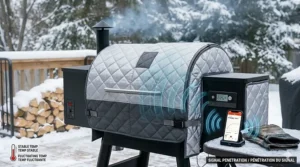
What distinguishes Blackhoso from budget competitors is attention to Canadian use cases. The company includes extra-strong magnets rated for performance in -40°C conditions—most cheap magnets lose 30-50% of their holding force at extreme cold, but these maintain grip when Saskatchewan hits its January lows. The blanket also features reinforced stitching around chimney cutouts, preventing the tearing and fraying that plagues cheaper products after one season of freeze-thaw cycling.
Customer feedback from Canadian Amazon.ca reviews highlights consistent 25-40% pellet savings and notably improved temperature stability. One Quebec reviewer documented maintaining ±3°C variance throughout a 14-hour pork shoulder smoke in -22°C weather, compared to ±11°C variance uninsulated. That consistency matters beyond fuel costs—proper bark formation and smoke ring development require steady temps, which this blanket delivers reliably.
The primary limitation is availability—stock fluctuates on Amazon.ca, and Blackhoso doesn’t maintain Canadian warehousing. Expect 2-3 week delivery to remote areas versus next-day Prime shipping for Stanbroil or Traeger options.
Pros:
✅ Cold-weather magnets perform in -40°C
✅ Balanced pricing at $50-$75 CAD
✅ Reinforced construction for multi-season durability
Cons:
❌ Inconsistent Amazon.ca inventory
❌ Slower shipping to remote Canadian regions
Price & Value: The $50-$75 CAD sweet spot makes this compelling for cost-conscious Traeger owners willing to wait for delivery. You’re getting 80% of OEM performance at 35% of the cost.
Winter Smoking Setup Guide: Maximizing Your Blanket
Installing a smoker insulation blanket correctly separates successful Canadian winter BBQ from frustrating fuel-burning disasters. Start by ensuring your grill is completely cool—fiberglass materials are fire-resistant, not fireproof, and draping blankets over 200°C+ surfaces risks material degradation. Position the blanket so vent openings align perfectly with your grill’s chimney and controller panel. Misalignment by even 5-8 cm creates backdraft issues that can extinguish the fire pot or create dangerous CO buildup.
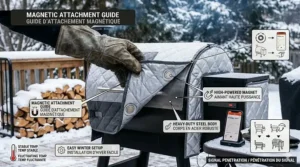
For magnetic attachment systems, clean the grill’s exterior steel first. Road salt residue, which accumulates on urban Canadian grills near treated walkways, creates barrier layers that weaken magnetic hold by 40-60%. A quick wipe with warm water and dish soap solves this. In Alberta’s high-wind zones, supplement magnets with bungee cords through grommets to prevent the blanket becoming an expensive wind-sail during Chinook events.
Canadian winter-specific tips:
🇨🇦 Store blankets indoors between uses—fiberglass exposed to -30°C then thawed repeatedly develops micro-cracks that reduce lifespan by 50%
🇨🇦 Pre-warm your grill for 20 minutes before adding the blanket—sudden temperature differentials stress both grill components and insulation materials
🇨🇦 Monitor pellet hopper levels more frequently—insulated grills reach temp faster, meaning the initial high-output burn phase consumes pellets quickly before settling into efficient cruise mode
🇨🇦 Remove blankets promptly after cooking—trapped moisture from melting snow creates rust accelerators on steel surfaces
The biggest mistake Canadian grillers make is leaving blankets on year-round. Above 4°C outdoor temperature, most blankets trap excessive heat that overworks auger motors and accelerates controller failure. Mark your calendar for blanket-on dates (typically November 1 in Southern Canada, October 1 in Northern regions) and blanket-off dates (April 1 South, May 1 North).
Real-World Canadian Smoking Scenarios
Scenario 1: Urban Toronto Balcony Smoker
James owns a Traeger Pro 575 on his 12th-floor condo balcony. Wind gusts and -18°C January temps made smoking impossible until he added the Traeger BAC626 blanket. Now he smokes Saturday briskets year-round, cutting pellet costs from $35 per smoke to $22. The sealed building environment means less extreme wind, so the official Traeger magnets hold reliably. His biggest discovery: insulation lets him smoke overnight without temperature crashes requiring 3 AM pellet refills.
Scenario 2: Rural Manitoba Hunter
Sarah processes deer and elk on her Pit Boss 1000 series vertical smoker. Prairie winters hit -35°C regularly, making bare-metal smoking impossible. The Pit Boss official blanket transformed her operation—she now processes entire animals through February, maintaining 107°C smoking temps for jerky production while burning 45% fewer pellets. The large blanket size accommodates her vertical smoker’s 6-rack capacity, crucial for commercial-scale game processing.
Scenario 3: Vancouver Weekend Enthusiast
Marcus uses a Camp Chef 24″ SmokePro for weekend ribs and pulled pork. Vancouver’s wet winters rarely dip below -5°C, but constant rain creates different challenges. The waterproof PU coating on his Stanbroil Camp Chef blanket prevents moisture absorption that would reduce insulation effectiveness. He notes the blanket pays for itself through extended grill lifespan—less temperature stress means fewer controller replacements and auger motor failures.
How to Choose Smoker Insulation Blankets in Canada
1. Match Blanket to Grill Model Precisely
Generic “universal” blankets create 3-8 cm gaps around vents and hoppers, losing 15-25% efficiency. Measure your grill’s width, depth, and height before buying. Verify chimney and hopper positioning matches blanket cutouts. Canadian buyers should specifically confirm compatibility with Canadian-market grill models, which sometimes differ from US versions in vent placement.
2. Prioritize Material Over Price
850+ GSM fiberglass offers genuine thermal resistance worth paying for. Cheaper 600 GSM alternatives save $20-30 CAD upfront but cost more in wasted pellets over one winter. Carbon felt blankets provide superior performance in extreme cold (-30°C and below) common in Prairie provinces and Northern regions. The higher 1000°C heat rating also enables multi-purpose use, spreading the cost across welding projects, fireplace applications, and multiple grills.
3. Consider Canadian Climate Zones
Coastal BC winters (0°C to -10°C, high moisture) → Prioritize waterproof outer coatings
Prairie provinces (-20°C to -40°C, high winds) → Focus on wind-resistant magnetic systems and reinforced construction
Atlantic Canada (-15°C to -25°C, wet snow) → Ensure fiberglass density prevents moisture absorption
Northern territories (-30°C to -50°C, extreme cold) → Only carbon felt or premium multi-layer fiberglass will function reliably
4. Calculate Total Cost of Ownership
A $195 CAD premium blanket saving 40% on pellets recoups costs in 8-12 smoking sessions at typical $25-35 CAD per bag pellet pricing. A $45 CAD budget option saving 25% takes 6-9 sessions. Factor in grill lifespan extension—temperature stability reduces controller wear, auger motor stress, and firepot degradation, potentially adding 2-3 years to grill life worth $300-600 CAD in replacement delay.
5. Verify Availability and Shipping
Amazon.ca stock levels fluctuate wildly for smoking accessories. Confirm in-stock status and realistic delivery timelines before purchase, especially if you’re in Yukon, NWT, Nunavut, or rural Quebec. Some brands maintain Canadian distribution centers (Traeger, Pit Boss), ensuring fast replacement if defects occur. Third-party imports may require 30+ day returns to overseas warehouses.
Common Mistakes When Buying Smoker Insulation Blankets
Mistake #1: Ignoring Temperature Compatibility
Many blankets explicitly warn against use above 0-4°C outdoor temperature. Canadian spring weather fluctuates wildly—an April weekend might see -5°C mornings and +12°C afternoons. Leaving blankets on during temperature swings overheats grills, potentially warping controller circuits or melting plastic hopper components. Remove blankets when outdoor temps exceed manufacturer limits, even if it’s inconvenient mid-smoke.
Mistake #2: Assuming “Fireproof” Means “Invincible”
Fire-resistant fiberglass withstands high heat but degrades from direct flame contact. Never drape blankets over grills during startup when flame-ups occur, or during high-heat searing above 230°C. One Manitoba user melted a $180 blanket by leaving it on during a 260°C steak sear—the direct flame exposure at the sear box opening created a $180 lesson in reading manufacturer warnings.
Mistake #3: Neglecting Winter Performance Specifications
Budget blankets often list impressive heat ratings (1000°F+) but fail in Canadian cold due to cheap magnets losing hold below -20°C or waterproof coatings cracking during freeze-thaw cycles. Prioritize reviews from Canadian buyers in similar climate zones—a blanket that works in Seattle won’t necessarily survive Saskatoon.
Mistake #4: Overlooking Provincial Regulations
Quebec requires bilingual product labeling and documentation. Some imported blankets lack French-language safety warnings, creating potential liability issues. Ontario and BC fire codes regulate balcony grilling in multi-unit dwellings differently—verify your condo allows insulated smoking accessories before investing, as some buildings prohibit modifications to outdoor appliances visible from public areas.
Mistake #5: Buying Without Checking Cross-Border Warranty
Many US-based blanket manufacturers void warranties for Canadian purchases or require return shipping to US addresses at buyer’s expense. Traeger and Pit Boss maintain Canadian warranty service, but aftermarket brands often don’t. Factor warranty logistics into purchasing decisions—a $40 CAD savings evaporates quickly if you pay $35 return shipping on a defective product.
Long-Term Cost & Maintenance in Canada
Smoker insulation blankets represent a multi-season investment requiring minimal but crucial maintenance. Proper care extends blanket lifespan from 2-3 seasons to 5-7 seasons, significantly improving cost-per-use economics.
Storage Protocol:
After each use, fold blankets loosely rather than tightly rolling—compressed fiberglass develops permanent creases that create thermal weak points. Store indoors in dry locations. Garage storage works if heated above freezing; unheated sheds expose blankets to condensation that promotes mold growth in insulation cotton layers. One overlooked trick: store with moisture-absorbing packets (the kind shipped with electronics) to prevent humidity damage during humid Canadian summers.
Cleaning Requirements:
Spot-clean with damp cloths rather than machine washing, which destroys fiberglass integrity. Grease buildup from smoke condensation should be addressed monthly during active winter smoking—Dawn dish soap and warm water work effectively without degrading materials. Avoid pressure washers; the force separates layered construction. Once annually, inspect seams and stitching for stress tears that develop around magnetic attachment points.
Cost Analysis Over Time:
Premium blankets ($180-220 CAD) costing $30-40 CAD per season over 5-6 years
Mid-range options ($110-140 CAD) costing $20-25 CAD per season over 5 years
Budget alternatives ($35-65 CAD) costing $15-20 CAD per season over 2-3 years
Factor pellet savings: a blanket preventing 30% fuel waste saves $7-12 per smoking session. Eight winter smokes annually equals $56-96 annual savings, making even premium blankets cash-positive by year two.
Repair vs Replace:
Small tears (under 5 cm) near edges can be patched with high-temp silicone sealant available at Canadian Tire for $8-12. Larger structural damage or failed magnetic systems warrant replacement. Watch for decreased performance—if pellet consumption creeps back toward pre-blanket levels, internal insulation has likely compressed and lost effectiveness.
Features That Actually Matter (And Those That Don’t)
Critical Features Worth Paying For:
Magnetic attachment systems — Not all magnets are equal. Heat-resistant neodymium magnets maintain hold at 150-175°C grill temperatures; cheap ceramic magnets lose 60% strength above 120°C. This matters during temperature recovery after lid openings or when running reverse-sear protocols.
Multi-layer construction — Three-layer systems (reflective inner + insulation core + weather-resistant outer) outperform single-layer designs by 40-60% in thermal retention testing. The physics is simple: each layer addresses different heat transfer mechanisms (radiation, conduction, convection).
Precise vent cutouts — Custom-designed chimney openings prevent backdraft and ensure proper smoke evaculation. Generic blankets requiring you to cut your own vents inevitably create oversized openings that leak heat.
Marketing Hype to Ignore:
“Military-grade” materials — Meaningless marketing term. Focus on measurable specs: GSM density, temperature ratings, and layer count.
Excessive temperature ratings — A blanket claiming 2000°F (1093°C) resistance is overkill for pellet grills maxing at 500°F (260°C). You’re paying for capability you’ll never use.
Miracle pellet savings claims — Beware blankets claiming 70-80% fuel reduction. Physics limits realistic savings to 25-50% depending on ambient temperature and wind conditions. Higher claims indicate deceptive marketing.
Brand partnerships — “Compatible with Traeger” doesn’t mean Traeger approved it. Aftermarket manufacturers use this language to appear official while offering no actual warranty coordination.
❓ FAQ: Smoker Insulation Blankets Canada
❓ Can smoker insulation blankets be used in Canadian spring and fall weather?
❓ Do insulation blankets work on offset smokers and charcoal grills?
❓ Will insulation blankets void my pellet grill warranty in Canada?
❓ How much do insulation blankets actually save on wood pellets in Canadian winters?
❓ Can I use welding blankets instead of grill-specific insulation blankets?
Conclusion: Year-Round Smoking in Canada is Achievable
Canadian winters no longer need to sideline your pellet grill. The right smoker insulation blanket transforms January from smoking season’s end into its most productive period—cheaper pellet prices, fewer grill crowds at retailers, and the satisfaction of pulling perfect brisket while snow accumulates on your patio.
The investment math is compelling: even premium $200 CAD blankets recoup costs through pellet savings within two seasons, while simultaneously extending grill lifespan by reducing temperature stress on controllers, augers, and firepots. Budget-conscious Canadians can achieve 80% of premium performance using $110-140 mid-range options or creative welding blanket solutions at $45-65.
Choose based on your specific situation. Traeger Pro owners wanting zero-compromise fit should invest in official BAC626 blankets. Multi-grill households or DIY enthusiasts benefit from versatile welding blankets. Everyone else finds excellent value in the Stanbroil or Blackhoso middle ground—proven performance without premium pricing.
Winter smoking in Canada isn’t just possible anymore; it’s becoming the new standard among serious BBQ enthusiasts who refuse to let geography dictate their cooking calendar. Your move.
Recommended for You
- 7 Best Wireless Meat Thermometers Canada 2026
- 7 Best Pellet Smoker Tubes Canada 2026
- 7 Best Alder Wood Chips for Salmon Canada 2026
Disclaimer: This article contains affiliate links. As an Amazon Associate, I earn from qualifying purchases. If you purchase products through these links, we may earn a small commission at no additional cost to you.
✨ Found this helpful? Share it with your friends! 💬🤗
