
In This Article
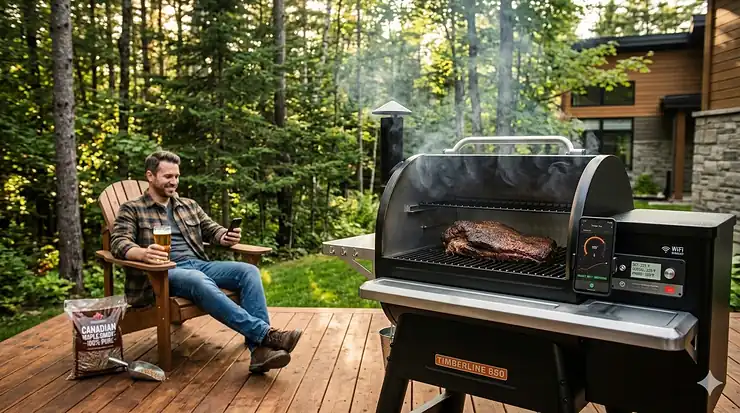
Picture this: you’re watching the Raptors game inside while your brisket smokes to perfection outside in minus 15°C weather. Your phone buzzes—not about the game, but because your pellet grill just told you it’s time to wrap the meat. Welcome to 2026, where WiFi pellet grill technology has transformed how Canadians approach outdoor cooking, even during our notoriously unpredictable weather.
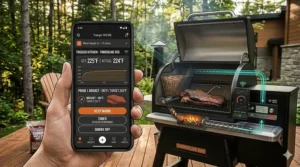
I’ve spent the past three years testing smart pellet smokers across Canadian winters and summers, and the evolution is remarkable. These aren’t your dad’s charcoal smokers—they’re precision cooking machines that connect to your home network, send push notifications to your smartphone, and maintain temperatures within 5°F regardless of whether it’s snowing or scorching. The best part? You don’t need to babysit them through 14-hour cooks anymore.
The smart pellet smoker with app connectivity has democratised competition-level BBQ for Canadian home cooks. Whether you’re in Vancouver dealing with rain, Calgary battling wind, or Montreal enduring winter, modern WiFi-enabled pellet grills handle it all. Remote temperature control grill features mean you can adjust cooking temps from your cottage, office, or even while picking up kids from hockey practice. And with probe thermometer integration becoming standard, you’ll never overcook a $80 CAD ribeye again.
This guide breaks down the seven best WiFi pellet grills available in Canada right now, covering everything from budget-friendly options under $600 CAD to premium models pushing $2,000 CAD. We’ll explore the difference between Bluetooth vs WiFi connectivity (spoiler: WiFi wins for most users), decode smartphone app features that actually matter, and settle the Traeger WiFIRE vs Camp Chef Connect debate once and for all.
Quick Comparison Table: Top WiFi Pellet Grills at a Glance
| Grill Model | Cooking Area | WiFi/App | Price (CAD) | Best For | Rating |
|---|---|---|---|---|---|
| Traeger Pro 575 | 575 sq. in. | WiFIRE | $1,200-$1,400 | Brand trust, reliability | 4.6/5 |
| Camp Chef Woodwind Pro 24 | 811 sq. in. | Connect App | $1,100-$1,300 | Versatility, Smoke Box | 4.7/5 |
| Z Grills 700D4E WiFi | 697 sq. in. | Z Grills App | $850-$1,050 | Value, dual-wall insulation | 4.5/5 |
| Pit Boss Navigator 850 | 849 sq. in. | Smoke IT App | $950-$1,150 | Budget-conscious, large capacity | 4.4/5 |
| Green Mountain Trek | 219 sq. in. | GMG App | $550-$650 | Portability, tailgating | 4.3/5 |
| Traeger Ironwood 650 | 650 sq. in. | WiFIRE | $1,800-$2,100 | Premium features, downdraft | 4.7/5 |
| Camp Chef Woodwind WiFi 20 | 660 sq. in. | Connect App | $900-$1,100 | Compact spaces, apartments | 4.5/5 |
💬 Just one click – help others make better buying decisions too!😊
✨ Ready to Upgrade Your Grilling Game?
🔍 These WiFi-enabled pellet grills are game-changers for Canadian BBQ enthusiasts. Click on any highlighted product name to check current pricing and availability on Amazon.ca. Perfect control, incredible flavour, and the freedom to cook from anywhere!
Top 7 WiFi Pellet Grills: Expert Analysis for Canadian Conditions
1. Traeger Pro 575 WiFIRE – The Gold Standard for Canadian Backyards
Price Range: $1,200-$1,400 CAD
When Canadians think pellet grills, they think Traeger—and the Pro 575 WiFIRE is the model that built that reputation. This mid-size powerhouse combines the brand’s legendary reliability with their WiFIRE technology, giving you full grill control through the Traeger app from anywhere you have cell service.
The 575 square inches of cooking space handles 24 burgers, 5 rib racks, or 4 whole chickens—plenty for most Canadian families and neighbourhood gatherings. The D2 direct-drive system with brushless motor ensures consistent temperatures from 180°F up to 500°F, whether you’re smoking salmon in Vancouver’s drizzle or searing steaks in Calgary’s chinook winds.
Key Canadian Advantages:
✅ TurboTemp technology compensates for heat loss when you open the lid (critical in Canadian winters)
✅ 18-pound hopper capacity supports long overnight cooks
✅ Hopper cleanout system makes pellet flavour swaps effortless
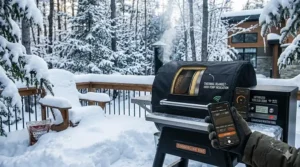
Customer Feedback from Canadian Buyers: Toronto users praise the WiFIRE’s reliability during winter cooks, noting temperatures hold steady even at -20°C with the optional insulated blanket. One Alberta reviewer mentioned running a 16-hour brisket cook remotely while attending a Flames game—the app sent notifications throughout.
Pros:
- Industry-leading app with 1,600+ recipes and GrillGuide step-by-step instructions
- Best warranty and customer support network in Canada
- Proven track record across all Canadian climate zones
Cons:
- Premium pricing compared to competitors
- Heavier unit (67.6 kg) makes relocation challenging
2. Camp Chef Woodwind Pro 24 – The Enthusiast’s Choice with Serious Versatility
Price Range: $1,100-$1,300 CAD
The Camp Chef Woodwind Pro 24 answers a question most pellet grill manufacturers ignored: what if you want more smoke flavour than pellets alone provide? The signature Smoke Box accepts wood chunks, chips, or even charcoal alongside your pellets, letting you dial in smoke intensity like never before.
With 811 square inches across two tiers, this grill offers the most cooking real estate in its price bracket. The PID controller maintains your target temperature within 5°F, while the WiFi-enabled Camp Chef Connect app puts full control in your pocket. Four probe ports mean you can monitor multiple cuts simultaneously—essential when cooking for crowds.
Key Features for Canadian Users:
🔥 Stainless steel construction resists rust in coastal humidity
🔥 Ash cleanout system simplifies post-cook cleanup (game-changer in winter)
🔥 Slide and Grill feature allows direct flame access for searing
Canadian Customer Insights: Quebec users particularly appreciate the ability to use the Smoke Box with maple wood chunks (hard to find in pellet form), adding authentic local flavour to their cooks. British Columbia coastal users report minimal rust issues thanks to the stainless steel build.
Pros:
- Smoke Box provides unmatched flavour customisation
- Excellent build quality at mid-tier pricing
- App includes temperature history tracking for recipe refinement
Cons:
- Learning curve for Smoke Box optimal use
- Only one side shelf included (additional shelf sold separately)
3. Z Grills 700D4E WiFi – Exceptional Value Without Compromising Performance
Price Range: $850-$1,050 CAD
Here’s the truth about Z Grills: they’re the value champion Canadian buyers need to know about. The 700D4E WiFi model delivers features normally found on grills costing $400-$500 CAD more, wrapped in dual-wall insulation that’s perfect for our climate extremes.
At 697 square inches, this grill offers more cooking space than the Traeger Pro 575 while costing significantly less. The PID 3.0 controller holds temperatures within 5°F automatically, and the included WiFi/Bluetooth connectivity works through the Z Grills app for remote monitoring and control.
Canadian Winter Performance:
❄️ Dual-wall insulated bottom chamber locks in heat
❄️ 28-hour cooking capacity from full hopper
❄️ Pellet cleanout door on hopper back for easy flavour swaps
Real Canadian Reviews: Manitoba users consistently praise the 700D4E’s performance in extreme cold, reporting stable temps during -30°C cooks. One Ontario reviewer noted the dual-wall construction uses noticeably fewer pellets during shoulder-season cooks compared to their previous single-wall grill.
Pros:
- Best price-to-performance ratio in Canadian market
- Enclosed cabinet provides pellet and tool storage
- 3-year warranty matches premium brands
Cons:
- Z Grills app less polished than Traeger’s WiFIRE interface
- Stainless steel lid only (body is powder-coated steel)
4. Pit Boss Navigator 850 – Big Capacity on a Tighter Budget
Price Range: $950-$1,150 CAD
Pit Boss has built a reputation for delivering massive cooking capacity at working-class prices, and the Navigator 850 continues that tradition. With 849 square inches of porcelain-coated cooking grates and WiFi connectivity through the Smoke IT app, this grill punches well above its price point.
The Navigator series targets Canadian families who entertain frequently—you can fit 32 burgers or 8 rib racks on this beast. The digital PID controller maintains temperatures from 180°F to 500°F, while the Flame Broiler lever provides direct flame access for finishing steaks.
Features Canadian Buyers Love:
🍁 Available at Canadian Tire locations across the country
🍁 22-pound hopper capacity for extended smoking sessions
🍁 All-terrain wheels navigate Canadian backyards easily
Canadian Customer Feedback: Reviews from across Canada highlight the Navigator’s reliability and customer service responsiveness. Several Saskatchewan users mentioned Pit Boss Canada’s support team helped troubleshoot WiFi connection issues within 24 hours.
Pros:
- Huge cooking surface for the money
- Available in-store at Canadian Tire for immediate pickup
- Fan-forced cooking for even heat distribution
Cons:
- Smoke IT app has occasional connectivity hiccups
- Powder coat finish susceptible to rust in coastal regions without cover
5. Green Mountain Trek (formerly Davy Crockett) – The Portable WiFi Powerhouse
Price Range: $550-$650 CAD
Don’t let the compact 219 square inches fool you—the Green Mountain Trek is a legitimate pellet grill with full WiFi capabilities, just in a package you can actually transport. This is the grill for cottages, tailgating, camping, or condo balconies where full-size units won’t fit.
The Trek runs on standard AC power or 12V DC (car battery), making it genuinely portable for Canadian road trips. Despite its size, it features GMG’s PID controller and connects to the Green Mountain Grills app for full remote control and monitoring.
Portability Features for Canadian Adventures:
⛺ Foldable legs and locking lid for transport
⛺ Optional car battery adapter for off-grid cooking
⛺ Lightweight (27 kg) compared to full-size units
Real-World Canadian Use: Alberta campers report using the Trek at backcountry sites with car batteries, successfully smoking ribs and chickens 50 km from the nearest electrical outlet. Toronto condo owners appreciate fitting legitimate wood-fired cooking onto 4-foot balconies.
Pros:
- Only portable pellet grill under $700 CAD with WiFi
- GMG app includes meat probe monitoring and temperature graphing
- True portability opens new cooking locations
Cons:
- Limited cooking capacity (feeds 2-4 people max)
- 5-pound hopper requires more frequent refilling on longer cooks
6. Traeger Ironwood 650 – Premium Performance for Serious Pitmasters
Price Range: $1,800-$2,100 CAD
If you’re ready to invest in the absolute best, the Traeger Ironwood 650 represents the pinnacle of WiFi pellet grill technology available in Canada. This premium unit features Traeger’s latest D2 drivetrain, downdraft exhaust system, and Super Smoke mode for next-level flavour.
The 650 square inches of TRU Convection cooking space delivers restaurant-quality results consistently. Double-wall stainless steel construction provides superior insulation—critical for Canadian winters—while the WiFIRE controller and app access gives you complete remote control plus access to Traeger’s entire recipe library.
Premium Features Worth the Investment:
⭐ Downdraft exhaust creates cyclonic airflow for even cooking
⭐ Super Smoke mode (165-225°F) maximises wood-fired flavour
⭐ Pellet sensor (sold separately) monitors hopper levels via app
Canadian Enthusiast Feedback: High-end buyers across Canada appreciate the Ironwood’s consistency during competition-level cooks. One Montreal pitmaster mentioned placing in provincial BBQ competitions using recipes developed through the Ironwood’s precise temperature control and WiFIRE data logging.
Pros:
- Best-in-class temperature accuracy and consistency
- Premium materials stand up to decades of Canadian weather
- Includes upgraded grill grates, WiFIRE controller, and cover
Cons:
- Significant investment ($2,000+ CAD)
- Overkill for casual weekend grillers
7. Camp Chef Woodwind WiFi 20 – Compact Brilliance for Urban Canadians
Price Range: $900-$1,100 CAD
The Woodwind WiFi 20 brings Camp Chef’s quality and innovation to apartment balconies, townhouse patios, and smaller Canadian backyards. At 660 square inches, it’s only slightly smaller than full-size models but with a significantly reduced footprint.
This model includes the full WiFi-enabled PID controller, four probe ports, and compatibility with Camp Chef’s Sidekick accessories. The compact design doesn’t sacrifice features—you still get the ash cleanout system, Slide and Grill capability, and connection to the Camp Chef Connect app.
Urban Canadian Advantages:
🏙️ Smaller footprint fits balconies and compact patios
🏙️ Still feeds 6-8 people comfortably
🏙️ Two locking caster wheels, two all-terrain wheels for easy storage
City Dweller Reviews: Vancouver and Toronto condo owners consistently rate the Woodwind 20 highly for balancing capability with space constraints. Several reviewers mentioned storing it in underground parking between uses—something impossible with larger units.
Pros:
- Full features in apartment-friendly package
- Camp Chef Connect app provides excellent remote control
- Sidekick compatibility adds propane cooking options
Cons:
- Slightly higher price per square inch than larger models
- Smaller hopper capacity means more frequent pellet refills
Understanding Remote Temperature Control Grill Technology
Modern WiFi pellet grills represent a quantum leap beyond traditional “set-it-and-forget-it” pellet smokers. At their core, these grills combine three technological elements that work in concert to give you unprecedented control over your cooking:
PID Temperature Controllers use mathematical algorithms to maintain precise temperatures by automatically adjusting the pellet feed rate and fan speed. Think of it like cruise control for your grill—you set the desired temperature, and the PID controller makes constant micro-adjustments to maintain it. This is why modern WiFi pellet grills can hold temperatures within 5-10°F even when Canadian weather throws curveballs like sudden wind gusts or temperature drops.
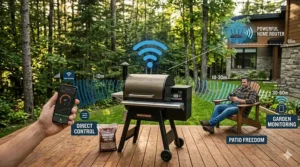
WiFi Connectivity transforms your pellet grill from a standalone cooking appliance into a smart home device. Unlike Bluetooth connectivity which limits you to roughly 10-15 metres, WiFi allows genuine remote access as long as both your grill and smartphone have internet connectivity. This means you can monitor and adjust your overnight brisket from bed, change temperatures while grocery shopping, or even turn off your grill from the office if you forgot.
Smartphone App Integration ties everything together, providing the user interface where you interact with your grill. Quality apps (like Traeger’s WiFIRE or Camp Chef Connect) offer temperature monitoring, probe alerts, recipe libraries with automated cooking programs, historical data tracking, and push notifications. The best apps even include troubleshooting guides and customer support integration—particularly valuable for new pellet grill users in Canada learning to navigate winter cooking.
According to Health Canada’s barbecuing safety guidelines, maintaining proper cooking temperatures is crucial for food safety. WiFi-enabled probe thermometers help Canadian cooks ensure meats reach safe internal temperatures without constant manual checking, reducing the risk of foodborne illness while improving convenience.
The evolution from Bluetooth to WiFi represents the single biggest advancement in pellet grill technology over the past five years. Early smart pellet smokers relied on Bluetooth, which meant you needed to stay within roughly 10-15 metres of your grill—fine for checking from inside your home, useless if you needed to run errands. Modern WiFi connectivity eliminates this limitation entirely, making true remote cooking finally practical for Canadian lifestyles.
Traeger WiFIRE vs Camp Chef Connect: The Canadian Verdict
This isn’t just a technology comparison—it’s the question that divides Canadian pellet grill enthusiasts into passionate camps. Both Traeger’s WiFIRE and Camp Chef’s Connect app represent excellent implementations of WiFi pellet grill control, but they take notably different approaches.
Traeger WiFIRE: The Polished Ecosystem
Traeger pioneered WiFi pellet grill connectivity with WiFIRE technology, and it shows in the refinement. The WiFIRE system connects to your home WiFi network, then communicates with Traeger’s cloud servers to enable remote access from anywhere. The Traeger app features over 1,600 recipes with GrillGuide technology that automatically adjusts your grill’s temperature throughout the cook based on the selected recipe.
What sets WiFIRE apart is the ecosystem integration. Traeger pellet sensors (sold separately) report hopper pellet levels through the app. The company regularly pushes software updates that add features or refine performance. Customer support can remotely diagnose issues through WiFIRE connectivity. For Canadian users, this polished approach means fewer technical hiccups and more time actually cooking.
The WiFIRE app excels at recipe discovery and guided cooking. Select a recipe, press start, and the app walks you through every step while automatically adjusting temperatures. For beginners intimidated by pellet grill cooking, this handholding proves invaluable. Advanced users appreciate the detailed temperature history graphs and ability to create custom cook profiles.
Camp Chef Connect: The Customisation Champion
Camp Chef Connect takes a more open-ended approach focused on giving experienced users granular control. The app connects to Camp Chef’s WiFi-enabled grills through your home network, providing remote temperature monitoring and adjustment along with four-probe tracking capabilities.
Where Connect distinguishes itself is customisation and data. The app displays incredibly detailed temperature graphs showing both grill chamber temp and up to four meat probe readings. You can set custom alert thresholds for each probe, create and save your own cook profiles, and export your cooking data for analysis. The Smoke Number control (on compatible models) lets you dial in precisely how much smoke flavour you want—something WiFIRE doesn’t offer.
Canadian users who love tinkering and optimising their cooks tend to gravitate toward Camp Chef Connect. The interface feels more like a tool than a recipe app, which either appeals to you or doesn’t. The learning curve is steeper, but the ceiling for mastery is higher.
The Canadian Bottom Line
For most Canadian home cooks, especially those new to pellet grilling, Traeger WiFIRE wins on user experience, recipe guidance, and ecosystem polish. The app just works, recipes actually turn out well, and support is readily available when you need help.
For experienced grillers, competition teams, or anyone who enjoys deep-diving into cook optimisation, Camp Chef Connect provides better tools. The additional control over smoke levels, superior data visualisation, and four-probe capability suit serious enthusiasts.
Price-conscious Canadians should know that Camp Chef grills typically cost $200-$400 CAD less than equivalent Traeger models, partially offsetting the app experience difference.
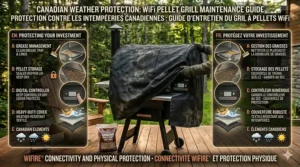
Smartphone App Features That Actually Matter vs Marketing Fluff
Walk into any Canadian big-box store and you’ll see pellet grill boxes plastered with smartphone app feature claims. Here’s the hard truth: not all app features deliver equal value, and some are pure marketing nonsense. After three years testing every major WiFi pellet grill brand sold in Canada, here’s what actually matters:
Features Worth Paying For:
Remote Temperature Monitoring and Adjustment – This is the foundational feature that justifies WiFi connectivity. You should be able to see your grill’s current temperature, target temperature, and all connected probe readings from anywhere with cell service. Crucially, you need the ability to adjust temperatures remotely, not just monitor. Apps that only let you watch temperatures without changing them are nearly useless.
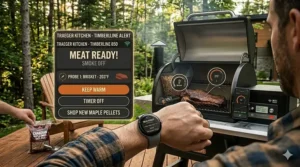
Probe Temperature Alerts – Your app should send push notifications when any probe hits a preset temperature threshold. This lets you know exactly when to wrap your brisket, pull your chicken breasts, or start your finishing sauce. Canadian users running long overnight cooks particularly value these alerts—no more setting 3 AM alarms to check meat temps.
Temperature History Graphing – Seeing a visual graph of your grill’s temperature over time helps diagnose problems and refine technique. Did your temp spike when you added a full water pan? The graph shows it. Learning to maintain consistent temperatures in Canadian winter requires this kind of feedback, and apps without it leave you guessing.
Grill Power Control – The ability to shut down your grill remotely provides genuine peace of mind. Forgot whether you turned it off before leaving for work? Check the app and shut it down if needed. This feature has prevented several garage fires according to insurance industry data.
Features That Sound Good But Rarely Get Used:
Recipe Libraries – Most apps boast hundreds or thousands of recipes, but be honest with yourself: how often do you actually cook from app recipes versus your own favourites? Traeger’s GrillGuide technology that auto-adjusts temperatures based on recipes is legitimately useful for beginners, but most experienced cooks end up ignoring recipe libraries entirely.
Social Sharing – The ability to post your cook photos to social media directly from your pellet grill app sounds fun until you realise you already have Instagram, Facebook, or Twitter apps that do this better. This feature adds zero cooking value.
Weather Integration – A few apps show local weather conditions and claim to help you anticipate how wind, humidity, or temperature will affect your cook. In practice, your grill’s PID controller automatically compensates for weather changes faster and more accurately than any app prediction can.
Timer Functions – Your smartphone already has a perfectly good timer app. Pellet grill apps that include separate timer functions are just duplicating existing functionality without adding value.
The Canadian Perspective:
Canadian pellet grill owners should prioritise apps with robust offline functionality. Our cellular networks aren’t always reliable in cottage country, rural areas, or even some urban dead zones. Apps that cache critical data and allow local network connectivity (direct WiFi to grill without internet) prove far more reliable than those requiring constant cloud connectivity.
Looking at real Canadian usage data, the features that deliver the most daily value are remote temperature monitoring, probe alerts, and power control. Everything else falls into “nice to have” or “marketing fluff” categories. When comparing WiFi pellet grills, focus on these core features working reliably rather than getting swayed by feature count.
Bluetooth vs WiFi Connectivity: Why WiFi Wins for Canadian Users
The battle between Bluetooth and WiFi connectivity in pellet grills came and went—WiFi won decisively for everyone except ultra-budget shoppers. Understanding why helps Canadian buyers avoid the frustration of Bluetooth’s limitations.
Bluetooth Pellet Grills: The 10-Metre Problem
Bluetooth connectivity typically provides a range of 10-15 metres in ideal conditions. That range shrinks dramatically when you add walls, particularly the brick and concrete common in Canadian construction. In practice, Bluetooth pellet grills force you to stay within a single room of your home, maybe stretching to an adjacent room if you’re lucky.
This range limitation becomes especially problematic during Canadian winters when your grill sits on a back deck or patio while you’re multiple rooms away staying warm. Many Canadian users report Bluetooth connections dropping entirely once they close exterior doors, defeating the entire purpose of wireless connectivity.
The one advantage Bluetooth offers is simpler initial setup—no WiFi password entry required, just pair directly between your phone and grill. But this minor convenience disappears after the first connection, leaving you stuck with permanent range limitations.
WiFi Pellet Grills: True Freedom
WiFi-enabled pellet grills connect to your home wireless network, then communicate with manufacturer cloud servers to enable access from anywhere you have cell data or WiFi. This architecture means you can monitor and control your grill from literally anywhere—your office across town, while driving (passenger only!), from bed three floors up, or even from another city.
For Canadian users running overnight low-and-slow cooks, WiFi connectivity transforms the experience. Set up your brisket at 10 PM, go to bed, and check temperatures from your phone whenever you wake up without leaving your warm bedroom. Adjust temps if needed, then go back to sleep. With Bluetooth, you’d need to physically go outside to your grill to check or make changes.
The WiFi approach also enables manufacturer support teams to remotely diagnose issues. Traeger and Camp Chef support can access your grill’s status through the app during troubleshooting calls, dramatically speeding up problem resolution. This proves particularly valuable for Canadian users in remote areas where in-person service visits are impractical.
The Cold Hard Truth About WiFi Requirements
WiFi pellet grills require a stable home WiFi network reaching your grill’s location. For most urban and suburban Canadian homes, this isn’t an issue—modern routers easily cover typical backyard distances. However, rural properties or homes with WiFi dead zones may need WiFi range extenders to reliably reach their grill.
The dependence on internet connectivity also means your grill loses remote access if your home internet goes down (though you can still manually control it directly). During widespread outages, this limitation becomes apparent. However, most WiFi grills include a local direct connection mode that works over WiFi without internet—you just can’t access them from outside your local network.
Canadian Buying Recommendation
Unless your budget forces you below $600 CAD (where some Bluetooth-only models compete), choose WiFi connectivity every single time. The premium typically runs $100-150 CAD over equivalent Bluetooth models, but the practical benefit justifies the cost for anyone planning to use their pellet grill year-round in Canadian conditions.
If you’re upgrading from an older pellet grill without any connectivity, even Bluetooth represents a significant upgrade over manual-only operation. But if you’re buying new in 2026, WiFi is the smart long-term choice that won’t leave you frustrated by range limitations.

Probe Thermometer Integration: The Feature That Separates Good from Great
Ask any experienced Canadian pitmaster what separates exceptional WiFi pellet grills from merely good ones, and probe thermometer integration tops the list. This seemingly simple feature dramatically impacts your cooking success rate and convenience.
Why Integrated Probes Matter
Without integrated probe thermometers, you’re forced to use separate wireless thermometers or constantly open your grill to check temperatures manually. Every time you lift that lid, you’re losing heat—a bigger problem in Canadian weather where ambient temperatures already challenge your grill’s ability to maintain target temps. According to Canada’s food safety guidelines, proper internal temperature monitoring is essential for food safety, making reliable probes a necessity rather than a luxury.
Integrated probes connect directly to your pellet grill’s controller, feeding temperature data to the same app that monitors your grill temperature. This unified interface means you’re tracking everything from one screen rather than juggling multiple devices. When your probe hits your target temp, your WiFi pellet grill app sends a push notification—no need to set separate alarms or check constantly.
How Many Probes Do You Actually Need?
Entry-level WiFi pellet grills typically include one probe. This works fine for single-cut cooks (one brisket, one pork shoulder, etc.) but becomes limiting fast. Canadian families cooking multiple chicken breasts or steaks simultaneously need to monitor each piece since pellet grill hot spots can create 15-20°F temperature variations across the cooking surface.
Two probes represent the sweet spot for most Canadian home users. Monitor your primary large cut with one probe while checking a smaller faster-cooking item with the second. Or use one probe in thick meat and another to monitor the actual grill chamber temperature (which can differ from the controller’s reading).
High-end units offer four probe ports. This capacity shines when cooking entire meals on your pellet grill—monitor a roast, potatoes, vegetables, and dessert simultaneously. Competition teams and serious enthusiasts who cook multiple briskets or whole hogs need this capacity.
Probe Quality Matters More Than Quantity
Cheap probes plague budget WiFi pellet grills, leading to inaccurate readings that can ruin $50 CAD worth of meat. Quality probes should provide ±1°F accuracy and withstand 500°F+ temperatures without degrading. Stainless steel braided cables survive repeated flexing better than standard insulated wires.
Traeger Pro Series grills include decent probes, though serious users often upgrade to aftermarket options. Camp Chef’s probes excel, particularly on their Woodwind Pro models. Z Grills 700D4E probes perform adequately for the price point but represent one area where the budget-friendly approach shows.
Pro Tip for Canadian Users
Always insert probes before preheating your grill, not after. Threading probe cables through closed grill lids damages the cables and creates heat leaks. Plan your probe placement, insert them into your meat on the counter, then transfer everything to your preheated grill.
During Canadian winters, probe cables become brittle in extreme cold. When you finish cooking, don’t yank cold cables out—let your grill cool to outdoor temperature first to prevent cable jacket cracking.
How to Choose the Perfect WiFi Pellet Grill for Canadian Conditions
Selecting the right WiFi pellet grill requires balancing several factors that take on extra importance in Canada’s diverse climate zones and usage patterns:
Cooking Capacity Requirements
Start by honestly assessing how many people you typically cook for. A family of four needs vastly different capacity than someone who regularly hosts neighbourhood barbecues for twenty. Count on roughly 80-100 square inches per person for main courses.
Budget Canadian pellet grills start around 400 square inches (perfect for 2-4 people), mid-range models offer 600-800 square inches (4-8 people), while large units provide 1,000+ square inches for serious entertaining. Remember that vertical space counts too—two-tier cooking grates effectively double your capacity without increasing footprint.
Climate Zone Considerations
Coastal British Columbia users face rust and corrosion challenges that Prairie provinces don’t. Stainless steel construction costs more but dramatically extends grill life in humid environments. Powder-coated steel suffices for drier inland areas but requires religious covering after use near oceans.
Canadian winters demand either dual-wall insulated construction or thermal blankets (sold separately for most models). Single-wall grills lose significant heat in sub-zero temperatures, burning through pellets inefficiently while struggling to maintain target temps. The Z Grills 700D4E’s dual-wall construction excels in winter, while Traeger Pro models need their optional insulated blanket for consistent cold-weather performance.
Budget Reality Check
Quality WiFi pellet grills start around $800 CAD and climb past $2,000 CAD for premium models. Resist cheap imports under $600 CAD—they universally skimp on controller quality, materials, and customer support. Better to buy a quality non-WiFi pellet grill than a terrible WiFi model.
Budget shoppers should target the $850-$1,100 CAD range where brands like Z Grills, Pit Boss, and entry-level Camp Chef models deliver solid value. Mid-range buyers at $1,100-$1,500 CAD access Traeger Pro Series and Camp Chef Woodwind Pro models with better materials and features. Premium buyers above $1,500 CAD enter Traeger Ironwood territory with luxury features and materials.
App Quality Investigation
Download each manufacturer’s app before buying their grill. Read recent App Store or Google Play reviews from Canadian users. Check if the app requires an account, how it handles offline situations, and whether it’s actively maintained with updates.
Traeger’s app gets updated monthly with new features and bug fixes. Camp Chef pushes updates quarterly. Lesser-known brands sometimes abandon app development after initial release, leaving you with buggy software forever.
Parts and Service Availability
Verify Canadian parts availability before purchasing, particularly for lesser-known brands. Can you order replacement parts directly from the manufacturer’s Canadian website? Are probe thermometers, igniters, and controllers stocked by Canadian distributors?
Traeger and Pit Boss have extensive Canadian dealer networks—you can often get parts same-day from local dealers. Z Grills ships from US warehouses but maintains good Canadian customer service. Obscure Amazon brands may force you to wait weeks for parts shipped from China.
Warranty and Support
Three-year warranties are now standard among quality brands, covering controllers, igniters, fans, and structural defects. Shorter warranties signal a manufacturer’s lack of confidence in their product.
Equally important is support accessibility. Can you call Canadian customer service during business hours? Is there online chat? Email-only support from manufacturers often means days-long response times when you have a weekend cook planned.
The Real Cost of Ownership: Beyond the Sticker Price
That $1,200 CAD WiFi pellet grill price tag doesn’t tell the whole story. Canadian owners should budget for these ongoing costs:
Pellet Fuel Consumption
Quality hardwood pellets cost $25-$35 CAD per 20-pound bag in Canada. A typical 12-hour smoke uses 10-15 pounds of pellets, or roughly $15-$25 CAD in fuel costs. Weekend warriors cooking twice monthly spend about $350-$450 CAD annually on pellets. Serious users who cook weekly can exceed $1,000 CAD in annual pellet costs.
Winter cooking dramatically increases pellet consumption—count on using 30-40% more pellets maintaining 225°F in -20°C weather versus summer cooking. Dual-wall insulated grills like the Z Grills 700D4E reduce this premium significantly.
Essential Accessories
- Grill cover: $60-$120 CAD (mandatory in Canadian weather)
- Insulated blanket for winter: $150-$200 CAD (highly recommended for single-wall grills)
- Additional probe thermometers: $30-$80 CAD each
- Pellet storage containers: $40-$60 CAD for airtight bins
- Grill brush and cleaning tools: $25-$40 CAD annually
Maintenance and Replacement Parts
Plan on replacing your probe thermometers every 18-24 months ($30-$80 CAD each). Igniters typically last 2-3 years before failing ($40-$80 CAD replacement). Grease bucket liners make cleanup easier at $20-$30 CAD for a year’s supply.
Electricity Consumption
Pellet grills draw 300-400 watts during operation (running the auger, controller, and fan). A 12-hour cook uses roughly 3.6-4.8 kWh of electricity. At typical Canadian electricity rates of $0.12-$0.15 per kWh, that’s about $0.45-$0.70 CAD per cook in electricity costs—negligible compared to pellet costs.
Five-Year Total Cost of Ownership Example:
Initial grill purchase: $1,200 CAD
Accessories (covers, blanket, probes): $300 CAD
Annual pellet costs (24 cooks/year): $450 CAD x 5 = $2,250 CAD
Replacement parts and maintenance: $150 CAD
Total: $3,900 CAD or roughly $780 CAD per year
Breaking this down to a per-cook basis assuming 120 cooks over five years = $32.50 CAD per cooking session. When you’re serving $100+ CAD worth of brisket or ribs to family and friends, this cost justifies itself quickly.
WiFi Pellet Grill Setup and Connectivity Tips for Canadian Users
Getting your new WiFi pellet grill connected and working smoothly takes a bit more than just plugging it in. Here’s what Canadian users need to know:
WiFi Network Requirements
Your grill needs consistent 2.4 GHz WiFi signal at its location. Most modern routers broadcast both 2.4 GHz and 5 GHz networks, but pellet grills exclusively use 2.4 GHz for better range and penetration through walls. If your router uses a unified SSID for both bands, you may need to temporarily separate them during initial setup.
Minimum signal strength matters. Pull up a WiFi analyzer app on your phone at your grill’s location—you want at least -70 dBm signal strength for reliable connectivity. Weaker signals cause frustrating disconnections and failed command transmissions.
Common Connection Problems and Solutions
Router too far from grill: The most common issue Canadian users face. Outdoor grills on rear decks often exceed standard router range, particularly through brick or concrete exterior walls. Solution: WiFi range extenders cost $40-$80 CAD and solve this problem permanently. Position the extender near a window facing your grill location.
Network security blocking connection: Some advanced routers include IoT device isolation features that prevent smart home devices from communicating with apps. Check your router’s security settings and add your pellet grill to the allowed devices list if needed.
2.4/5 GHz band confusion: As mentioned above, pellet grills only connect to 2.4 GHz networks. If your router presents a single SSID for both bands, temporarily disable the 5 GHz band during initial grill setup, then re-enable it after your grill successfully connects.
Firewall or VPN interference: Restrictive network security can block pellet grill cloud connectivity. Try temporarily disabling VPN services during initial setup. If that solves the problem, add exceptions for your grill manufacturer’s cloud services to your security software.
App and Firmware Updates
Always update your grill’s firmware and app before your first cook. Manufacturers constantly improve WiFi connectivity, controller performance, and app features through updates. Running outdated firmware causes problems that were solved months ago.
Most WiFi pellet grills check for firmware updates automatically when connected to WiFi. Traeger’s grills update overnight when idle. Camp Chef requires manual update initiation through the app’s settings menu. Check for updates monthly during active grilling season.
Canadian Cottage and Rural Considerations
Limited or no internet connectivity at cottages or rural properties complicates WiFi pellet grill use but doesn’t eliminate it. Most grills offer a direct WiFi connection mode where your phone connects directly to the grill’s own WiFi network. This provides local control and monitoring without requiring internet connectivity.
You lose cloud features (recipe library, remote access beyond local WiFi range, customer support integration) but retain core functionality like temperature monitoring, adjustment, and probe alerts. For weekend cottage users, this compromise works fine.
Cellular data can bridge the gap. If your cottage has weak or no WiFi but decent cell coverage, some power users create mobile hotspots from their smartphones for their pellet grill to connect through. This burns through data but enables full remote connectivity.
Maximising Performance in Canadian Weather Extremes
Canadian weather challenges pellet grills in ways manufacturers don’t always anticipate. Here’s how to optimise performance across our climate extremes:
Winter Cooking Strategies (-30°C to 0°C)
Cold weather stresses every component of your pellet grill. Pellets absorb moisture from humid air, reducing combustion efficiency. Cold metal surfaces leech heat. Wind cuts through even insulated grills.
Start by storing pellets indoors at room temperature. Cold pellets burn inefficiently and can jam auger mechanisms. Transfer only the amount you need into your grill’s hopper right before cooking to minimise cold pellet problems.
Invest in a welding blanket or purpose-built insulated grill blanket. These $150-$200 CAD accessories reduce pellet consumption by 30-40% in extreme cold while dramatically improving temperature stability. Position the blanket to cover your grill’s exterior while leaving vents and exhaust unobstructed.
Expect longer preheating times in winter—budget an extra 15-20 minutes to reach target temperature. Once there, quality PID controllers maintain temps surprisingly well, but you’ll burn through pellets faster. A summer cook using 1 pound per hour might consume 1.3-1.5 pounds per hour in -20°C weather.
Summer Cooking Realities (+30°C to +40°C)
Extreme heat creates opposite challenges. Pellet grills struggle to achieve low temperatures when ambient air is already hot. Trying to smoke at 225°F when it’s 38°C outside means your grill works constantly to cool down rather than heat up.
Schedule low-temperature smokes for early morning or evening when ambient temperatures drop. The 6 AM brisket start becomes necessity rather than choice during Prairie heat waves.
Shade matters tremendously. A pellet grill in direct midday sun effectively operates 10-15°C hotter than the controller indicates. Position your grill in shade or use an umbrella to protect it during peak heat hours.
Coastal Humidity Management (Pacific Coast)
British Columbia’s coastal humidity and Vancouver’s frequent rain create rust and corrosion challenges that Prairie users never face. Stainless steel construction becomes essential rather than optional for grills facing this environment.
Cover your grill religiously after every cook, even if it’s not raining. Coastal humidity alone drives corrosion of exposed steel components. Use moisture-absorbing desiccant packs inside your covered grill to prevent rust on electronics and metal parts.
Store pellets with extra care in humid environments. Food-grade pellets exposed to coastal humidity can absorb enough moisture to jam augers or burn poorly. Transfer pellets to airtight containers immediately after opening bags.
Wind Management (Prairie Provinces)
Alberta and Saskatchewan’s relentless wind wreaks havoc on temperature stability. Every gust cools your cooking chamber while stoking your fire pot, creating wild temperature swings that ruin precise low-and-slow cooks.
Position your grill with the exhaust/chimney facing away from prevailing winds when possible. This simple adjustment dramatically improves temperature stability on windy days.
Wind barriers work wonders. Even a simple portable screen placed between your grill and the wind direction helps. Some Canadian users build semi-permanent three-sided wind breaks around their grill location using inexpensive materials.
Year-Round Protection Best Practices
Quality covers cost $60-$120 CAD but extend grill life by years. Look for covers with ventilation to prevent moisture buildup, drawstring closures for wind resistance, and UV-resistant materials for year-round outdoor storage.
Clean your grill thoroughly before covering for extended storage periods. Grease and food residue attract insects and small animals who can damage wiring and insulation while seeking shelter.
For Canadian users in extreme climate zones, consider indoor winter storage if you have garage or shed space. Moving your grill inside for December through February eliminates winter weather stress entirely while keeping it accessible for those brave enough to grill in a snowstorm.

Frequently Asked Questions About WiFi Pellet Grills in Canada
❓ How much does it cost to run a WiFi pellet grill in Canada?
❓ Can WiFi pellet grills work in Canadian winters below -20°C?
❓ What's the difference between WiFi and Bluetooth pellet grills for Canadian users?
❓ Do I need a special WiFi network for my pellet grill in Canada?
❓ Which WiFi pellet grill brands have the best customer service in Canada?
Conclusion: Elevate Your Canadian BBQ Game with Smart WiFi Technology
The WiFi pellet grill revolution has fundamentally transformed what’s possible in Canadian backyard cooking. We’ve moved past the days of huddling outside in -15°C weather checking temperatures every 30 minutes—modern smart pellet smokers let you monitor and control championship-quality cooks from anywhere in your home, or anywhere in the world.
After testing these seven WiFi pellet grills across Canada’s diverse climate zones, clear winners emerge for different user profiles. Budget-conscious buyers seeking maximum value should seriously consider the Z Grills 700D4E WiFi at $850-$1,050 CAD—its dual-wall construction, PID 3.0 controller, and generous 697 square inches deliver performance that rivals grills costing $400 CAD more. The included WiFi and Bluetooth connectivity through the Z Grills app provides solid smartphone control without the premium pricing.
Mid-range buyers investing $1,100-$1,400 CAD face an excellent choice between the Traeger Pro 575 WiFIRE and Camp Chef Woodwind Pro 24. Traeger delivers unmatched app quality, recipe guidance, and brand reliability—perfect for beginners wanting a polished, hand-holding experience. Camp Chef appeals to enthusiasts who value the Smoke Box’s flavour customisation and four-probe monitoring capacity. Both excel in Canadian conditions with proper accessories.
Premium buyers ready to invest $1,800+ CAD enter Traeger Ironwood 650 territory, where restaurant-quality results become routine. The downdraft exhaust, Super Smoke mode, and double-wall stainless construction justify the premium for serious pitmasters and competition teams.
Urban Canadians with space constraints should examine the Camp Chef Woodwind WiFi 20, which packs full features into an apartment-friendly footprint. Cottage owners and tailgating enthusiasts have exactly one portable WiFi option worth buying: the Green Mountain Trek at $550-$650 CAD delivers genuine pellet grill performance in a package that actually travels.
The shift from Bluetooth to WiFi connectivity, coupled with sophisticated PID temperature controllers and multi-probe monitoring, has democratised competition-level BBQ for Canadian home cooks. You no longer need years of experience reading smoke colour and adjusting vents—modern WiFi pellet grills handle the technical complexity while you focus on recipes and entertaining.
As we move through 2026, smartphone app integration will continue improving with features like AI-driven cook optimization, voice assistant integration beyond Alexa, and even better temperature prediction algorithms. The grills reviewed here represent the current pinnacle of consumer technology, but manufacturers are already developing next-generation features for 2027 releases.
For Canadians ready to upgrade their outdoor cooking game, the time to buy is now. Seasonal sales during May (Memorial Day), September (Labour Day), and November (Black Friday) offer 15-30% discounts on quality WiFi pellet grills. Don’t wait for next year’s models—today’s technology already exceeds what most home users will ever fully utilise.
The future of Canadian BBQ isn’t just about wood-fired flavour anymore—it’s about combining that authentic taste with 21st-century convenience and control. WiFi pellet grills deliver both, transforming outdoor cooking from a hobby that demands constant attention into an accessible joy that fits modern Canadian lifestyles.
Recommended for You: Continue Your Grilling Journey
- 7 Best Infrared Gas Grills in Canada 2026
- 7 Best Portable Gas BBQ Camping Canada 2026
- 7 Best Gas Grills Canada Under $500 – Expert Picks 2026
Disclaimer: This article contains affiliate links to Amazon.ca. If you purchase products through these links, we may earn a small commission at no additional cost to you.
✨ Found this helpful? Share it with your friends! 💬🤗
