
In This Article
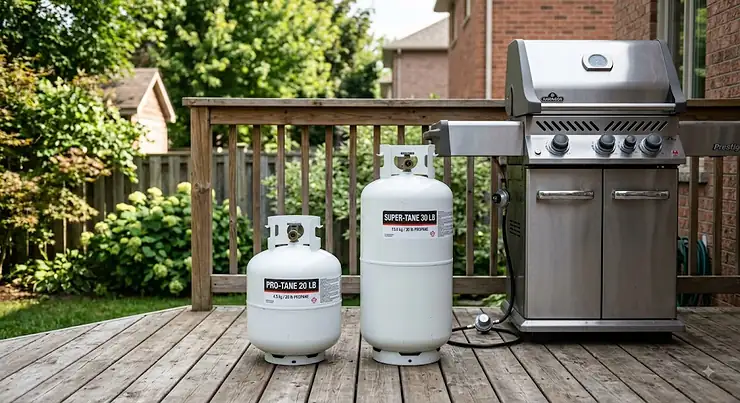
If you’ve ever run out of propane mid-sear on a Saturday night, you already know why the 20 lb vs 30 lb propane tank for grilling question matters more than it sounds. It’s not just a size chart — it’s the difference between a smooth backyard season and a mad dash to the nearest exchange cage in your socks. Most Canadian households default to the standard 20 lb tank because it’s what came with the grill, but that default isn’t always the right call once you start hosting bigger cookouts or running a smoker every weekend.
This guide breaks down the real trade-offs: burn time, refill logistics, storage space, and what each size actually costs to own over a few grilling seasons. We’ll also walk through seven real, currently available propane tanks — steel and composite, 20 lb and 30 lb — so you’re not guessing at the hardware store. Propane itself, a byproduct of natural gas processing and oil refining, has been the backyard fuel of choice since the mid-20th century, and the tank you pick determines how often you’ll be thinking about it at all (Wikipedia: Propane).
Whether you’re a once-a-month griller in a condo with a tiny balcony or someone who fires up the smoker three times a week from May through Thanksgiving, there’s a tank size that fits your actual habits better than the one you probably have right now.
Quick Comparison: 20 lb vs 30 lb Propane Tank at a Glance
Before diving into individual products, here’s the fast version — the numbers that actually decide which tank belongs on your patio.
| Feature | 20 lb Tank | 30 lb Tank |
|---|---|---|
| Propane capacity | ~4.5-4.7 gal (≈17 L / 9 kg) | ~7 gal (≈26 L / 13.6 kg) |
| Full tank weight | ~37 lb (17 kg) | ~50-55 lb (23-25 kg) |
| Typical burn time (3-burner grill, medium-high) | 18-20 hours | 27-30 hours |
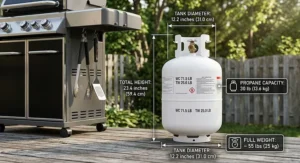
| Height (approx.) | 46-48 cm (18 in) | 58-60 cm (23-24 in) |
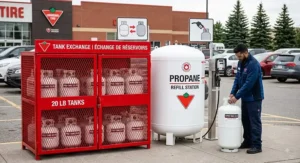
| Exchange availability | Excellent — every hardware store, gas station, grocery chain | Good, but noticeably fewer exchange points |
| Best for | Casual to regular grillers, small patios, apartments/condos | Frequent grillers, smokers, large families, limited storage trips |
The math here isn’t complicated, but it’s easy to underestimate: a 30 lb tank holds roughly 50% more propane than a 20 lb tank, yet it isn’t 50% harder to store or find — most exchange networks in Canada, including Petro-Canada’s propane exchange program, stock both sizes at the same locations (Petro-Canada propane exchange). Where the 20 lb tank wins is portability and fit — it slides into a standard grill cabinet and is manageable for most people to lift and carry one-handed when full. The 30 lb tank wins on fewer refill trips, which matters more than people expect once grilling frequency climbs past twice a week.
💬 Just one click — help other Canadian golfers make a smarter bag choice too!😊
Top 7 Propane Tanks for Grilling: Expert Analysis
We looked at real, currently listed propane tanks spanning budget steel cylinders, gauge-equipped mid-range options, and a lightweight composite alternative. Every product below includes genuine spec interpretation and aggregated review themes — not manufactured testimonials.
1. Flame King YSN-201 20 lb Steel Propane Tank — best budget classic for weekend grilling
The Flame King YSN-201 is the tank most Canadians picture when they think “propane cylinder” — a plain white 20 lb steel cylinder with a Type 1 OPD (overfill protection device) valve, and for good reason: it’s inexpensive and it just works. The DOT- and TC-compliant steel shell holds the standard 4.5-4.7 gallons of propane, translating to roughly 18-20 hours of burn time on a typical three-burner grill running medium-high — enough for six to eight cookouts before a refill for most households. Based on the spec comparison with pricier options below, this is the tank to buy if you just want a reliable spare without paying for extras like a gauge. Reviewers consistently report that the OPD valve makes exchanges hassle-free at any Canadian Tire or gas station cage, since it’s the universal North American standard valve type. A common complaint in user reviews is the powder coat scratching or chipping after a season or two of being tossed in and out of a truck bed, which is cosmetic but does accelerate surface rust if the tank lives outdoors uncovered.
Pros:
- ✅ Lowest cost of entry into refillable propane ownership
- ✅ Universally accepted at exchange programs across Canada
- ✅ Compact enough for tight grill-cabinet storage
Cons:
- ❌ No built-in gauge — you’re guessing fuel level by weight
- ❌ Basic powder coat scratches and rusts faster than premium finishes
At around C$45-C$60 for a new, pre-purged cylinder, the Flame King YSN-201 is hard to beat as a first tank or a backup spare, though budget-conscious buyers should factor in that a fuel gauge (see product #2) often pays for itself in convenience alone.
2. Flame King YSN230b 20 lb Steel Propane Tank with Gauge — best for at-a-glance fuel monitoring
Nearly identical in shell and capacity to the YSN-201, the Flame King YSN230b adds a built-in dial gauge to the valve assembly — and that one addition changes the ownership experience more than the spec sheet suggests. What most buyers overlook about gauge-equipped tanks is that they don’t just prevent mid-cook surprises; they let you plan ahead, so you’re never exchanging a tank that still had half a cookout left in it. The 20 lb steel cylinder itself carries the same 4.5-4.7 gallon capacity and roughly 18-20 hour burn window as the base model, with a DOT/TC-compliant OPD valve for safe, standard-fit connections. This is the pick for hosts who grill on a schedule — birthday parties, weekly family dinners — where knowing you’re at 20% before guests arrive beats finding out at 20% mid-sear. Aggregated review sentiment on gauge-equipped tanks in this category is generally positive on accuracy for the first year or two, though a recurring theme is that dial gauges can drift or stick as the valve ages, so treat the reading as a strong estimate rather than a precise fuel computer.
Pros:
- ✅ Built-in gauge removes the guesswork on fuel level
- ✅ Same reliable OPD valve and steel build as base models
- ✅ Ideal for planned events where running out isn’t an option
Cons:
- ❌ Gauge accuracy can drift over multiple refill cycles
- ❌ Costs more than a no-gauge tank for the same capacity
Expect to pay in the C$55-C$75 range at the time of research — a modest premium over the base steel tank that most frequent hosts consider worthwhile.
3. Manchester Tank 20 lb Steel Propane Cylinder — best OEM-grade steel build quality
Manchester Tank is one of the original equipment manufacturers that many other brands source their cylinders from, and buying the Manchester-branded 20 lb tank directly is essentially skipping the middleman on build quality. The cylinder is UL listed, ships with a Type 1 OPD valve, and features the same rugged all-steel construction with rust-inhibiting powder coat used across the industrial and commercial propane supply chain. Based on the spec comparison, there’s little functional difference from other 20 lb steel tanks in terms of capacity or burn time — what changes is the manufacturing pedigree, which matters if you’re the type of buyer who cares about who actually welds the seams. Honest analysis here: this is less a “better performing” tank and more a “built by the people who build everyone else’s tanks” tank, which appeals to buyers who prioritize provenance over marketing. Reviewers who’ve owned both branded and generic 20 lb cylinders tend to note the Manchester valve assembly feels noticeably more solid when connecting and disconnecting regulators, a small but real quality-of-life detail over a tank’s 10-year service life.
Pros:
- ✅ OEM-level manufacturing many other brands rely on
- ✅ UL-listed with a solid, easy-turning valve assembly
- ✅ Consistent quality control across production batches
Cons:
- ❌ No gauge included on the base configuration
- ❌ Slightly less widely marketed, so retail availability varies by region
Priced similarly to other 20 lb steel tanks — typically C$45-C$65 — the value case rests on longevity rather than flashy features.
4. Worthington 303954 30 lb Steel Propane Cylinder — best step-up for frequent grillers and families
Once you move into 30 lb territory, the Worthington 303954 is one of the most established names in the category. Manufactured to Transport Canada (TC) and DOT specifications, this tank stands roughly 23.7 inches (60 cm) tall with a 12.3-inch (31 cm) diameter and a tare weight of about 23.5 lb — meaning a full tank weighs in around 50-55 lb once loaded with 7 gallons of propane. Here’s what to weigh: that extra capacity over a 20 lb tank isn’t just “more of the same,” it’s roughly 50% more burn time, which for a family grilling three or four times a week can mean the difference between a monthly refill run and a biweekly one. What most buyers overlook about the jump to 30 lb is the physical size difference — this tank often needs a larger grill cabinet or a dedicated spot on the patio, since it won’t fit the compact side-shelf storage many 20 lb-oriented grills are designed around. Reviewers consistently praise Worthington’s rust-inhibiting Durabond coating for holding up multiple seasons outdoors, and the reinforced carry collar for making the heavier full tank easier to lift than its weight suggests.
Pros:
- ✅ Roughly 50% more burn time than a 20 lb tank
- ✅ TC/DOT-compliant with durable, rust-resistant coating
- ✅ Reinforced collar eases lifting a heavier full tank
Cons:
- ❌ Won’t fit compact 20 lb-sized grill cabinets
- ❌ Fewer exchange locations stock 30 lb tanks than 20 lb
At around C$80-C$110 for a new cylinder, this is the tank worth budgeting for if grilling frequency has crept up faster than your current tank keeps pace with.
5. Manchester Tank 30 lb Steel Propane Cylinder — best for dual-tank rotation and fewer refill runs
Mirroring the OEM-grade case made for the 20 lb Manchester tank above, the Manchester Tank 30 lb cylinder brings the same manufacturing pedigree to the larger capacity class. Specs include a 12.2-inch (31 cm) diameter, UL-listed steel construction, and a Type 1 OPD valve — holding the same roughly 7 gallons as other 30 lb tanks in this guide. On paper this means near-identical burn time to the Worthington above, so the real decision driver is strategy rather than spec: some households buy two 30 lb Manchester tanks and rotate them, refilling one while the other is in use, which effectively eliminates the “ran out mid-cook” scenario entirely for serious smokers and multi-burner setups. Based on the spec comparison, there’s no meaningful performance gap between competing 30 lb steel tanks from reputable manufacturers — the differentiator is availability and price at the time you’re buying. Aggregated review sentiment for Manchester-branded 30 lb tanks skews toward commercial and semi-commercial buyers (caterers, food-truck operators) who value consistent batch quality over brand marketing.
Pros:
- ✅ Enables a two-tank rotation strategy for zero-downtime grilling
- ✅ Consistent OEM manufacturing quality
- ✅ Standard OPD valve fits every regulator on the market
Cons:
- ❌ Running two tanks doubles your storage footprint
- ❌ No gauge on the base model
Budget roughly C$85-C$115 per tank, and note that a two-tank rotation strategy essentially doubles this cost upfront in exchange for near-total peace of mind.
6. Flame King YSN-301 30 lb Steel Propane Tank with Gauge — best large tank with built-in fuel gauge
Combining the capacity of the 30 lb class with the convenience of a built-in gauge, the Flame King YSN-301 targets exactly the buyer who wants fewer refill trips and fewer surprises in the same package. The dial gauge sits on the valve assembly and gives a live readout as propane depletes — genuinely useful given how much longer a 30 lb tank stays in service between refills, since a purely weight-based guess becomes less reliable the longer you go without checking. Reviewers consistently note that the combination of size and gauge makes this the preferred tank for anyone running a smoker for multi-hour cooks, where knowing you have fuel for the full 6-8 hour brisket session matters more than it does for a 20-minute burger night. What the spec sheet won’t tell you, but reviewers note, is that the gauge needle can be harder to read from a distance compared to smaller tanks, simply because the valve sits higher up on the taller 30 lb body — worth factoring in if you tend to check fuel level from across the patio rather than up close.
Pros:
- ✅ Gauge readout ideal for long smoking sessions
- ✅ Full 30 lb capacity reduces refill frequency significantly
- ✅ DOT/TC compliant with a standard OPD valve
Cons:
- ❌ Gauge can be harder to read at a distance on the taller body
- ❌ Premium over a no-gauge 30 lb tank
Expect a price range around C$95-C$125, positioning it as the mid-to-premium pick for anyone whose grilling has evolved into genuine smoking.
7. Viking Cylinders 17 lb Composite Propane Tank — best lightweight, see-through pick for tight storage spaces
Stepping outside steel entirely, the Viking Cylinders composite propane tank (distributed by Dr. Shrink) uses a fibreglass-reinforced composite shell instead of steel — a genuinely different approach worth knowing about even though its 17 lb capacity sits just under the 20 lb standard. The translucent composite body lets you see the actual liquid propane level through the shell, which sidesteps the whole gauge-accuracy debate that dogs steel tanks entirely. Based on the spec comparison, composite tanks like this one weigh noticeably less than steel equivalents even when full, and they don’t rust — a real advantage for anyone storing a tank in a coastal or high-humidity Canadian climate where steel corrosion is a genuine long-term maintenance issue. Honest analysis: the trade-off is capacity (17 lb versus the 20-30 lb steel options above) and a higher price per pound of propane, so this is less a “better” tank and more a specialized one — ideal for smaller balconies, condo storage lockers, or anyone who simply hates lugging a heavy steel cylinder. Reviewers frequently mention the visual fuel gauge as the standout feature, alongside the tank’s lighter carry weight being easier on backs and vehicles alike.
Pros:
- ✅ See-through shell shows exact propane level, no gauge needed
- ✅ Corrosion-proof composite resists Canadian climate extremes
- ✅ Noticeably lighter to carry than steel tanks of similar size
Cons:
- ❌ Lower capacity than standard 20 lb or 30 lb steel tanks
- ❌ Fewer exchange locations accept composite tanks
Composite tanks like this typically run in the C$110-C$140 range — a real premium, but one some buyers happily pay to never scrape rust off a tank again.
Top 7 Propane Tanks Compared
| Product | Capacity | Approx. Full Weight | Gauge | Best For |
|---|---|---|---|---|
| Flame King YSN-201 | 20 lb | ~37 lb | No | Budget spare tank |
| Flame King YSN230b | 20 lb | ~37 lb | Yes | Planned events, hosts |
| Manchester Tank 20 lb | 20 lb | ~37 lb | No | Build-quality-focused buyers |
| Worthington 303954 | 30 lb | ~50-55 lb | No | Frequent family grillers |
| Manchester Tank 30 lb | 30 lb | ~50-55 lb | No | Two-tank rotation setups |
| Flame King YSN-301 | 30 lb | ~50-55 lb | Yes | Long smoking sessions |
| Viking Cylinders composite | 17 lb | ~28-30 lb | Visual | Tight storage, corrosion-prone climates |
Looking at the table above, the Worthington 303954 offers the clearest jump in value for anyone grilling more than twice a week, while the Flame King YSN-201 remains the sensible entry point if you’re simply replacing a worn-out spare. Buyers wrestling with limited storage space should note that the Viking Cylinders composite tank trades raw capacity for weight and corrosion resistance — a fair trade if your patio or storage locker is genuinely tight on room. If gauge accuracy across a long smoking session matters most, the Flame King YSN-301 justifies its premium over the gauge-less 30 lb options.
Practical Usage Guide: Setting Up and Storing Your Propane Tank
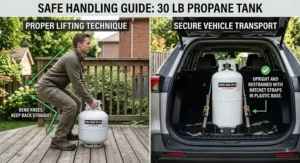
Getting a new tank home is only step one — how you set it up and store it determines both safety and how long it lasts. First, always store propane tanks outdoors, upright, and away from direct sunlight or ignition sources; never in a basement, garage, or enclosed shed, a rule that applies whether you’re storing a Flame King YSN-201 or a Worthington 303954 (Petro-Canada propane exchange). During first-time setup, check the O-ring on your regulator connection before attaching a new tank, and always open the tank valve slowly — a fast full-open can trigger the OPD valve’s safety flow limiter, which will make your grill sputter as if it’s out of fuel even when it isn’t. A common first-30-days mistake is over-tightening the regulator connection, which can damage the threading; hand-tight plus a quarter turn is plenty. For maintenance, do a soapy-water leak check at every connection point once a season — bubbles mean a leak, no bubbles means you’re good to go. One optimization trick many grillers miss: rotating between two tanks (as discussed with the Manchester 30 lb option) not only prevents mid-cook shortages but also lets each tank “rest,” which some propane suppliers suggest can reduce valve wear over years of use compared to constant single-tank cycling.
Real-World Scenarios: Which Tank Size Fits Your Grilling Life
Rather than a generic recommendation, here’s how tank size maps to three common Canadian grilling profiles. If you’re a condo-dwelling weekend griller doing burgers and the odd steak once or twice a week on a small balcony, a single 20 lb tank like the Flame King YSN-201 is genuinely the right call — anything larger just eats storage space you don’t have for burn time you won’t use. If you’re a suburban family hosting weekly dinners, birthday parties, and the occasional backyard tournament for the neighbourhood kids, the gauge-equipped Flame King YSN230b hits the sweet spot of predictability without the bulk of a 30 lb tank. And if you’re running a smoker three-plus times a week from spring through fall — 8-hour brisket sessions, weekend rib marathons — the Worthington 303954 or Flame King YSN-301 pays for itself in reduced refill trips within a single season, especially once you factor in the time cost of driving to an exchange cage every week versus every two to three weeks.
How to Choose Between a 20 lb and 30 lb Propane Tank
Choosing the right tank comes down to five practical questions, in order of importance:
- How often do you actually grill? Once a week or less strongly favours 20 lb; three or more times a week starts justifying 30 lb.
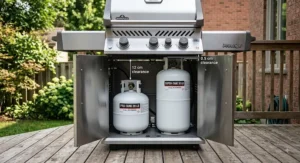
- How much storage space do you have? A 30 lb tank is roughly 25% taller and won’t fit most compact grill-side cabinets designed for 20 lb tanks.
- Can you comfortably lift 50+ lb? A full 30 lb tank weighs noticeably more than a full 20 lb tank, which matters for anyone with mobility considerations.
- Do you cook long sessions (smoking) or short ones (weeknight grilling)? Long sessions favour the larger reserve capacity of a 30 lb tank.
- How close is your nearest exchange or refill point? If it’s inconvenient to get to, a larger tank reduces how often you need the trip.
Working through these in order tends to produce a clear answer faster than staring at spec sheets, since grilling frequency alone resolves the decision for most households before storage space or lifting capacity even become factors.
20 lb vs 30 lb Propane Tank: The Full Comparison
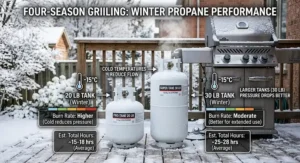
Beyond the numbers, the practical experience of owning a 20 lb versus a 30 lb tank differs in ways that don’t show up on a spec sheet. A 20 lb tank is the more forgiving choice logistically — it fits standard grill cabinets, it’s light enough for most people to carry one-handed even when full, and because it’s the most common size in circulation, every exchange program in the country stocks it without fail. A 30 lb tank flips those trade-offs: you gain roughly 50% more cook time per fill, which is a genuinely bigger deal than it sounds once you’re grilling several times a week, but you give up some portability and universal fit. Where the 30 lb tank clearly wins is total cost of ownership for heavy users — fewer refill trips means less gas, less time, and in many cases a slightly better per-gallon rate since larger refills sometimes come at a marginal discount compared to constant small top-ups. Where the 20 lb tank wins is flexibility: it’s the size every backup, every rental grill, and every second-hand cylinder defaults to, so sticking with it keeps your setup simple and interchangeable.
| Factor | 20 lb Tank | 30 lb Tank |
|---|---|---|
| Portability | Excellent, one-handed carry | Moderate, needs both hands full |
| Refill frequency (3x/week grilling) | Every 6-7 days | Every 9-10 days |
| Fits standard grill cabinet | Yes, in most cases | Often too tall |
| Exchange network coverage | Near-universal | Good but patchier |
| Best value scenario | Occasional to weekly grillers | Frequent grillers, smokers |
The pattern in this table mirrors real-world grilling habits more than raw capacity does: a 20 lb tank’s near-universal exchange coverage matters most for anyone who travels with their grill or doesn’t want to think about propane logistics at all, while the 30 lb tank’s refill-interval advantage compounds nicely for anyone already committed to grilling as a near-daily habit rather than an occasional one.
Common Mistakes When Buying a Large Propane Tank for BBQ
The single most common mistake is buying a 30 lb tank without first confirming it’ll physically fit the grill’s existing tank shelf or cabinet — measure the height and diameter of your current setup before upgrading, because a 30 lb tank that doesn’t fit ends up sitting loose on the ground, which isn’t ideal for stability or safety. A second mistake is assuming bigger is always better value; if you genuinely only grill occasionally, a 30 lb tank just means more propane sitting around aging (and propane does have practical shelf-life considerations tied to tank condition, not the gas itself degrading meaningfully) rather than real savings. Third, buyers often skip checking the manufacture date stamped on the tank collar — a used or older tank nearing its 10-year requalification window in Canada may get rejected at exchange or refill, leaving you stuck (Transport Canada cylinder requalification FAQ). Finally, some buyers don’t realize that not every retailer’s exchange program accepts every brand of tank — as several Canadian consumers have discovered the hard way, a competitor’s tank isn’t always accepted even when it looks identical, so it’s worth confirming your local exchange point’s policy before you’re standing there with an empty tank and no backup plan.
Tank Capacity, Grilling Frequency, and Storage Space: How They Interact
These three factors — tank capacity, grilling frequency, and available storage space — don’t operate independently, and treating them as separate decisions is how people end up with the wrong tank. Grilling frequency should be the primary driver: someone who grills once every week or two simply doesn’t burn through enough propane to justify the storage footprint of a 30 lb tank, regardless of how much patio space they have. Storage space becomes the tiebreaker when frequency alone doesn’t produce a clear winner — a household grilling three times a week with a spacious detached-garage storage area (kept per Transport Canada’s outdoor-storage guidance, never indoors) can comfortably go 30 lb, while an identical grilling frequency in a condo with a shoebox-sized storage locker might reasonably stick with 20 lb and simply accept slightly more frequent refill trips as the price of a smaller footprint. Tank capacity, in other words, should flex to match the tighter of your two real-world constraints — frequency or space — not just whichever number looks more impressive on the box.
Long-Term Cost & Maintenance: What a 30 lb Tank Really Costs Over Time
The upfront price gap between a 20 lb and 30 lb tank — roughly C$30-C$50 more for the larger cylinder — tells only part of the cost story. Over a typical five-month Canadian grilling season, a frequent griller doing three cooks a week might refill a 20 lb tank eight to ten times versus five to six times for a 30 lb tank, and each refill or exchange trip carries a real cost beyond the propane itself: fuel to get there, time spent, and the wear on whatever vehicle makes the trip. Maintenance costs are similar between sizes — both require the same 10-year Transport Canada requalification cycle, the same annual soapy-water leak checks, and the same eventual valve or gasket replacement if a tank develops a slow leak. Where the larger tank pulls ahead financially is in per-refill efficiency: many propane retailers price 30 lb fills at a slightly better per-gallon rate than 20 lb fills, since the fixed handling cost of each transaction gets spread across more propane.
| Cost Factor | 20 lb Tank (Annual, 3x/week grilling) | 30 lb Tank (Annual, 3x/week grilling) |
|---|---|---|
| Upfront tank cost | C$45-C$75 (one-time) | C$80-C$125 (one-time) |
| Refill/exchange trips per season | ~9-10 | ~5-6 |
| Requalification cycle | 10 years | 10 years |
The takeaway from this comparison is that the 30 lb tank’s higher upfront cost is largely recovered through fewer refill trips within the first full grilling season for anyone genuinely cooking several times a week, while occasional grillers rarely reach the volume needed to make that math work in their favour.
Safety, Storage Space & Regulations Guide
Propane cylinders in Canada fall under Transport Canada’s dangerous goods framework, and the practical rules for backyard grillers boil down to a handful of consistent points. Always store tanks outdoors, upright, and shielded from direct heat or sunlight — never in a garage, basement, or any enclosed living space, since propane is heavier than air and will pool rather than dissipate if it ever leaks indoors. Every refillable cylinder must carry a valid manufacture or requalification stamp, and in Canada that stamp is only good for 10 years before the tank needs professional reinspection or replacement; attempting to fill an expired tank is not just against policy at most exchange points, it’s not legal. Transport Canada maintains detailed guidance on cylinder markings and registered requalifiers for anyone who wants to verify a used tank’s status before buying it secondhand (Transport Canada cylinder FAQ). When a tank finally does reach end of life — rusted through, failed inspection, or simply too old — don’t put it in household trash or general recycling; most municipalities and several retailers offer dedicated hazardous-waste drop-off or exchange-for-recycling options built specifically for propane cylinders (Regional Recycling: propane tank disposal).
✨ Ready to Stock Up Before Grilling Season Peaks!
🔍 Take your backyard cookouts to the next level with a tank sized for how you actually grill. Click on any highlighted pick above to check current pricing and availability, and make sure this season’s burgers, ribs, and brisket never get cut short by an empty tank.
Features That Actually Matter (And Those That Don’t)
With seven tanks compared, it’s worth separating genuine value from marketing noise. A gauge that actually matters: yes, a built-in dial or a translucent composite shell that shows fuel level is a real, everyday-useful feature, especially for anyone running long smoking sessions where guessing wrong means a half-cooked brisket. The OPD valve is non-negotiable — every tank in this guide has one, and it’s been the North American standard since the late 1990s for good reason, so it’s not a feature to weigh, just a baseline requirement. What doesn’t matter nearly as much as marketing suggests: cosmetic finish colour or minor styling differences between otherwise identical steel tanks, and claims of “premium” steel that isn’t backed by a specific gauge thickness or certification. Capacity and build quality — from manufacturers like Worthington and Manchester Tank — consistently outweigh cosmetic extras when it comes to which tank actually serves you well over a decade of use.
Frequently Asked Questions
❓ What size propane tank is best for grilling?
❓ How long does a 20 lb propane tank last on a grill?
❓ Can I use a 30 lb propane tank on a grill made for 20 lb?
❓ How much does it cost to fill a 30 lb propane tank in Canada?
❓ How often does a propane tank need to be requalified in Canada?
Conclusion
The 20 lb vs 30 lb propane tank for grilling decision really comes down to matching tank capacity to how you actually cook, not how you imagine you might cook someday. For weekend warriors and condo dwellers, a 20 lb tank like the Flame King YSN-201 or gauge-equipped Flame King YSN230b keeps things simple, affordable, and easy to store. For families and smokers cooking multiple times a week, the extra burn time from a Worthington 303954 or Flame King YSN-301 pays off in fewer refill trips and less mid-cook anxiety. And for anyone genuinely tight on storage space or living somewhere corrosion is a real concern, the composite Viking Cylinders tank offers a legitimately different answer worth considering. Whichever size you land on, the core safety and maintenance rules stay the same: store it outside, upright, checked annually, and requalified on schedule. Get that part right, and the rest is just deciding how many cookouts you want between refills.
Recommended for You
- 20 lb Propane Tank for BBQ: 7 Best Picks for Canada (2026)
- Natural Hardwood Briquettes for Smokers: 7 Best Picks for 2026
- Competition-Grade Charcoal Briquettes for BBQ: 7 Top Picks (2026)
Disclaimer: This article contains affiliate links. As an Amazon Associate, I earn from qualifying purchases. If you purchase products through these links, we may earn a small commission at no additional cost to you.
✨ Found this helpful? Share it with your friends! 💬🤗
