
In This Article
Picture this: it’s a long weekend in July, the neighbours are heading over, and you’re standing in the backyard wondering whether you made the right call on your smoker. Sound familiar? If you’ve been going back and forth on the kamado vs offset smoker debate, you’re definitely not alone. This is one of the most hotly contested questions in the Canadian BBQ community, and honestly, both sides have a compelling argument.
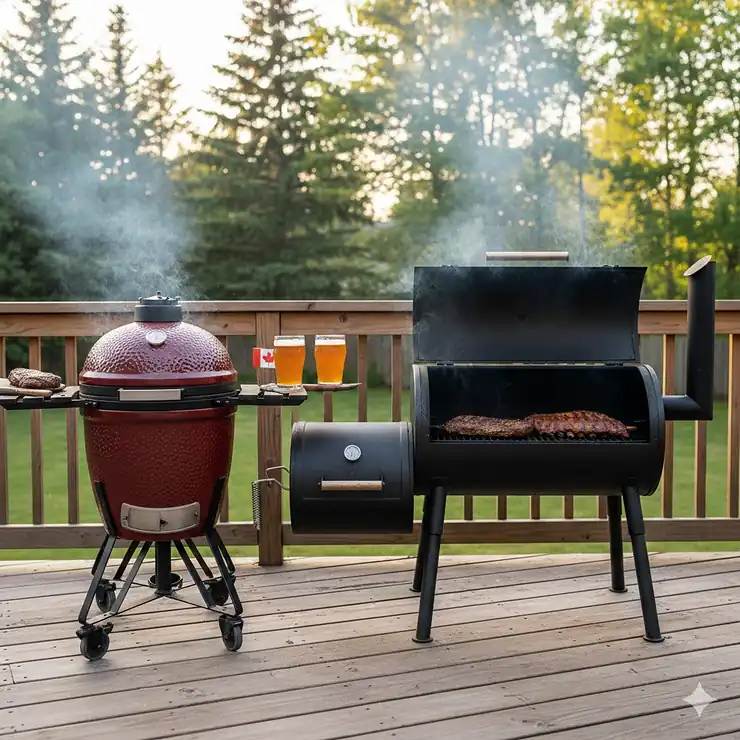
So what exactly are we comparing? A kamado (often called a ceramic grill or egg-shaped smoker) is a thick-walled, dome-shaped cooker that traps heat with remarkable efficiency and functions as a grill, smoker, oven, and more. An offset smoker, on the other hand, is a barrel-shaped unit with a separate firebox attached to the side — the classic pitmaster setup you’ve seen at roadside BBQ joints across Texas and, increasingly, in Canadian backyards from Vancouver to Halifax.
The kamado vs offset smoker choice really boils down to three things: what you’re cooking, how hands-on you want to be, and how much space — and budget — you’ve got. This guide breaks it all down with seven real products available in Canada, honest performance comparisons, and everything you need to make the right choice before summer hits. Let’s fire things up! 🍁
Quick Comparison Table: Kamado vs Offset Smoker at a Glance
| Feature | Kamado | Offset Smoker |
|---|---|---|
| Heat Retention | ⭐⭐⭐⭐⭐ Excellent | ⭐⭐⭐ Moderate |
| Temperature Stability | Very high | Requires active management |
| Fuel Efficiency | Uses 30–50% less charcoal | Higher fuel consumption |
| Smoke Flavour | Rich, moist | Deep, traditional wood smoke |
| Cooking Capacity | Limited (one zone) | Large, multi-rack |
| Learning Curve | Moderate | Steep |
| Portability | Heavy (ceramic) | Heavy (steel) |
| Price Range (CAD) | $350 – $4,800+ | $400 – $1,200+ |
| Best For | Versatility, efficiency | Volume cooking, BBQ purists |
| Canadian Winter Use | ✅ Excellent insulation | ❌ Heat loss in cold temps |
💬 Just one click – help others make better buying decisions too! 😊
Top 7 Kamado & Offset Smokers for Canada: Expert Analysis 🏆
✨ Don’t Miss These Exclusive Deals!
🔍 Take your backyard BBQ to the next level with these carefully selected products available in Canada. Click on any highlighted item to check current pricing and availability on Amazon.ca. These tools will help you create authentic smoky flavours your family will love!
1. Kamado Joe Classic II 18″ Ceramic Charcoal Grill & Smoker (KJ23RHC)
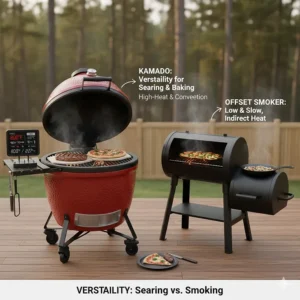
The Kamado Joe Classic II is arguably the most popular ceramic kamado in Canada right now, and for good reason. It features an 18-inch cooking surface (456 sq. in. total), a two-tier Divide & Conquer flexible cooking system, a built-in cast iron top vent, and the brand’s signature slide-out ash drawer. The thick ceramic walls deliver superb temperature stability whether you’re running it at 107°C (225°F) for a long brisket session or cranking it to 370°C (700°F) for a Neapolitan-style pizza.
Price: ~$2,199 CAD (Canadian Tire, BBQ Canada)
Availability: Widely available across Canada 🍁
Canadian buyers consistently praise it for its build quality and the included accessories. One Toronto reviewer noted it held steady at 225°F for an 18-hour cook with minimal charcoal.
✅ Superb temperature control
✅ Divide & Conquer system for multi-zone cooking
✅ Best-in-class ceramic build
❌ Heavy (68 kg) — not easy to move
❌ Premium price point
2. Big Green Egg Large Ceramic Kamado Grill
The original kamado. Since 1974, the Big Green Egg Large has been the benchmark for ceramic grill vs barrel smoker comparisons. The Large model offers 465 sq. in. of cooking area and is made from NASA-grade ceramic that can handle temperatures from 70°C (160°F) all the way to 370°C+ (700°F+). It’s sold through authorised Canadian dealers rather than big-box stores, which also means you get expert local support — a significant advantage in provinces where shipping and returns can be complicated.
Price: ~$1,200–$1,500 CAD (Large, base egg only — table/nest sold separately)
Availability: Through authorised dealers across Canada; see BigGreenEgg.ca for your nearest retailer
The BGE community — affectionately known as “EGGheads” — is enormous in Canada, making it easy to find recipes, accessories, and advice locally.
✅ Industry-leading ceramic quality
✅ Massive Canadian community and dealer network
✅ Lifetime warranty on ceramic components
❌ Accessories (table, nest) add significant cost
❌ Not sold on Amazon.ca — dealer purchase only
3. Char-Griller AKORN E16620 Kamado Charcoal Grill & Smoker
If your budget doesn’t stretch to four figures, the Char-Griller AKORN E16620 is the best value kamado you can get in Canada. Instead of ceramic, it uses triple-walled 22-gauge steel with a porcelain-coated interior — which makes it lighter (about 27 kg) and more resistant to cracking. It offers 447 sq. in. of total cooking space, cast iron grates, and a removable stainless steel warming rack.
Price: ~$350–$450 CAD (Amazon.ca)
Availability: Amazon.ca, select Canadian Tire locations
Canadian buyers on RedFlagDeals.com note it holds temperature well once dialled in. One user from Ontario ran it through a full winter season with decent results, though they recommend a cover for our harsh Canadian weather.
✅ Budget-friendly entry into kamado cooking
✅ Lighter than ceramic — easier to store in winter
✅ Cast iron grates for great sear marks
❌ Less heat retention than ceramic models
❌ Can rust in humid Canadian climates — needs a cover
4. Kamado Joe Konnected Joe Digital Ceramic Grill & Smoker (KJ15041123)
For those who want the kamado experience without babysitting airflow, the Kamado Joe Konnected Joe adds WiFi connectivity and a built-in temperature controller to the Classic Joe platform. The digital fan system maintains your target temp automatically — huge for long overnight cooks. It’s 18 inches of ceramic cooking area with the full Divide & Conquer system and comes with the iKamand app for remote monitoring.
Price: ~$2,899 CAD (BBQ Canada, select Canadian retailers)
Availability: Limited stock; check BBQ Canada or Kamado Joe’s Canadian dealer locator
Canadian buyers who work from home love this for setting a 10-hour brisket cook and literally ignoring it. WiFi range is reported to work well even in larger Canadian backyards.
✅ Set-and-forget temperature control
✅ App monitoring from inside during cold Canadian winters ❄️
✅ Full ceramic kamado performance
❌ Most expensive option in this guide
❌ Connectivity issues reported in rare cases
5. Oklahoma Joe’s Highland Offset Smoker (Model 15202037)
Now we cross over to offset territory. The Oklahoma Joe’s Highland is the most iconic and accessible offset smoker available in Canada, and it’s the classic benchmark in any ceramic grill vs barrel smoker debate. With 619 sq. in. of primary cooking space and 281 sq. in. of secondary space in the firebox chamber, it can handle five briskets, seven pork shoulders, or ten whole chickens in one go. The heavy-gauge steel construction and porcelain-coated grates are built to handle serious loads.
Price: ~$500–$600 CAD (Home Depot Canada, Amazon.ca, RONA)
Availability: Widely available across Canada 🍁
Canadian reviews at RONA note it runs hot and requires practice to manage. One Quebec buyer called it a “perfect training ground” for anyone wanting to master wood-fire BBQ. The learning curve is real but rewarding.
✅ Huge cooking capacity for feeding crowds
✅ Authentic low-and-slow smoke flavour
✅ Widely available across Canada
❌ Paint can peel off the firebox after heavy use
❌ Temperature management takes considerable practice
6. Oklahoma Joe’s Highland DLX Offset Smoker & Grill
The Oklahoma Joe’s Highland DLX is the upgraded sibling of the Highland, redesigned specifically to address the original model’s shortcomings. It adds an extra upper cooking grate (328 sq. in. additional), an easy-access ash pan, pivoting cool-touch handles, rubber-treaded wheels for better mobility, and a more robust staging shelf. Same 619 sq. in. primary cooking footprint, better execution overall.
Price: $599 CAD (Home Depot Canada — confirmed February 2026)
Availability: Home Depot Canada nationwide
Canadian buyers upgrading from a basic charcoal grill find the DLX the most complete package in the offset category. The improved ash pan alone makes clean-up significantly less painful during a Canadian summer weekend.
✅ Upgraded features over the original Highland
✅ Better airflow and ash management
✅ Great value for a full offset smoking setup
❌ Still requires active fire management every 45–60 minutes
❌ Steel construction loses heat faster in cold Canadian weather
7. Broil King Keg 5000 Charcoal Grill Smoker (Model 911470)
Here’s a sleeper pick for Canadian BBQ enthusiasts. The Broil King Keg 5000 is a steel-bodied kamado-style grill that offers 480 sq. in. of primary cooking space on heavy-duty cast iron grates. What sets it apart is its double-walled insulation and the fact that Broil King is a Canadian brand (headquartered in Waterloo, Ontario 🍁), meaning you get excellent dealer support, parts availability, and warranty service across the country.
Price: ~$1,100–$1,300 CAD (BBQ Canada, select retailers)
Availability: Available through Canadian BBQ specialists and the Broil King dealer network
Canadian buyers particularly love that warranty claims and service are handled domestically. No south-of-the-border customer service runarounds.
✅ Canadian brand with strong domestic support network
✅ Excellent cast iron grates and insulation
✅ More affordable than ceramic kamados at similar capacity
❌ Less versatile ecosystem than Kamado Joe or Big Green Egg
❌ Not as widely reviewed as the big ceramic names
Top 7 Products Comparison Table (CAD Pricing)
| Product | Type | Cooking Area | Price (CAD) | Rating |
|---|---|---|---|---|
| Kamado Joe Classic II KJ23RHC | Ceramic Kamado | 456 sq. in. | ~$2,199 | ⭐⭐⭐⭐⭐ |
| Big Green Egg Large | Ceramic Kamado | 465 sq. in. | ~$1,200–$1,500 | ⭐⭐⭐⭐⭐ |
| Char-Griller AKORN E16620 | Steel Kamado | 447 sq. in. | ~$350–$450 | ⭐⭐⭐⭐ |
| Kamado Joe Konnected Joe KJ15041123 | Smart Ceramic Kamado | 456 sq. in. | ~$2,899 | ⭐⭐⭐⭐⭐ |
| Oklahoma Joe’s Highland 15202037 | Offset Smoker | 900 sq. in. | ~$500–$600 | ⭐⭐⭐⭐ |
| Oklahoma Joe’s Highland DLX | Offset Smoker | 947 sq. in. | $599 | ⭐⭐⭐⭐ |
| Broil King Keg 5000 (911470) | Steel Kamado | 480 sq. in. | ~$1,100–$1,300 | ⭐⭐⭐⭐ |
Ceramic Grill vs Barrel Smoker: The Core Differences Explained
Let’s get into the actual mechanics, because this is where the kamado vs offset smoker debate really lives. A ceramic kamado works on convection — heat rises from the lump charcoal at the base, circulates through the dome, and cooks food from all angles simultaneously. The thick ceramic walls act as a heat battery, absorbing and radiating warmth back into the chamber. This is why a well-loaded kamado can run for 16–18 hours on a single load of charcoal.
An offset barrel smoker works completely differently. The firebox sits adjacent to — and slightly below — the main cooking chamber. Heat and smoke travel horizontally through the cook chamber and exit through a chimney on the opposite end. This creates a temperature gradient, meaning the end closer to the firebox is always hotter. Learning to use that gradient is part of the craft. According to Wikipedia’s entry on barbecue, the offset smoker design traces its roots to the Southern United States oil industry, where workers fashioned smokers from repurposed oil drums — which explains the classic barrel shape.
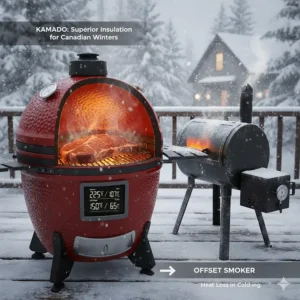
For Canadians, this temperature gradient matters a lot. In February, a steel offset smoker loses heat to the cold air significantly faster than a ceramic kamado, which is heavily insulated. That charcoal efficiency comparison isn’t even close: kamados typically use 30–50% less fuel for the same cook time.
Temperature Stability: Who Wins? 🌡️
Temperature stability is probably the single biggest practical difference between these two cookers, and it’s the question I get asked most often.
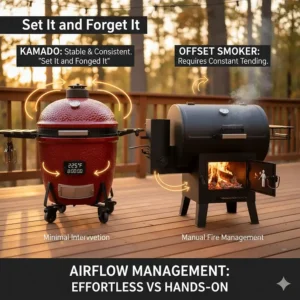
On a kamado, once you dial in your temperature using the top and bottom vents, the ceramic walls maintain it with minimal intervention. You can walk away for an hour, come back, and find the thermometer barely moved. This is why ceramic kamados are so popular for overnight brisket cooks — you genuinely can set them and sleep. The temperature stability of a well-managed kamado can stay within a ±5°C (±10°F) range for hours at a time.
An offset smoker demands more of you. You’re feeding logs or chunks to the firebox every 45 minutes to an hour. You’re adjusting the intake damper and the exhaust flue. You’re watching for temperature spikes when a fresh log catches. This hands-on approach is exactly what seasoned pitmasters love about offset smoking — it’s interactive, it’s a skill, and the flavour payoff from real wood combustion is undeniable. But if you’re a beginner or you just don’t have the time to babysit a 10-hour cook, this learning curve for beginners can feel overwhelming.
The verdict: kamado wins on stability, offset wins on flavour authenticity for traditional wood-smoke BBQ lovers.
Charcoal Efficiency Comparison: Real Numbers 📊
Here’s something Canadian buyers appreciate: charcoal costs money, and lump hardwood charcoal has gotten more expensive. So let’s talk fuel consumption rate in practical terms.
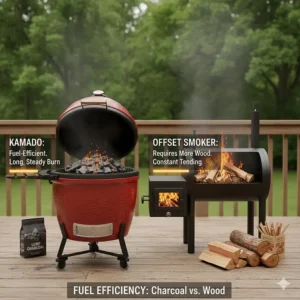
A Kamado Joe Classic II running at 107°C (225°F) for a 12-hour cook typically uses 2–3 kg of lump charcoal. The same session on an Oklahoma Joe’s Highland offset might use 4–6 kg of charcoal plus 4–6 splits of wood. Over a BBQ season of 20 cooks, that difference adds up fast.
| Cook Type | Kamado Charcoal Use | Offset Charcoal + Wood Use |
|---|---|---|
| 12-hr Low & Slow (225°F) | 2–3 kg charcoal | 4–6 kg + 4–6 wood splits |
| High-Heat Sear (700°F) | 1–1.5 kg charcoal | N/A (not ideal for offset) |
| Pizza Cook (700°F+) | 1.5 kg charcoal | N/A |
| 6-hr Ribs (250°F) | 1.5–2 kg charcoal | 3–4 kg + 3 wood splits |
The kamado’s fuel efficiency advantage is significant, especially if you’re cooking year-round in a Canadian climate where cold air is constantly working against you. That said, there’s something to be said for the flavour contribution of real wood logs in an offset — charcoal alone doesn’t produce the same smoke profile.
Learning Curve for Beginners: Honest Advice 🎓
If you’re new to charcoal cooking, here’s the honest breakdown.
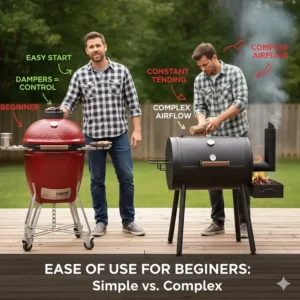
Kamado for beginners: The learning curve is moderate. You’ll spend your first two or three cooks understanding how the vents affect temperature, learning that you almost always approach your target temp from below (never open the vents wide and blast past your target), and figuring out how different lump sizes burn. After three or four cooks, most people feel comfortable. The American Institute for Cancer Research also notes that indirect cooking methods like kamado smoking can reduce the formation of harmful compounds compared to direct high-heat grilling, which is worth knowing.
Offset for beginners: Steeper. You’ll need to understand fire management — building a clean-burning fire, avoiding dirty white smoke (which tastes bitter) and aiming for thin blue smoke, managing the firebox damper, and rotating meat from the hot end to the cool end of the chamber. Many beginners run too hot and dry out their meat. A good moisture source (a water pan in the chamber) helps. The payoff, though, is a deeply flavoured result that many cooks say they simply cannot replicate on a kamado.
The Canadian Culinary Federation recognizes low-and-slow smoking as a legitimate culinary technique, and BBQ competitions across Canada — from the Canadian BBQ Championships in Whistler to local events in Ontario — almost exclusively feature offset-style results.
How to choose the right cooker for you in Canada: a quick 6-step guide
- Assess your cooking frequency — more than once a week favours a kamado for efficiency.
- Set your budget clearly in CAD before browsing (kamados: $350–$4,800+; offsets: $400–$1,200).
- Consider your available outdoor space — offsets are long and wide; kamados are compact footprints.
- Think about Canadian winters — kamados outperform in cold weather; cover your offset or store it inside.
- Decide if you want versatility (kamado) or BBQ authenticity (offset).
- Factor in fuel costs over 2–3 seasons, not just the purchase price.
Big Green Egg vs Oklahoma Joe’s: The Iconic Head-to-Head 🥊
This is the matchup everyone asks about, so let’s address it directly. The Big Green Egg Large and the Oklahoma Joe’s Highland represent the gold standard in their respective categories, and they’re completely different tools.
The BGE excels at moisture retention. The thick ceramic dome creates a humid cooking environment that keeps proteins juicy even over long cooks. A 10-hour pork shoulder on a BGE tends to emerge with better moisture than the same cook on an offset, purely because of that convection environment. For baking — bread, pizza, desserts — the BGE is genuinely superior. According to Serious Eats, kamado-style ceramic cookers produce notably more moist results in long protein cooks than open-grate smokers.
The Oklahoma Joe’s, on the other hand, creates a drier, smoke-heavier environment that many competitive BBQ cooks actually prefer for brisket bark formation and rib texture. That classic smoke ring you see in competition BBQ photos? It’s easier to develop in an offset, where the smoke density and airflow dynamics are fundamentally different.
Price difference in Canada is stark: a BGE Large runs $1,200–$1,500 CAD for the egg alone (add $400–$800 for a proper nest or table), while the Oklahoma Joe’s Highland sits at $500–$600 CAD all-in. If budget is the primary concern, the offset wins outright.
✨ Ready to Upgrade Your Backyard BBQ?
🔍 Whether you’re going kamado or offset, Canada has great options at every price point. Click any highlighted product name to check the latest pricing and stock on Amazon.ca or your preferred Canadian retailer. Your best backyard cook ever is just one decision away!
Canadian Winter BBQ: Which Survives Our Winters Better? ❄️🍁
This is a question that rarely comes up in American BBQ guides but matters enormously in Canada. We’re not Florida. In January in Calgary, Edmonton, or even Toronto, outdoor temperatures can drop to -20°C or below. Both cooker types can technically run in winter, but they behave very differently.
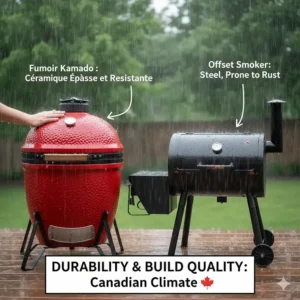
A ceramic kamado handles Canadian winters remarkably well. The thick ceramic walls retain heat so effectively that even in sub-zero temperatures, you can maintain a 225°F cook without dramatically increasing charcoal usage. Many Canadian kamado owners cook year-round with minimal changes to their normal setup. Just make sure the ceramic hasn’t cracked from moisture freezing in it — always store with the vents open to allow airflow.
Steel offset smokers are much more vulnerable to cold weather. The thin steel walls bleed heat into the cold air at a much higher rate, meaning you’ll be burning significantly more fuel and making more frequent fire adjustments than you would in summer. Some Canadian offset owners line the firebox area with fire bricks to help retain heat, or wrap the cook chamber in a welding blanket. It works, but it’s extra effort.
Natural Resources Canada’s energy efficiency resources (nrcan.gc.ca) offer some useful context on heat retention and thermal mass in outdoor settings — the same principles that make ceramic outperform steel in winter BBQ apply to insulation science broadly.
Who Should Buy Which: Final Recommendations 🎯
You’ve absorbed a lot of information, so let me cut through it clearly.
Choose a kamado if you: cook solo or for a small family, want versatility (grill, smoke, bake, roast), prioritise fuel efficiency, cook through Canadian winters, are willing to pay more upfront for long-term value, or simply don’t want to babysit a firebox all afternoon.
Choose an offset smoker if you: regularly cook for large groups, are serious about traditional wood-smoke BBQ flavour above all else, enjoy the hands-on process of fire management, have a covered outdoor space for the unit, and are comfortable with a steeper learning curve.
For most Canadian families buying their first dedicated smoker, a mid-range kamado like the Kamado Joe Classic II or the budget-friendly Char-Griller AKORN offers the best balance of performance, versatility, and season-long usability. If you’re a serious pitmaster chasing competition-level bark and smoke ring, the Oklahoma Joe’s Highland DLX is an exceptional value at $599 CAD and a legitimate pathway to that goal.
FAQ: Kamado vs Offset Smoker in Canada ❓
❓ Which is better for cold Canadian winters — kamado or offset?
❓ What is the price range for kamado grills in Canada?
❓ How much charcoal does a kamado use compared to an offset smoker?
❓ Is a kamado or offset smoker easier for beginners?
❓ Can I use an offset smoker as a regular grill in Canada?
Conclusion: Your Backyard, Your Call 🍖🍁
The kamado vs offset smoker debate doesn’t have a single correct answer — and that’s actually a good thing, because it means the right tool for you actually exists. After digging into the specs, the Canadian pricing, and the real-world feedback from backyard cooks from BC to Nova Scotia, here’s what I’d tell a friend: if you want one cooker that does everything well through every Canadian season, go kamado. If BBQ is your passion and you want to truly master the craft of wood-fire smoking, the offset is your teacher.
For most Canadians, the Kamado Joe Classic II at ~$2,199 CAD represents the best overall package. Budget-conscious buyers should seriously consider the Char-Griller AKORN at $350–$450 CAD. And if you’re committed to offset cooking, the Oklahoma Joe’s Highland DLX at $599 CAD from Home Depot Canada is hard to beat for the price.
Whatever you choose, fire it up before the first snowflake falls — and then fire it up again when it does. That’s the Canadian way. 🔥❄️
✨ Found Your Perfect Smoker? Act Now!
🔍 Don’t wait for summer to start planning — these models sell out fast in Canada. Click any highlighted product to check current pricing on Amazon.ca or your preferred Canadian retailer. Your neighbours will be talking about that smoke all season long!
Recommended for You
- Pellet Grill vs Gas Grill: 7 Best Picks for Canada 2026
- Propane vs Natural Gas BBQ: 7 Best Grills in Canada 2026
- Weber vs Napoleon Gas BBQ: 7 Best Picks for Canadians in 2026
Disclaimer: This article contains affiliate links to Amazon.ca and other Canadian retailers. If you purchase products through these links, we may earn a small commission at no additional cost to you.
✨ Found this helpful? Share it with your friends! 💬🤗
