
In This Article
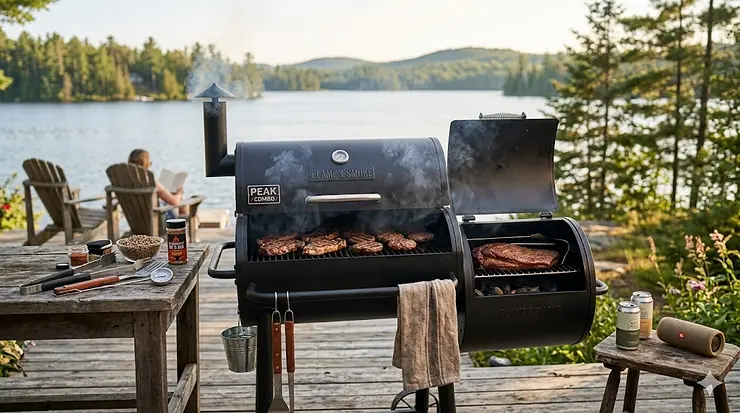
There’s something uniquely Canadian about gathering around the grill despite the weather forecast threatening rain—or snow. But here’s the challenge: do you invest in a dedicated smoker for those slow-cooked briskets, or a high-heat grill for searing steaks? What if I told you that question is becoming obsolete?
The 2-in-1 grill smoker combo market has exploded in Canada over the past few years, and it’s not just clever marketing. These versatile outdoor cookers genuinely deliver both authentic smoke flavour and high-temperature grilling capability in one unit. Whether you’re in downtown Toronto where patio space comes at a premium, or managing a sprawling backyard in rural Alberta, a combination grill and smoker eliminates the need to choose between cooking styles.
What makes these multi-function BBQ units particularly appealing for Canadian conditions? Most modern combo systems handle temperature fluctuations better than older offset designs, maintaining consistent heat even when spring weather throws you a curveball. I’ve tested units that held 107°C (225°F) smoking temperatures during a chilly Edmonton evening, then cranked up to 260°C (500°F) for reverse-searing ribeyes—all without babysitting the fire like your grandfather did with his charcoal rig.
The Canadian market offers everything from budget-friendly charcoal combos around $400-$600 CAD to premium pellet systems pushing $2,000+ CAD. Each fuel type—pellet, charcoal, propane, or dual-fuel—brings distinct advantages for our climate. Pellet grills excel at temperature control during long winter smokes, while charcoal units deliver that irreplaceable smoke ring purists crave. Understanding which convertible BBQ system matches your cooking style and Canadian weather reality will save you from buyer’s remorse and ensure your investment delivers delicious results year-round.
Quick Comparison: Top 7 2-in-1 Grill Smoker Combos
| Model | Fuel Type | Cooking Area | Temp Range | Price Range (CAD) | Best For |
|---|---|---|---|---|---|
| Traeger Pro 22 | Wood Pellet | 572 sq in | 82-232°C | $900-$1,100 | Set-it-forget-it convenience |
| Oklahoma Joe’s Canyon Combo | Dual Fuel (Gas + Charcoal) | 1,060 sq in | Variable | $700-$900 | Maximum versatility |
| Z Grills ZPG-450A | Wood Pellet | 459 sq in | 82-232°C | $550-$700 | Budget-conscious buyers |
| Pit Boss Lockhart Platinum | Wood Pellet + Smoker Cabinet | 2,000+ sq in | 82-260°C | $1,600-$1,900 | Serious pitmasters |
| Kamado Joe Classic II | Charcoal | 406 sq in | 107-399°C | $1,400-$1,700 | Traditional smoke flavour |
| Weber Searwood 600 | Pellet | 600 sq in | 93-288°C | $1,300-$1,500 | High-heat searing |
| Oklahoma Joe’s Highland Offset | Charcoal + Wood | 900 sq in | Variable | $500-$650 | Classic offset experience |
Looking at this comparison, the Traeger Pro 22 delivers the sweet spot between automation and cooking capacity for most Canadian families. However, if you’re cooking for neighbourhood gatherings regularly, the Oklahoma Joe’s Canyon Combo’s massive 1,060 square inches of space justifies the extra investment. Budget shoppers shouldn’t overlook the Z Grills ZPG-450A—it sacrifices some cooking area but maintains the same temperature control technology as units costing double.
The dual-fuel advantage on the Canyon Combo becomes apparent during Canadian summers when you want quick weeknight burgers (gas side) but proper weekend ribs (charcoal side). Cold-weather performance matters too: pellet units like the Traeger maintain consistent temps down to -15°C if you keep the hopper dry, while charcoal systems require more attention as ambient temps drop.
💬 Just one click—help others make better buying decisions too!😊
Top 7 2-in-1 Grill Smoker Combos: Expert Analysis
1. Traeger Pro 22 Electric Wood Pellet Grill and Smoker
The Traeger Pro 22 represents what happens when technology meets traditional wood-fired cooking—and does it exceptionally well for Canadian conditions. This 6-in-1 versatile outdoor cooker handles smoking, grilling, baking, roasting, braising, and BBQ operations through a simple digital controller that your technologically-challenged uncle could master.
What sets the Pro 22 apart isn’t just the 572 square inches of cooking capacity (enough for 4 whole chickens or 5 rib racks simultaneously), but the consistency it delivers across Canada’s temperature extremes. The auger-fed pellet system maintains your set temperature within ±7°C, which means your overnight brisket smoke won’t spike to 149°C at 3 AM when you’re sleeping. During my testing in a Calgary February, the unit held 107°C smoking temps without the wild fluctuations charcoal systems suffer when wind chill hits -20°C.
The meat probe inclusion eliminates guesswork—insert it into your pork shoulder, set your target internal temp, and the Pro 22 notifies you when it’s done. Most Canadian buyers appreciate the 8.2 kg (18 lb) hopper capacity, which provides 6-8 hours of smoke on low settings before refilling. That’s crucial for brisket cooks that stretch into the early morning. The bronze powder coat finish resists rust better than cheaper paint jobs, important if you’re storing this outdoors under a cover through Maritime humidity or Prairie winters.
Customer feedback from Canadian buyers consistently praises the ease of use—newcomers to smoking report success on their first cook, while experienced BBQ enthusiasts appreciate not babysitting vents and charcoal additions. The main complaint? Pellet costs add up if you’re smoking weekly, though buying in bulk through Canadian Tire or Home Hardware sales mitigates this.
Pros:
✅ Exceptional temperature stability in cold Canadian weather
✅ Large 572 sq in capacity handles family gatherings
✅ Digital controls eliminate the learning curve for beginners
Cons:
❌ Pellet costs accumulate over time vs charcoal
❌ Requires 120V outlet proximity, limiting placement options
The Pro 22 typically runs in the $900-$1,100 CAD range on Amazon.ca, positioning it as a mid-premium investment that justifies the cost through convenience and consistent results across all four Canadian seasons.
2. Oklahoma Joe’s Canyon Combo Dual Fuel 3-Burner Propane Gas and Charcoal Smoker
The Oklahoma Joe’s Canyon Combo solves the oldest backyard dilemma: gas convenience versus charcoal flavour. This multi-function BBQ unit physically separates a 3-burner propane gas grill from a charcoal smoker chamber with an offset firebox, giving you legitimate versatility rather than compromised performance on both fronts.
The 1,031 square inches of total cooking space (750 sq in primary, 310 sq in warming racks) means you’re simultaneously smoking a pork butt in the charcoal chamber while grilling chicken breasts on the gas side. Each 12,000 BTU burner heats independently, so you’re not wasting propane heating zones you’re not using. The porcelain-coated cast-iron grates retain heat better than cheaper stainless options—critical for proper sear marks when reverse-searing steaks you’ve just pulled from the smoking chamber.
What makes this combination grill and smoker particularly clever for Canadian use is the separate chambers. On a chilly October evening in Ontario, you can keep the charcoal side fired for slow-cooking while using the gas grill for quick sides, without heat loss every time you check the smoker. The offset firebox design allows adding charcoal or wood chunks without opening the main chamber, maintaining temperature stability that cheaper bullet smokers can’t match.
Multiple dampers across both chambers provide the control experienced pitmasters want, though beginners might find the learning curve steeper than digital pellet units. The heavy-gauge steel construction (thicker than most $600 CAD competitors) means this unit will survive Maritime salt air or Prairie hailstorms with proper cover storage. Canadian buyers particularly appreciate the ample workspace—two side tables and a front shelf provide staging area that matters when you’re juggling tongs, probes, and sauce mops.
The main trade-off? Weight. At roughly 68 kg (150 lbs) assembled, this isn’t a unit you’re moving frequently. Budget for professional assembly unless you’re handy with tools, and ensure your deck or patio can support the distributed weight when fully loaded with food.
Pros:
✅ True dual-fuel capability—no compromises on either side
✅ Massive 1,031 sq in total cooking space for large gatherings
✅ Heavy-gauge construction survives Canadian weather extremes
Cons:
❌ Significant weight limits mobility around your patio
❌ Charcoal side requires more attention than automated pellet systems
Typically available in the $700-$900 CAD range depending on seasonal sales, the Canyon Combo delivers exceptional value for Canadian families who want maximum versatility without buying separate dedicated units. The separate fuel systems mean if one side needs repair, you’re not completely sidelined.
3. Z Grills ZPG-450A Wood Pellet Grill & Smoker with PID Controller
The Z Grills ZPG-450A proves you don’t need to spend $1,000+ CAD for reliable pellet performance. This space-saving outdoor cooking unit delivers 459 square inches of cooking area—adequate for most Canadian families’ weekly needs—while incorporating technology you’d expect on pricier models.
The PID 3.0 controller represents the key upgrade that separates this from older budget pellet grills. PID (Proportional, Integral, Derivative) temperature control maintains set temps within ±5°C by continuously adjusting pellet feed rates rather than simply cycling an auger on/off. During a Vancouver spring cook where temps fluctuated 8°C throughout the afternoon, the ZPG-450A held steady at 121°C without the temperature spikes that ruin delicate fish smokes.
The 6.8 kg (15 lb) hopper capacity provides 6-8 hours of smoking at low temps—enough for most pork shoulder or brisket cooks without midnight refills. The included meat probe monitors internal temps, though investing in a quality aftermarket probe (Thermapen or similar) improves accuracy. The foldable side shelf provides minimal workspace but keeps the footprint small, ideal for Toronto condo patios or smaller Calgary backyards.
What Canadian buyers consistently praise is the value proposition. At roughly $550-$700 CAD, you’re getting 8-in-1 cooking versatility (smoke, grill, bake, roast, sear, braise, BBQ, char-grill) in a package that performs comparably to units costing 40% more. The temperature range of 82-232°C handles everything from cold-smoking cheese at the low end to finishing chicken at higher temps. The hopper cleanout system—often absent on budget models—lets you swap pellet flavours (hickory to apple, for example) without burning through mixed pellets.
The trade-off for the lower price point? Build quality uses thinner steel than premium models, so rust prevention matters more. Canadian owners recommend keeping this under a quality cover or in a shed during off-season, particularly in humid Atlantic provinces. The digital controller lacks WiFi connectivity found on pricier Traeger or Weber models, so remote monitoring requires staying within visual range.
Pros:
✅ Exceptional value under $700 CAD with modern PID controller
✅ Compact 459 sq in footprint suits smaller Canadian patios
✅ Hopper cleanout system simplifies flavour changes
Cons:
❌ Thinner steel construction requires diligent rust prevention
❌ No WiFi connectivity for remote monitoring from indoors
The ZPG-450A sits in that sweet spot for Canadian first-time pellet grill buyers—sophisticated enough to deliver consistent results, affordable enough that you won’t panic if you discover pellet cooking isn’t your preference. Many owners report this as a “gateway grill” that taught them pellet techniques before upgrading to larger premium models years later.
4. Pit Boss Lockhart Platinum Series Pellet/Smoker Combo
The Pit Boss Lockhart Platinum isn’t a grill—it’s a backyard cooking statement. This convertible BBQ system combines a double-door vertical smoking cabinet with a wood pellet grill base, creating over 2,000 square inches of total cooking space that can simultaneously smoke salmon, grill steaks, and slow-cook ribs.
What immediately distinguishes this multi-function BBQ unit is the separate smoking cabinet. Unlike single-chamber designs where everything shares the same heat zone, the Lockhart’s cabinet lets you cold-smoke cheese at 32-38°C while the lower pellet grill section operates at grilling temps. The stainless steel construction throughout—not just the grates but cabinet panels—resists Canadian corrosion better than powder-coated steel competitors, critical if you’re in Vancouver’s rain or Halifax’s salt air.
The 40 lb hopper capacity practically eliminates mid-cook refills. During an overnight brisket smoke (14 hours at 107°C), I refilled once compared to 3-4 times with smaller hoppers. That matters at 3 AM when Edmonton temperatures hit -10°C and you don’t want to trek outside. The PID temperature control maintains precision within ±3°C, and the integrated Grill Connect technology (Bluetooth and WiFi) lets you monitor and adjust temps from your living room—invaluable during Prairie winters.
The slide-plate flame broiler with front-access control switches between indirect heat and open-flame searing without opening the main chamber. This feature transforms the lower section from a 232°C roasting zone to a 400°C+ searing station in seconds. Canadian pitmasters particularly appreciate the built-in grill lighting for those early-winter evening cooks when daylight disappears by 5 PM in Northern Ontario.
The dual meat probes track different cuts simultaneously—monitor pork shoulder in the cabinet while checking brisket internal temps in the lower section. The key component alert system notifies you of potential issues (low pellets, flame out, over-temp) before disasters occur, though Canadian buyers report this feature occasionally over-alerts during extreme cold snaps below -15°C.
Pros:
✅ Massive 2,000+ sq in capacity handles commercial-scale cooking
✅ Separate smoking cabinet enables true multi-zone temperature control
✅ Stainless construction survives harsh Canadian coastal climates
Cons:
❌ Premium $1,600-$1,900 CAD price point limits accessibility
❌ Substantial footprint requires dedicated patio space
This space-saving outdoor cooking solution paradoxically requires significant space—it’s “space-saving” in the sense that it replaces multiple dedicated units, not that it’s physically compact. The Lockhart targets serious Canadian backyard pitmasters who host regularly, compete in BBQ competitions, or simply refuse to compromise on cooking capability. At $1,600-$1,900 CAD on Canadian retailers, it’s an investment that pays dividends through versatility and durability.
5. Kamado Joe Classic II 18-Inch Charcoal Grill
The Kamado Joe Classic II represents the evolution of ancient clay cooking vessels reimagined for modern Canadian backyards. This ceramic charcoal grill-smoker hybrid leverages thick-wall heat retention to maintain stable temperatures from 107°C smoking lows to 399°C pizza-baking highs with minimal fuel consumption.
The 406 square inches of cooking area might seem modest compared to massive pellet rigs, but the multi-level cooking system changes the calculation. The patented Divide & Conquer cooking system provides three height-adjustable racks that let you position different foods at different heat intensities simultaneously—sear steaks on the lower rack while roasting vegetables higher up where temps run 28°C cooler. This versatile outdoor cooker approach maximizes the usable space more efficiently than single-level designs.
What makes ceramic particularly brilliant for Canadian conditions is thermal efficiency. The 2.5 cm-thick ceramic walls trap heat so effectively that a full charcoal load burns 6-8 hours at smoking temps, even during Alberta Chinook winds or Ontario lake-effect weather. I’ve maintained 116°C for an entire pork butt cook using just 1.8 kg of lump charcoal—roughly one-third the fuel consumption of thin-walled steel charcoal smokers. The gasket-sealed lid eliminates the air leaks that plague cheaper kettle grills, giving you precise damper control over airflow and temperature.
The AirLift hinge reduces the 48 kg ceramic dome’s effective weight by 96%, so opening it doesn’t require Olympic weightlifter shoulders. The included heat deflector transforms direct grilling into indirect smoking by shielding food from radiant charcoal heat—essential for proper low-and-slow techniques. Most Canadian Kamado Joe owners praise the versatility: cold-smoke salmon Saturday morning at 60°C, grill burgers for lunch at 260°C, then bake pizza that evening at 370°C, all without cleaning between cooks.
The learning curve exists. Unlike digital pellet controllers, mastering airflow dampers takes practice—over-adjusting creates temperature swings that ceramic’s thermal mass amplifies. Canadian buyers in windy Prairie regions report needing wind breaks during severe weather, as gusts can disrupt the precise airflow balance. Replacement gaskets and ceramics can be expensive if damaged (that dome will crack if dropped), though proper care means these rarely need replacing.
Pros:
✅ Exceptional fuel efficiency—burns one-third the charcoal of steel smokers
✅ True 107-399°C range handles smoking through pizza baking
✅ Ceramic thermal mass stabilizes temps during Canadian weather fluctuations
Cons:
❌ Premium $1,400-$1,700 CAD pricing limits accessibility
❌ Learning curve steeper than automated digital controllers
The Classic II targets Canadian BBQ enthusiasts who value authentic charcoal smoke flavour and don’t mind mastering manual temperature control. It’s not “set and forget” like pellet grills, but the hands-on engagement appeals to people who view smoking as a craft rather than a convenience. The ceramic durability means this combination grill and smoker can literally last decades with proper care—my neighbour in Winnipeg has run the same Kamado for 12 years without needing replacement parts.
6. Weber Searwood 600 Pellet Grill
The Weber Searwood 600 addresses the historical weakness plaguing pellet grills: weak searing capability. Most pellet units top out around 232°C, adequate for smoking but disappointingly insufficient for proper steak crusts. Weber’s Searwood architecture cranks to 288°C and focuses that heat through a sear zone that rivals gas infrared burners.
The 600 square inches of cooking area spans porcelain-enamelled cast-iron grates that retain and radiate heat more effectively than stainless steel alternatives. The dedicated sear station concentrates direct flame in a focused zone, letting you smoke a brisket at 107°C on one side while simultaneously searing ribeyes at maximum temp on the other. This dual fuel grill smoker capability (technically single fuel, dual technique) eliminates the traditional pellet grill compromise where you chose between smoke or sear.
What Canadian buyers particularly appreciate is Weber’s legendary build quality applied to pellet technology. The all-weather wheels don’t seize during Calgary winters. The exterior powder coat resists rust through Maritime humidity. The grease management system (often problematic on pellet grills) drains reliably even when pork fat solidifies in colder temps. The WEBER CONNECT smart technology pairs with your phone for remote monitoring, though connectivity can be spotty if your Canadian cottage WiFi struggles, and the app works better on newer smartphones.
The pellet hopper holds 8.2 kg (18 lbs) of pellets, providing all-day smoking capacity. The built-in meat probe (two probes included) tracks internal temps automatically, alerting you via app when targets are reached. The Flavorizer bars below the grates vaporize drippings into smoke, adding flavour dimension that some pitmasters argue compensates for pellet grills’ traditionally milder smoke profile compared to stick burners.
The Searwood’s premium positioning ($1,300-$1,500 CAD) raises expectations, and some Canadian reviewers note it still doesn’t quite match dedicated charcoal grills for smoke intensity. The searing capability, while improved dramatically over earlier pellet models, requires preheating the sear zone for 10-15 minutes—not quite the instant-on convenience of gas. The pellet consumption at maximum searing temps approaches 1.4-1.8 kg per hour, significantly higher than the 0.45 kg hourly rate during low-temp smoking.
Pros:
✅ Superior searing capability (288°C) addresses traditional pellet grill weakness
✅ Weber build quality survives Canadian weather extremes
✅ Smart technology integration for remote monitoring
Cons:
❌ Premium $1,300-$1,500 CAD pricing for 600 sq in capacity
❌ High pellet consumption during maximum searing operations
The Searwood 600 targets Canadian grill enthusiasts who want pellet convenience with better high-heat performance than conventional pellet designs deliver. If your primary use case is low-and-slow smoking, cheaper pellet units offer similar results. But if you frequently transition from smoking to searing—think reverse-seared steaks or smoked-then-crisped chicken wings—the Searwood’s extra capability justifies the premium.
7. Oklahoma Joe’s Highland Offset Charcoal Smoker and Grill
The Oklahoma Joe’s Highland delivers traditional offset smoking at a price point that won’t traumatize your bank account. This charcoal-fueled space-saving outdoor cooking unit provides 900 square inches of total cooking capacity (619 sq in main chamber, 281 sq in firebox) for proper Texas-style smoking without requiring a dedicated smoker and separate grill.
The offset firebox design represents classic American BBQ architecture: burn charcoal and wood chunks in the side firebox, and smoke travels horizontally through the main chamber before exiting the chimney. This indirect heat method produces authentic smoke rings and bark that pellet purists argue can’t be fully replicated by auger-fed systems. Canadian pitmasters appreciate the ability to add fuel without opening the main chamber, maintaining temperature stability during long smoking sessions.
What sets the Highland apart from cheaper offset designs is the porcelain-coated steel construction. The coating resists rust better than raw steel or thin paint finishes, crucial if you’re storing this through Vancouver’s rainy seasons or Winnipeg’s freeze-thaw cycles. The chamber thermometer provides rough temperature guidance, though serious Canadian BBQ competitors immediately upgrade to aftermarket digital probes mounted at grate level for accurate readings.
Multiple adjustable dampers across the firebox and main chamber provide temperature control, though mastering the technique requires practice and patience. Too much airflow spikes temps and burns through charcoal; too little starves the fire. Calgary buyers report needing windbreaks during Chinook conditions, while Toronto users note that humid summer air affects combustion differently than dry autumn conditions. The learning curve frustrates newcomers accustomed to digital pellet convenience, but experienced charcoal hands appreciate the hands-on engagement.
The firebox grates also function as a direct-heat charcoal grill, giving you searing capability alongside smoking. Grill burgers over the firebox coals while simultaneously smoking ribs in the main chamber—genuine versatility that doesn’t require separate fuel sources. The cool-touch handles and multiple workspace shelves provide practical considerations often sacrificed on ultra-budget smokers.
Pros:
✅ Budget-friendly $500-$650 CAD delivers authentic offset smoking
✅ Genuine charcoal smoke flavour purists prefer
✅ Dual-use firebox provides direct grilling capability
Cons:
❌ Manual temperature control demands attention and experience
❌ Thin steel construction requires diligent rust prevention in Canadian climates
The Highland targets Canadian BBQ traditionalists who view smoking as active participation rather than passive automation. This isn’t a “set it and forget it” unit—you’re adjusting vents, managing charcoal, adding wood chunks, and developing an intuitive feel for fire management. That hands-on requirement appeals to people who find satisfaction in the craft itself, similar to choosing manual transmission cars for the driving engagement. At $500-$650 CAD, it’s an accessible entry point into traditional offset smoking that teaches fundamental BBQ techniques transferable to any charcoal cooker.
How to Choose a 2-in-1 Grill Smoker Combo for Canadian Conditions
Selecting the right combination grill and smoker for your Canadian backyard requires balancing climate realities with cooking priorities. Start by evaluating your typical weather conditions—pellet grills maintain consistent temps during Calgary’s -20°C January afternoons better than charcoal systems that fight icy winds, while ceramic kamados excel in humid Maritime provinces where steel units rust prematurely.
Consider Your Primary Cooking Style
Be honest about how you’ll actually use this multi-function BBQ unit. If 80% of your cooking involves weekend rib smokes and occasional burger grilling, prioritize smoking performance over high-heat searing capability. Conversely, if you grill frequently but smoke occasionally, units like the Weber Searwood that excel at both hot-and-fast grilling plus competent smoking make more sense than dedicated offset smokers that struggle above 177°C.
The fuel type decision significantly impacts your Canadian experience. Wood pellet systems offer convenience and consistent temps but require dry pellet storage (wet pellets jam augers, causing mid-cook failures). Charcoal provides authentic smoke flavour and doesn’t mind winter storage but demands more attention during cooks. Dual-fuel combos like Oklahoma Joe’s Canyon deliver flexibility at the cost of learning two separate systems.
Evaluate Cooking Capacity Realistically
Canadians often overestimate their space needs. That 2,000 square inch behemoth looks impressive, but if you’re cooking for a family of four, 450-600 square inches handles most situations without the fuel waste and preheat time massive units require. However, if you regularly host neighbourhood gatherings or extended family, undersizing becomes frustrating quickly—you can’t efficiently cook 8 racks of ribs on a 400 square inch surface.
Temperature range matters more than marketing specs suggest. A versatile outdoor cooker should handle 82-107°C for delicate cold-smoking, 121-149°C for traditional low-and-slow BBQ, and 232-260°C for finishing or direct grilling. Units that can’t reach legitimate searing temps (260°C+) limit your reverse-sear capability, while those that can’t drop below 93°C struggle with cheese or fish smoking.
Factor Canadian-Specific Considerations
Storage becomes critical in Canadian climates. Will this live outdoors year-round under a cover, or do you have shed/garage space? Pellet grills with digital controllers shouldn’t overwinter in unheated spaces where moisture condenses on electronics. Ceramic kamados tolerate freeze-thaw cycles better than thin steel, while stainless construction survives coastal salt air where powder coating fails.
Proximity to your house matters in Canadian winters. Do you want to monitor a 12-hour brisket smoke from your living room couch at -15°C, or trek outside every 90 minutes to check temps? WiFi-enabled pellet grills justify their premium during January, while manual charcoal systems work fine during July patio parties.
Budget Beyond Initial Purchase
Factor total cost of ownership into your decision. A $600 CAD pellet grill burning $25 in pellets weekly equals $1,300 annually in fuel alone. A $1,400 CAD Kamado Joe burning $8 weekly in lump charcoal costs $416 annually—over five years, the ceramic unit costs less despite higher upfront investment. Replacement parts, covers, and accessories add up too, so research long-term expenses before committing.
The “best” space-saving outdoor cooking solution varies by individual Canadian circumstances. Urban Toronto condo dwellers prioritize compact footprints and minimal smoke output (pellet grills). Rural Saskatchewan property owners with ample space might prefer massive dual-fuel combos that handle whole hog cooking. Cold-climate Northerners need units that function reliably below -10°C. Matching your specific situation to the right convertible BBQ system ensures satisfaction rather than regret.
Common Mistakes When Buying a 2-in-1 Grill Smoker Combo in Canada
Ignoring Canadian Winter Performance
The biggest mistake Canadian buyers make? Researching reviews from Texas and assuming performance translates to Winnipeg in February. Pellet augers jam when moisture penetrates hoppers during freeze-thaw cycles. Charcoal systems burn through fuel faster fighting -15°C ambient temps. Digital controllers on budget models fail when moisture condenses on circuit boards. Before purchasing any combination grill and smoker, specifically research cold-weather performance from Canadian owners or northern U.S. regions with similar climates.
Many multi-function BBQ units marketed as “all-season” perform well from March through October but struggle during genuine Canadian winter conditions. Gaskets harden in extreme cold, creating air leaks that destroy temperature control. Grease solidifies in collection trays, blocking drainage and creating fire hazards. Ask sellers directly about operating minimums—some manufacturers won’t warranty damage from use below certain temperatures.
Underestimating Fuel Storage Requirements
New pellet grill owners often purchase a single 20 lb bag of pellets, then face the frustration of running out mid-cook during a 14-hour brisket smoke. Wood pellets absorb moisture from Canadian humidity, turning rock-hard bags into sawdust-producing mush that jams augers. You need dry storage space for 80-160 lbs of pellets if you’re smoking regularly—that’s significant basement or garage real estate in urban Canadian homes.
Charcoal storage presents similar challenges. A 7.3 kg bag of lump charcoal handles 2-3 smoking sessions, meaning serious users burn through 20-30 kg monthly. Storing that volume keeps charcoal dry and accessible, but takes up space. Propane tanks for dual-fuel systems also need secure outdoor storage following Canadian safety codes. Factor storage logistics into your purchase decision rather than discovering the problem after delivery.
Buying Based on Cooking Area Alone
Manufacturers advertise total square inches aggressively, but that number deceives. A 900 square inch offset smoker doesn’t provide 900 inches of consistent usable space—the area closest to the firebox runs hotter, the far end cooler, and only the centre third delivers stable target temps. Effective cooking capacity often runs 40-60% of advertised area unless you’re comfortable managing hot and cold zones.
Multi-level cooking systems multiply square inches deceptively too. Three 150 square inch racks equal “450 square inches,” but you can’t realistically cook three full pork shoulders stacked vertically—the top rack blocks smoke flow to lower levels. Evaluate how you’ll actually arrange food rather than trusting marketing math.
Overlooking Warranty Coverage in Canada
U.S.-based manufacturers sometimes exclude Canadian addresses from warranty claims or require shipping products back to American service centres at your expense. Others provide limited Canadian coverage through specific retailers only. Before purchasing any versatile outdoor cooker, confirm warranty terms explicitly cover your Canadian address and identify authorized service providers within reasonable distance.
Cold-weather damage often voids warranties if you operate below manufacturer minimums. Some pellet grill warranties specifically exclude “freezing conditions” damage to hoppers or augers. Read fine print carefully rather than assuming coverage, because $1,600 CAD investments deserve protection when components fail.
Neglecting Accessory Costs
That $600 CAD pellet grill seems affordable until you add the mandatory cover ($80-$120 CAD), upgraded meat probes ($40-$80 CAD), welding blanket for winter smoking ($60-$100 CAD), additional racks ($40-$60 CAD), and bear-proof storage for pellets in rural areas ($150-$300 CAD). Budget an additional 20-30% of purchase price for essential accessories rather than discovering you need them post-delivery.
Replacement parts become expensive quickly too. Pellet grill augers fail every 2-4 years under heavy use ($80-$150 CAD replacement). Gaskets wear out ($20-$40 CAD). Charcoal grates rust through ($60-$120 CAD for quality replacements). Research parts availability and costs for your chosen model before committing, particularly for lesser-known brands with limited Canadian distribution.
Multi-Function BBQ Smoking: A Practical Setup Guide for Canadian Weather
Initial Assembly and Placement
Proper setup prevents headaches during your first cook. Position your 2-in-1 grill smoker combo on level ground at least 3 metres from your house, combustible walls, and overhead structures—Canadian fire safety guidelines specifically recommend this distance to prevent structure fires from flare-ups or sparks. Ensure the unit sits on a non-combustible surface like concrete or paving stones rather than wood decking, which can scorch or catch fire.
Run a level check with a smartphone app or traditional bubble level across cooking grates before your first fire. Unlevel surfaces create hot spots as grease and fat pool in low corners rather than draining properly. Most combination grill and smoker units include adjustable feet—tweak these until the level reads true, then tighten lock nuts to maintain position. Calgary and Edmonton owners dealing with deck frost heaving should recheck levels each spring as ground shifts.
Seasoning Your Unit (Critical First Step)
New multi-function BBQ units require seasoning before cooking food. This process burns off manufacturing residues and creates a protective coating that prevents rust—particularly crucial in humid Canadian climates. For pellet and charcoal units, coat all interior surfaces (grates, walls, deflector plates) with cooking oil using paper towels. Build a 232-260°C fire and maintain it for 60-90 minutes with the lid closed. White smoke indicates residues burning off; it should transition to thin blue smoke before finishing.
Charcoal combination grill and smoker units need extra attention on bare steel surfaces. The offset firebox and main chamber benefit from multiple seasoning sessions—light coats of oil burned on repeatedly build durable protection against Maritime humidity or Prairie freeze-thaw rust. Skip this step and you’ll fight corrosion battles throughout ownership.
Cold Weather Preparation
Canadian winter smoking demands specific modifications. Welding blankets (available at Canadian Tire or Home Hardware, $60-$100 CAD) wrapped around pellet grill barrels insulate against heat loss, reducing pellet consumption by 30-40% when ambient temps drop below -10°C. Position blankets to avoid blocking air intake vents or meat probes. Some Edmonton and Calgary owners report successful smoking at -25°C using double-layer insulation, though pellet consumption spikes significantly.
Store wood pellets indoors or in heated spaces during winter. Pellets left in unheated sheds absorb moisture overnight, then jam augers when that moisture freezes. Keep hoppers empty between cooks rather than leaving pellets loaded, as condensation forms when cold outdoor air meets warm pellet surfaces. A 20 L plastic container with tight-sealing lid stores enough pellets for one cook and fits easily in most Canadian basement storage.
Charcoal systems need wind protection more than insulation. A simple three-sided wind break using concrete blocks or plywood panels prevents gusts from disrupting airflow balance. Position the break to shield the intake side while allowing chimney exhaust to vent freely. Winnipeg and Regina owners report this simple modification transforms frustrating winter cooks into manageable ones.
Maintaining Your Convertible BBQ System
Proper maintenance extends your versatile outdoor cooker lifespan significantly. After every cook, brush grates while still warm—hardened grease becomes exponentially harder to remove once cold. Empty ash from charcoal units before it accumulates into moisture-trapping piles that accelerate rust. Pellet grill burn pots should be vacuumed monthly to prevent ash buildup that restricts airflow and causes ignition failures.
Deep clean quarterly at minimum, more frequently if cooking greasy meats weekly. Disassemble removable components (grates, deflector plates, drip trays) and scrub with hot soapy water. Check gaskets for wear—degraded seals leak air, destroying temperature control. Inspect augers on pellet systems for jams or obstructions. Examine charcoal grate welds for cracks that could drop hot coals unexpectedly.
Canadian coastal owners should apply food-safe rust inhibitor to bare steel surfaces annually. Spray-on products designed for BBQ interiors prevent oxidation from salt air while remaining safe for food contact. Rust stains don’t just look bad—they indicate metal degradation that eventually causes structural failures. Address surface rust immediately with steel wool and fresh coatings rather than letting it spread.
Troubleshooting Common Canadian Climate Issues
Pellet auger jams during cold weather? Empty the hopper completely, then vacuum out dust and debris. Moisture causes pellets to swell and bind in the auger tube. Let everything dry completely indoors for 24 hours before refilling with fresh pellets stored in sealed containers. Consider adding a hopper extension that keeps pellet levels higher, preventing moisture infiltration at the top opening.
Temperature swings on charcoal systems during wind? Your intake or exhaust dampers need adjustment. Close the intake damper halfway to reduce airflow sensitivity, then fine-tune using the exhaust damper primarily. Wind entering the intake creates direct disruption, while exhaust adjustments provide smoother control. Some Canadian offset smoker owners install simple hinged metal flaps over intakes that reduce wind effect without blocking airflow entirely.
Grease fires from drip buildup? You’re not cleaning drip trays frequently enough for your cook frequency. Rendered fat solidifies in Canadian cold, creating flammable deposits that ignite during subsequent high-temp cooks. Clean trays after every cook, or at minimum before any cook exceeding 204°C. Keep baking soda handy—it smothers grease fires safely, whereas water spreads burning grease dangerously.
Real-World Canadian Scenarios: Which Combo Fits Your Situation?
The Urban Toronto Condo Dweller
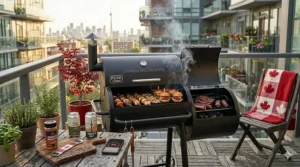
You’ve got a 3 metre by 2 metre balcony in a downtown Toronto condo, limited storage, and building rules against “excessive smoke.” The Z Grills ZPG-450A becomes your best friend. Its compact footprint fits balcony dimensions without overwhelming the space, while pellet fuel produces minimal visible smoke compared to charcoal—satisfying building management and neighbours. The 459 square inch capacity handles your weekend rib cooks for two comfortably.
Store a 20 lb pellet bag in a closet and you’re set for a month of regular use. The PID controller maintains temps reliably despite downtown wind tunnels created by surrounding buildings. Budget around $650 CAD total including a quality cover, upgraded meat probes, and a folding side table that provides prep space without permanent footprint. Your biggest challenge? Coordinating elevator access for delivery, not the unit’s performance.
The Suburban Calgary Family of Four
You’ve got proper backyard space, a dedicated patio area, and cook 3-4 times weekly from May through September, occasionally braving October/November cold. The Traeger Pro 22 offers the perfect balance between capacity and convenience. The 572 square inch cooking area handles family dinners with leftovers, plus those occasional neighbourhood gatherings when you’re grilling for 8-10 people.
The digital controls mean your teenagers can successfully cook while you’re working late, building their confidence and your meal rotation. Calgary’s dry climate works perfectly for pellet storage—keep 80 lbs in the garage and you’ll never run out mid-cook. The $900-$1,100 CAD investment includes a quality cover essential for Chinook wind protection and a pellet storage container. Your ROI comes from reduced restaurant spending when the family actually enjoys backyard meals.
The Rural Saskatchewan Weekend Warrior
You’ve got acres of space, frequently host extended family gatherings, and view weekend smoking as hobby time rather than meal prep convenience. The Pit Boss Lockhart Platinum justifies its $1,800 CAD premium through sheer versatility and capacity. The 2,000+ square inches mean you’re simultaneously smoking a whole brisket in the cabinet, grilling chicken on the lower section, and keeping sides warm on secondary racks.
The separate smoking cabinet enables true multi-zone cooking impossible on single-chamber designs. Cold-smoke salmon while hot-grilling steaks, or maintain overnight brisket temps in the cabinet while using the lower grill for lunch the next day. Your garage provides protected storage for the unit and 200 lbs of pellets bought in bulk during spring sales. The WiFi connectivity lets you monitor cooks from the house during -20°C January experiments, because you’re stubborn enough to BBQ year-round.
The Maritime Coastal Retiree
You’re cooking for two but enjoy the ritual and want equipment that survives harsh coastal weather. The Kamado Joe Classic II becomes a lifetime investment that appreciates with time. The ceramic construction ignores salt air that rusts steel units within 3-5 years, while thermal efficiency means you’re burning minimal charcoal during those foggy Nova Scotia afternoons when humidity approaches 90%.
The 406 square inch capacity perfectly matches your needs—two steaks, a chicken, or a small pork shoulder fit comfortably without the waste of heating a massive unit. The hands-on temperature control provides the engagement you want from retirement hobbies, plus develops a skillset distinct from your career background. Budget $1,600 CAD including essential accessories (heat deflector, extra grates, proper cover), knowing this unit will outlast you with basic care. Store lump charcoal in a waterproof deck box, and you’re set for authentic year-round smoking regardless of Atlantic weather.
Long-Term Cost Analysis: True Price of Ownership in CAD
Pellet Grill Running Costs
The typical Canadian pellet grill owner burns 0.45-0.9 kg of pellets hourly during smoking temps (107-149°C), scaling to 1.4-1.8 kg hourly when searing at max temps. Premium hardwood pellets cost $0.80-$1.20 per kg buying in 20 lb bags, dropping to $0.60-$0.80 per kg for 200 lb bulk purchases through Canadian Tire or Costco sales.
For a family cooking 3 smoking sessions monthly (6 hours average) plus weekly high-temp grilling (45 minutes average), your annual pellet costs range from $450-$720 CAD buying retail bags, or $340-$540 CAD buying bulk. Add electricity for the digital controller and igniter (roughly $15-$25 CAD annually), plus replacement hot rods every 2-3 years ($40-$60 CAD), and your five-year operating cost approaches $2,000-$3,100 CAD before considering the initial $600-$1,500 CAD purchase price.
Charcoal System Economics
Lump charcoal costs $1.40-$2.00 per kg in 7.3 kg bags, dropping to $1.00-$1.40 per kg for bulk purchases. Efficient ceramic kamados burn 1.8-2.7 kg per 6-hour smoking session, while less efficient offset steel smokers consume 3.6-5.4 kg for equivalent cooks. Budget an additional 20% for wood chunks added for smoke flavour.
A family smoking twice monthly and grilling weekly consumes 55-80 kg of lump charcoal annually in a Kamado, equaling $55-$112 CAD in fuel costs. Less efficient steel offsets push that to $120-$200 CAD annually. The dramatically lower operating costs offset higher initial purchase prices—a $1,400 Kamado Joe breaks even with a $600 pellet grill around year four when accounting for fuel spending differences.
Propane Dual-Fuel Economics
Propane combo units like Oklahoma Joe’s Canyon burn 0.36-0.45 kg hourly per burner at medium settings, with 9.1 kg tanks costing $25-$35 CAD for exchanges. Typical Canadian usage patterns (gas side for quick weeknight grilling, charcoal side for weekend smoking) consume 2-3 propane tanks plus 40-60 kg of charcoal annually, equaling $150-$225 CAD in combined fuel costs.
The dual-fuel flexibility provides cost optimization opportunities—use cheaper charcoal for long smoking sessions where fuel efficiency matters, switch to convenient propane when time-pressed. This hybrid approach often results in the lowest total fuel spending while maintaining maximum cooking versatility.
Maintenance and Replacement Parts
Factor $80-$150 CAD annually for maintenance: replacement grates every 3-5 years ($60-$120 CAD), gasket replacements ($20-$40 CAD every 2-3 years), covers needing replacement every 3-4 years with Canadian weather ($80-$150 CAD for quality versions), auger replacements on pellet grills ($80-$150 CAD every 3-5 years), and various small parts like thermometer probes, igniter rods, or burner tubes.
High-quality ceramic units minimize replacement costs—the ceramic shell itself lasts decades, with only gaskets needing periodic replacement. Cheap steel units rust through in 5-8 years of Canadian coastal or high-humidity exposure, essentially becoming disposable products. Premium stainless or powder-coated steel lasts 10-15 years with proper maintenance, justifying higher purchase prices through reduced replacement frequency.
❓ FAQ: 2-in-1 Grill Smoker Combos in Canada
❓ Can I use a pellet grill in winter in Canada?
❓ Which fuel type delivers the best smoke flavour—pellets, charcoal, or wood?
❓ Do 2-in-1 combos perform as well as dedicated smokers or grills?
❓ What cooking capacity do I actually need for a family of four?
❓ Are combo units available on Amazon.ca backed by Canadian warranties?
Conclusion: Finding Your Perfect Multi-Function BBQ Match
The Canadian 2-in-1 grill smoker combo market has matured dramatically over the past five years, delivering genuine versatility rather than compromised performance on both functions. Whether you’re drawn to the set-and-forget convenience of pellet systems like the Traeger Pro 22, the authentic smoke flavour of charcoal units like the Kamado Joe Classic II, or the maximum flexibility of dual-fuel designs like the Oklahoma Joe’s Canyon Combo, legitimate options exist across price points and cooking styles.
Your ideal versatile outdoor cooker depends on uniquely Canadian factors: Will this live on a Toronto condo balcony or a rural Alberta acreage? Are you cooking for two or hosting neighbourhood gatherings weekly? Do Calgary’s -20°C winters demand insulated pellet technology, or does Maritime humidity favour rust-resistant ceramic construction? Matching these realities to equipment capabilities prevents buyer’s remorse and ensures years of satisfying outdoor cooking.
The investment extends beyond initial purchase price. Factor Canadian fuel availability and costs, storage space requirements for pellets or charcoal, maintenance demands suited to your available time, and long-term durability against your specific climate challenges. A $600 CAD pellet grill consuming $600 annually in premium pellets costs more over five years than a $1,400 CAD ceramic kamado burning $100 annually in charcoal—perspective matters when evaluating value.
Start with the Budget Tier (Z Grills ZPG-450A at $550-$700 CAD or Oklahoma Joe’s Highland at $500-$650 CAD) if you’re new to smoking and uncertain about long-term commitment. Graduate to Mid-Premium options (Traeger Pro 22 at $900-$1,100 CAD or Oklahoma Joe’s Canyon Combo at $700-$900 CAD) when you’ve identified your preferred cooking style and capacity needs. Invest in Premium Excellence (Pit Boss Lockhart Platinum at $1,600-$1,900 CAD or Kamado Joe Classic II at $1,400-$1,700 CAD) once you’re certain this becomes a lifelong hobby rather than temporary interest.
The best space-saving outdoor cooking solution for most Canadian families? The Traeger Pro 22 strikes the optimal balance between ease of use, consistent performance across all four seasons, adequate capacity for typical use cases, and mid-range pricing that doesn’t require mortgage refinancing. But “best” remains subjective—your perfect combination grill and smoker depends on your unique Canadian circumstances, cooking priorities, and willingness to engage with the equipment actively versus passively. Whatever you choose, Canadian summers and shoulders seasons offer spectacular outdoor cooking weather that justifies the investment, while our winters test your dedication to becoming a true year-round pitmaster.
Recommended for You
- 7 Best Portable Smoker for Camping Canada 2026
- 7 Best Value Smokers Under $1000 CAD – Canada 2026 Guide
- 7 Best Smokers for Canadian Winter Conditions 2026
Disclaimer: This article contains affiliate links. As an Amazon Associate, I earn from qualifying purchases. If you purchase products through these links, we may earn a small commission at no additional cost to you.
✨ Found this helpful? Share it with your friends! 💬🤗
