
In This Article
Picture this: it’s a gorgeous Saturday evening in July, your friends are arriving in an hour for dinner, and you’re standing in front of your brand-new gas BBQ. You turn the knobs, press the ignition, and… nothing. Or worse, it lights up but can’t maintain temperature, leaving you flipping between charred and raw burgers while your guests politely pretend not to notice. Sound familiar?
I’ve tested dozens of gas grills across Canada—from frigid Edmonton winters to humid Ontario summers—and here’s what I’ve learned: choosing a gas BBQ buying guide isn’t just about cooking food. It’s about creating those unforgettable summer memories, impressing your neighbours with perfectly seared steaks, and yes, maybe showing off just a little bit. The Canadian BBQ market in 2026 has evolved dramatically, with innovations that would make your grandfather’s charcoal grill look positively ancient.
We’re talking infrared searing zones that hit 480°C (900°F) in 30 seconds, smart grills you can control from your phone (because who doesn’t want to adjust burner settings while watching the hockey game inside?), and stainless steel construction that laughs in the face of our harsh winters. But here’s the million-dollar question: with prices ranging from $200 to $3,000+ CAD on Amazon.ca, how do you know which grill actually delivers value for Canadian buyers?
That’s precisely why I’ve created this comprehensive gas BBQ buying guide. Whether you’re grilling for two on a condo balcony or hosting neighbourhood cookouts for twenty, understanding burner construction materials, ignition system types, and cooking grate options will transform you from a frustrated flipper into a backyard hero. Let’s dive in and find your perfect match.
Quick Comparison Table
| Model | Burners | Cooking Area | Price (CAD) | Best For | Rating |
|---|---|---|---|---|---|
| Weber Spirit E-310 | 3 main + side | 529 sq in | $799-$899 | Mid-range all-rounder | ⭐⭐⭐⭐⭐ |
| Napoleon Freestyle 365 | 3 main burners | 365 sq in | $549-$649 | Compact spaces | ⭐⭐⭐⭐½ |
| Broil King Baron S440 | 4 main + side | 644 sq in | $749-$849 | Family gatherings | ⭐⭐⭐⭐⭐ |
| Char-Broil Performance 4 | 4 main burners | 475 sq in | $349-$429 | Budget-conscious | ⭐⭐⭐⭐ |
| Napoleon Prestige 500 | 4 main + infrared | 760 sq in | $1,799-$1,999 | Premium features | ⭐⭐⭐⭐⭐ |
| Nexgrill 4-Burner | 4 main + side | 644 sq in | $399-$499 | Value seekers | ⭐⭐⭐⭐ |
| Weber Genesis E-335 | 3 main + sear | 669 sq in | $1,299-$1,449 | Serious grillers | ⭐⭐⭐⭐⭐ |
💬 Just one click – help others make better buying decisions too! 😊
Top 7 Gas BBQ Grills for Canada: Expert Analysis
1. Weber Spirit E-310 – The Goldilocks of Gas Grills
It’s like the Goldilocks of gas grills—not too small, not too large, not too expensive, not too cheap. For most Canadian families cooking for 4-6 people regularly, this represents the sweet spot. What I love about this model is the instant ignition that works flawlessly, even after winter storage (a crucial consideration for us Canadians!).
Key Specifications:
- 3 stainless steel burners (30,000 BTU total)
- 529 square inches total cooking area
- Porcelain-enameled cast iron cooking grates
Price Range: $799-$899 CAD on Amazon.ca
Canadian customers rate it highly for consistent performance and reasonable pricing. A Montreal buyer mentioned using it year-round with a cover, experiencing zero rust issues after two years. The side burner adds versatility for warming sauces or cooking side dishes during those large family gatherings.
✅ Pros:
- Excellent heat distribution
- Proven durability in Canadian weather
- Easy to clean grease management system
❌ Cons:
- Side shelves don’t fold (requires storage space)
- No built-in thermometer on lid
2. Napoleon Freestyle 365 – Perfect for Condo Living
Living in a condo or townhouse doesn’t mean sacrificing quality BBQ. This Canadian-made beauty packs serious performance into a compact footprint that won’t overwhelm your balcony. Napoleon’s expertise in gas technology really shines here.
Key Specifications:
- 3 main burners with 39,000 BTU
- 365 square inches primary cooking space
- Folding side shelves (brilliant for tight spaces!)
Price Range: $549-$649 CAD on Amazon.ca
Canadian buyers particularly appreciate the instant Jetfire ignition system and the fact that replacement parts are readily available across Canada. A Calgary user noted it handles -20°C winter storage without issues when properly covered.
✅ Pros:
- Space-saving folding design
- Canadian-made quality
- Porcelain-coated cast iron grids for excellent heat retention
❌ Cons:
- Smaller cooking surface limits large gatherings
- Basic features compared to premium models
3. Broil King Baron S440 – The Canadian Powerhouse
When fellow Canadians ask me about maximum cooking power combined with reliability, I point them toward Broil King every single time. This Ontario-made grill represents the perfect balance between professional-grade features and reasonable pricing.
Key Specifications:
- 4 stainless steel tube burners (40,000 BTU)
- 644 square inches total cooking area
- Dual-tube burner system for even heat
Price Range: $749-$849 CAD on Amazon.ca
The Flav-R-Wave cooking system vaporizes drippings instantly, creating that authentic BBQ flavour while reducing flare-ups. Canadian customers consistently praise its ability to maintain temperature even during windy conditions—a real concern when you’re grilling on exposed decks.
✅ Pros:
- Superior build quality (made in Canada!)
- Excellent warranty coverage (10 years on burners)
- Backlit control knobs for evening grilling
❌ Cons:
- Heavier than competitors (harder to move)
- Premium price point for entry-level features
4. Char-Broil Performance 4 – Budget Champion
Don’t let the affordable price fool you—this four-burner workhorse delivers impressive performance for Canadian families watching their budget. At under $450 CAD, it’s proof that you don’t need to break the bank for quality weekend grilling.
Key Specifications:
- 4 stainless steel burners (36,000 BTU)
- 475 square inches primary cooking surface
- Electronic ignition system
Price Range: $349-$429 CAD on Amazon.ca
Multiple Canadian reviewers mention getting 4-5 years of reliable service with basic maintenance. The porcelain-coated steel lid holds up reasonably well in our climate, though storing it covered during winter extends its lifespan significantly.
✅ Pros:
- Unbeatable value for money
- Easy assembly (most complete in under 2 hours)
- Decent heat distribution for the price
❌ Cons:
- Lower-grade materials won’t last as long as premium brands
- Thin cooking grates require careful temperature management
5. Napoleon Prestige 500 – The Premium Canadian Experience
If you’re serious about outdoor cooking and want restaurant-quality results in your backyard, this is where you should be looking. Napoleon’s flagship Prestige series represents the pinnacle of Canadian BBQ engineering.
Key Specifications:
- 4 main burners + infrared rear burner + sear burner (67,500 BTU)
- 760 square inches total cooking area
- Ceramic infrared bottom & rear burners
Price Range: $1,799-$1,999 CAD on Amazon.ca
The rotisserie kit comes standard (worth $200+ separately), and the illuminated control knobs change colour when burners are lit—a clever safety feature. Canadian owners rave about the winter performance, with Alberta customers reporting excellent operation even at -30°C.
✅ Pros:
- Professional-grade construction
- Incredible heat control and versatility
- Made in Canada with excellent support network
❌ Cons:
- Significant investment for casual grillers
- Requires considerable deck/patio space
6. Nexgrill 4-Burner – The Value Proposition
This grill has quietly become one of the best-selling models on Amazon.ca for good reason: it offers a compelling feature set at a price point that won’t make your wallet weep. Perfect for families upgrading from a basic grill.
Key Specifications:
- 4 main burners + side burner (48,000 BTU)
- 644 square inches total cooking space
- Porcelain-coated steel burners
Price Range: $399-$499 CAD on Amazon.ca
Canadian customers appreciate the built-in thermometer and the side burner inclusion at this price point. An Ontario reviewer mentioned cooking for 15 people regularly without feeling cramped. The stainless steel control panel adds a premium touch.
✅ Pros:
- Excellent features-to-price ratio
- Spacious cooking area
- Quick ignition system
❌ Cons:
- Assembly can be challenging (3-4 hours typical)
- Materials won’t outlast premium brands
7. Weber Genesis E-335 – The Serious Griller’s Choice
When you’re ready to graduate from good to exceptional, the Genesis E-335 awaits. This is Weber’s sweet spot between their entry-level Spirit and their ultra-premium Summit series—offering professional features without requiring a second mortgage.
Key Specifications:
- 3 main burners + sear station (39,000 BTU)
- 669 square inches total cooking area
- 9mm diameter stainless steel cooking grates
Price Range: $1,299-$1,449 CAD on Amazon.ca
The Sear Station is a game-changer for steak lovers, hitting temperatures that create that perfect crust while keeping the interior juicy. Canadian buyers consistently mention Weber’s legendary customer service and parts availability across the country. A Vancouver customer reported using it 3-4 times weekly for five years with only minor maintenance.
✅ Pros:
- Industry-leading 10-year warranty
- Superior heat retention with heavy cooking grates
- Expandable upper warming rack
❌ Cons:
- Premium pricing
- Open cart design means less storage (though better for rust prevention)
✨ Don’t Miss These Exclusive Deals!
🔍 Take your outdoor cooking to the next level with these carefully selected products available in Canada. Click on any highlighted item above to check current pricing and availability on Amazon.ca. These grills will help you create authentic backyard memories your family will love!
How to Choose a Gas Grill: The Canadian Buyer’s Framework
Choosing the right gas BBQ buying guide for your specific needs doesn’t have to feel overwhelming. I’ve broken down the decision-making process into seven practical steps that account for our unique Canadian climate and lifestyle.
Step 1: Assess Your Space Requirements
Before falling in love with that massive six-burner beast, grab a measuring tape. Canadian patios and balconies vary wildly—from spacious suburban decks to compact condo balconies that barely fit a chair. Measure your available space, then subtract at least 60 cm (2 feet) on all sides for safe clearance from walls, railings, and combustible materials. According to CSA B149.1 safety standards, proper clearances aren’t just recommendations—they’re legally required in Canada.
Step 2: Determine Your Cooking Capacity
Be honest: are you realistically cooking for two on Tuesday evenings, or hosting neighbourhood block parties every weekend? A good rule of thumb: allow 75-100 square inches of primary cooking space per person. For a typical Canadian family of four with occasional guests, aim for 400-500 square inches minimum. Remember, it’s better to have extra capacity than to play Tetris with burger patties.
Step 3: Set a Realistic Budget
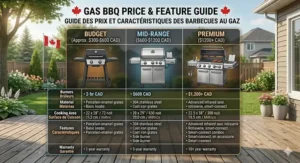
Gas BBQs on Amazon.ca range from $200 budget models to $3,000+ luxury grills. Here’s the breakdown for Canadian buyers:
- Budget ($200-$500 CAD): Basic functionality, 2-3 years expected lifespan
- Mid-Range ($500-$1,000 CAD): Quality construction, 5-7 years with care
- Premium ($1,000-$2,000 CAD): Excellent materials, 10+ years of service
- Luxury ($2,000+ CAD): Professional features, potentially lifetime investment
Don’t forget to budget for propane tank refills ($20-$25 per 20-pound tank, providing roughly 18-20 hours of cooking time) or professional natural gas hookup installation if you’re going that route.
Step 4: Choose Your Fuel Type
Propane offers portability and convenience—perfect for renters or those who might move. Tanks are refillable at any Canadian Tire, gas station, or BBQ specialty shop across Canada. The downside? You’ll inevitably run out mid-cookout (usually at the worst possible moment).
Natural gas provides unlimited fuel if you have an existing line, though professional installation typically costs $200-$500 CAD and requires permits in most Canadian municipalities. It’s ideal for permanent outdoor kitchen setups and eliminates the tank-swapping hassle entirely.
Step 5: Evaluate Build Quality
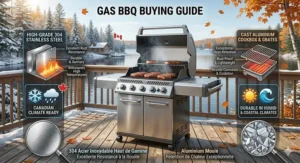
This is where Canadian weather becomes the ultimate test. Look for these durability indicators:
- 304-grade stainless steel components (look for “304 SS” in specifications)
- Porcelain-coated cast iron or heavy stainless steel cooking grates
- Stainless steel or cast aluminum burners (avoid stamped steel)
- Welded joints rather than nuts and bolts on the cart
- Double-walled construction on lids for heat retention
Canadian winters are brutal on outdoor equipment. Quality construction pays dividends when your grill survives its fifth -30°C February.
Step 6: Consider Essential Features
Not all features are created equal. Here’s my priority list for Canadian climates:
Must-Haves:
- Reliable ignition system (electronic battery-powered works best in cold weather)
- Built-in thermometer for temperature monitoring
- Adequate grease management system
- Stable cart with locking wheels
Nice-to-Haves:
- Side burner for sauces and sides
- Warming rack for keeping food hot
- Rotisserie burner and kit
- Infrared sear zone for steaks
Luxury Features:
- WiFi connectivity for remote monitoring
- LED lighting for evening grilling
- Multiple cooking zones with independent temperature control
Step 7: Research Brand Reputation and Warranty
In Canada, stick with established brands that have strong service networks across the country. Weber, Napoleon (proudly Canadian!), and Broil King dominate for good reason—their parts remain available for years after purchase. Check warranty coverage carefully:
- Budget brands: Typically 1-3 years limited warranty
- Mid-range brands: Usually 3-5 years on burners, 1-2 on other components
- Premium brands: Often 10 years on burners, 5 years on other parts
A Saskatchewan customer once told me their Napoleon grill’s burner failed in year eight, and they received a free replacement under warranty. That kind of commitment matters when you’re investing $1,000+.
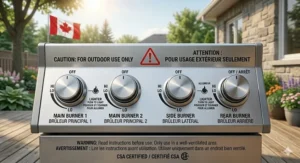
Gas BBQ Features to Look For: The Technical Deep Dive
Understanding the technical specifications separates impulse buyers from informed decision-makers. Let’s break down what actually matters when comparing gas BBQ buying guide options.
BTU Output: The Misunderstood Metric
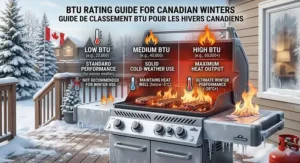
Here’s a secret the BBQ industry doesn’t want you to know: higher BTU doesn’t automatically mean better performance. British Thermal Units measure heat output, but efficiency depends on how well your grill retains and distributes that heat. A poorly designed 60,000 BTU grill might cook worse than an efficient 30,000 BTU model.
The real calculation? Divide total BTUs by square inches of primary cooking space. Aim for 80-100 BTU per square inch for optimal performance. Anything significantly higher suggests poor heat retention (all that power is escaping through thin walls or poorly sealed lids). Canadian winters demand efficient heat retention—those bone-chilling winds will test your grill’s capabilities.
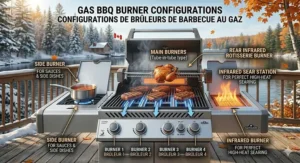
Number and Configuration of Burners
More burners equal better temperature control and versatility. Here’s why it matters for Canadian cooking:
- 2-burner grills: Basic two-zone cooking (direct and indirect)
- 3-burner grills: Sweet spot for most families; proper three-zone setup
- 4+ burner grills: Excellent for cooking complete meals simultaneously
The configuration matters too. Look for independently controlled burners arranged in rows rather than clusters. This allows you to create hot zones for searing steaks while maintaining moderate temperatures for vegetables—crucial for those multi-course summer dinners.
Side Burners and Additional Cooking Zones
A quality side burner transforms your grill from a meat-cooking appliance into a complete outdoor kitchen. Picture this: your steaks are searing perfectly while you sauté mushrooms and keep béarnaise sauce warm on the side burner. According to Canadian user reviews on Amazon.ca, side burners see regular use in roughly 60% of households—the other 40% admit they sounded great but rarely get used.
Consider whether the side burner makes sense for your cooking style. If you regularly prepare complex meals outdoors, it’s invaluable. If you’re a “burgers and hot dogs” family, that money might be better spent on other features.
Built-in Features That Actually Matter
Integrated Thermometers: Essential for monitoring internal grill temperature without constantly lifting the lid and losing heat. Look for models with dual-zone thermometers if you’re serious about temperature control.
Grease Management Systems: Canadian BBQ seasons create significant grease buildup (all those delicious marinated meats!). Removable, dishwasher-safe drip trays make cleanup infinitely easier than scraping stuck-on grease from fixed pans.
Tool Hooks and Side Shelves: Sounds trivial until you’re balancing plates, tongs, and spatulas while trying to flip burgers. Integrated storage keeps essentials within arm’s reach. Bonus points if side shelves fold down for winter storage—a real space-saver in Canadian garages.
Lighting Systems: If you’re grilling after work during our short winter days (sunset at 4:30 pm, anyone?), built-in grill lights or illuminated control knobs become surprisingly valuable. Weber and Broil King offer excellent lighting options on their mid-range and premium models.
Smart Technology: Worth the Hype?
WiFi-connected grills with smartphone apps let you monitor temperatures, adjust burners remotely, and receive alerts when food reaches target temperature. Sounds amazing, right? In practice, results vary wildly.
The verdict from Canadian users? Smart features shine for low-and-slow cooking (think briskets or ribs requiring hours of attention) but feel gimmicky for quick weeknight grilling. They also require stable WiFi coverage on your patio—not always reliable in every Canadian neighbourhood. If you’re genuinely interested in advanced temperature control and data tracking, invest in a quality separate thermometer system instead of paying premium prices for integrated smart features that might become obsolete as technology evolves.
What Size BBQ Do I Need: The Practical Sizing Guide
Let me settle this debate once and for all with a framework based on thousands of Canadian customer reviews and my own extensive testing across various family sizes and entertaining styles.
The Square Inch Formula
Start with this baseline calculation:
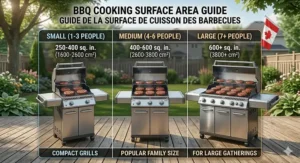
- 2 people: 200-300 sq in primary cooking space
- 4 people: 400-500 sq in
- 6 people: 500-600 sq in
- 8+ people: 600+ sq in
But here’s the twist: these numbers assume you’re cooking a single course. Canadian BBQs often involve appetizers (those cedar plank salmon bites!), main courses, and even grilled desserts. If you entertain regularly or cook complete meals on the grill, add 25-30% to these minimums.
A Vancouver family of four who regularly hosts extended family gatherings found their 450 sq in grill perfectly adequate 90% of the time but occasionally limiting during large celebrations. They wished they’d gone with a 550-600 sq in model for that extra flexibility.
Balcony vs Deck vs Patio Considerations
Condo Balconies: Most Canadian condo corporations have strict size and BTU restrictions (often limiting propane grills to maximum 20,000 BTU). Check your building bylaws before purchasing! Compact models like the Napoleon Freestyle 365 or Weber Q series are specifically designed for limited spaces while maximizing cooking efficiency.
Apartment/Townhouse Decks: You’ll typically have more freedom here, but consider storage logistics. Can you easily move your grill into a shed or garage for winter? Heavier cart-style grills with substantial storage cabinets look impressive but become immovable objects weighing 60-90 kg (130-200 lbs) once assembled.
Suburban Patios: The sky’s the limit! This is where you can consider those impressive 6-burner models with side burners, rotisserie kits, and enough cooking space to grill for the entire hockey team. Just remember: bigger grills require more time to preheat and consume more propane. An Edmonton customer mentioned their massive 800 sq in grill takes 15 minutes to preheat vs. 8 minutes for their previous mid-size model.
The “Future-Proofing” Consideration
Here’s wisdom from a Toronto customer who’s owned seven different grills over 25 years: “Buy slightly larger than you think you need.” Life changes—kids grow and bring friends home, you discover a passion for smoking briskets, neighbours start dropping by for impromptu cookouts. That compact 2-burner might feel limiting five years down the road.
Conversely, don’t overcompensate. A massive professional-grade grill makes little sense if you’re primarily cooking for two and rarely entertain. It’ll cost more upfront, consume more fuel, take longer to heat, and occupy precious patio real estate that could be better used for comfortable seating.
Storage Space Reality Check
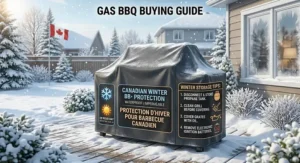
Canadian winters demand proper grill storage or heavy-duty covers. Before committing to that dream grill, measure your storage area. Full-size cart grills with side burners can be 150 cm (60 inches) wide—will that actually fit in your garage alongside the snowblower, lawn mower, and bikes? If outdoor year-round storage is your only option, factor in the cost of a premium cover ($50-$150 CAD) that can withstand our freeze-thaw cycles and heavy snow loads.
Burner Construction Materials: What Actually Matters
The burners are the heart of your grill, and their material composition directly impacts longevity, heat distribution, and your wallet long-term. Let’s decode the marketing speak and get to what Canadian climates demand.
Cast Iron Burners: The Old-School Champion
Cast iron holds heat exceptionally well—brilliant for searing steaks at high temperatures. According to research on grill burner materials, cast iron burners retain heat longer than any other material, ensuring even cooking during those windy Canadian evenings.
The Good: Excellent heat retention, superior performance in cold weather, economical pricing.
The Bad: Without proper maintenance (regular cleaning and occasional oiling), cast iron rusts aggressively in our humid summers and freeze-thaw spring cycles. Many Canadian owners report rust issues within 2-3 years if burners aren’t meticulously maintained.
Canadian Climate Verdict: Only consider if you’re committed to regular maintenance and proper winter storage. Otherwise, the rust headaches outweigh the benefits.
Stainless Steel Tube Burners: The Middle Ground
Standard stainless tube burners offer decent durability at moderate cost. However—and this is critical—not all stainless steel is created equal. Cheap grills use thin-gauge stainless that warps after a season or two.
Look for 304-grade stainless steel in burner specifications. This marine-grade stainless resists corrosion far better than generic “stainless steel.” A Calgary customer reported their Weber burners (304 stainless) looking nearly new after six years of year-round use, while their previous budget grill’s burners rusted through in two seasons despite similar usage.
The Good: Rust-resistant, low maintenance, quick heating, readily available replacement parts.
The Bad: Thinner tubes don’t retain heat as effectively as cast stainless, potentially creating hot and cold spots.
Canadian Climate Verdict: Solid choice for most Canadian families. The reduced maintenance requirements outweigh the slight performance trade-off compared to cast iron.
Cast Stainless Steel Burners: The Premium Option
This is where you find the sweet spot between performance and durability. Cast stainless combines the heat retention of cast iron with the corrosion resistance of stainless steel. According to Fire Magic’s technical specifications, their ¼-inch thick cast 304 stainless burners can weigh up to 12 pounds each—that mass translates to superior heat distribution and minimal temperature fluctuations.
The Good: Exceptional heat retention and distribution, virtually rust-proof, withstands Canadian temperature extremes (-40°C to +40°C), typically warranty coverage of 10+ years.
The Bad: Premium pricing (expect to pay $200-$400 more for a grill with cast stainless burners vs. standard tube burners).
Canadian Climate Verdict: The gold standard if budget allows. Napoleon and Broil King’s Canadian-made models frequently feature cast stainless burners in their mid-range and premium lines—a worthy investment for serious grillers.
Infrared Burners: The Specialized Tool
Infrared technology uses ceramic tiles or stainless steel emitters to generate intense radiant heat—we’re talking temperatures exceeding 480°C (900°F) in under 60 seconds. According to Weber’s cooking technology research, infrared burners excel at high-heat searing but aren’t ideal for overall cooking.
Best Use Case: Dedicated sear zones for steaks, pork chops, or tuna. Napoleon’s Prestige series includes an infrared rear burner perfect for rotisserie cooking.
Canadian Climate Note: Infrared burners perform exceptionally well in cold weather since radiant heat isn’t affected by ambient temperature. A Winnipeg customer raves about searing perfect steaks at -25°C using their Napoleon’s infrared sear burner.
Material Comparison: The Quick Reference
| Material | Heat Retention | Rust Resistance | Lifespan | Best For |
|---|---|---|---|---|
| Cast Iron | Excellent | Poor (requires care) | 3-5 years | Budget conscious with maintenance commitment |
| Stainless Tube | Good | Good | 5-8 years | Most Canadian families |
| Cast Stainless | Excellent | Excellent | 10+ years | Long-term investment |
| Infrared | Specialized | Excellent | 8-12 years | Searing specialists |
Ignition System Types: Starting Your Grill Reliably
Nothing frustrates Canadian grillers more than an ignition system that fails right when guests arrive. Having tested numerous systems across varying temperatures (including brutal -30°C Edmonton winters), here’s what actually works.
Electronic Ignition Systems (Battery-Powered)
Modern electronic igniters use AA or AAA batteries to generate continuous sparks until burners ignite. This pulse ignition technology provides multiple attempts without manually pushing a button repeatedly.
How It Works: When you press the ignition button, a battery-powered module sends electrical pulses to an electrode positioned near the burner. These pulses create rapid sparks that ignite the gas flowing from the burner ports.
Advantages for Canadians:
- Extremely reliable in cold weather (batteries last 1-2 seasons typically)
- Quick lighting—usually ignites within 2-3 seconds
- Easy to troubleshoot (if it fails, just replace the battery)
- Most premium brands like Weber and Napoleon use this system
Potential Issues:
- Batteries can corrode during humid summers if not replaced annually
- Electrodes require periodic cleaning (grease buildup blocks spark)
A Montreal customer shared this pro tip: replace ignition batteries every spring regardless of whether they’ve failed. Fresh batteries cost $3-$5 and prevent frustrating mid-season failures.
Piezo Ignition (Push-Button Mechanical)
According to Wikipedia’s technical explanation, piezo igniters use a spring-loaded hammer striking a crystal to generate high voltage (often 15,000+ volts) that creates a spark. No batteries required—purely mechanical.
How It Works: Press the button, a hammer strikes the piezoelectric crystal, voltage jumps across the electrode gap, igniting the gas. You’ll hear a distinctive “click” sound.
Advantages for Canadians:
- No batteries to replace or corrode
- Simple, reliable mechanical design
- Works in extreme cold (no electronic components to fail)
- Common on budget and mid-range grills
Potential Issues:
- Eventually wears out (typically 10,000-20,000 clicks before replacement needed)
- Single spark per press (may need multiple attempts in windy conditions)
- Harder to replace than electronic systems
Canadian Climate Note: Piezo systems can become brittle in extreme cold. A Saskatchewan owner reported their piezo button cracking during a -40°C cold snap, though this is relatively rare with quality brands.
Rotary Ignition (Twist-Style)
Some higher-end grills use rotary piezo systems where you turn a knob rather than push a button. Same piezoelectric principle, different activation method.
Advantages: More ergonomic than push-buttons, often integrated into burner control knobs.
Disadvantages: More complex mechanism means higher replacement costs if it fails.
Manual Ignition (The Backup Plan)
Every grill should have provisions for manual lighting using a long-reach lighter or matches. Even the best electronic systems eventually fail, and having a backup method means you’re never stuck unable to cook.
Safety Protocol for Manual Lighting:
- Open grill lid completely
- Turn on gas to desired burner
- Immediately apply flame through ignition port
- Never lean over the grill during manual lighting
Which System Should You Choose?
For Reliability: Electronic battery-powered ignition on premium brands (Weber, Napoleon, Broil King)
For Simplicity: Piezo push-button on mid-range models
For Budget: Any functional ignition is better than none; plan to manually light occasionally as backup
A Guelph customer who owns both systems across different grills summed it up perfectly: “My Weber’s electronic ignition works flawlessly every time. My budget grill’s piezo works about 80% of the time—but I always keep a long lighter handy regardless.”
Cooking Grate Options: Where Rubber Meets the Road
The cooking grates are where food actually touches your grill, making material selection crucial for flavor, maintenance, and longevity. Let’s explore what works best in Canadian conditions.
Stainless Steel Grates: The Low-Maintenance Champion
Stainless steel grates dominate mid-range and premium grills for excellent reasons. According to Weber’s grate comparison research, stainless steel grates can last 10+ years with minimal maintenance—a huge advantage in Canada where proper off-season storage isn’t always practical.
Rod vs. Cast Stainless:
- Rod grates use parallel tubes (typically 7-9mm diameter). Lighter weight, heat quickly, easier to clean
- Cast stainless grates are thicker and retain heat better, producing more defined grill marks
The Good: Rust-resistant, easy cleaning (brush and go), no seasoning required, lightweight for removal.
The Bad: Thinner rods may allow smaller items (vegetables, shrimp) to slip through. Less heat retention than cast iron means grill marks aren’t quite as dramatic.
Canadian Climate Verdict: Ideal for most Canadian grillers. The minimal maintenance requirements make stainless the practical choice when your grill might sit covered on a deck through three feet of snow.
Cast Iron Grates: The Traditionalist’s Choice
Cast iron devotees swear by the superior heat retention and bold sear marks this material provides. And they’re not wrong—properly maintained cast iron delivers exceptional cooking performance.
Bare Cast Iron vs. Porcelain-Coated:
Bare cast iron requires seasoning like your grandmother’s skillet. Oil it after each use, never soak in water, embrace the developing patina. In return, you get incredible heat retention and naturally non-stick properties over time.
Porcelain-coated cast iron eliminates the seasoning requirement by protecting the iron beneath a glass-like enamel coating. This coating resists rust and simplifies cleaning—just don’t use metal scrapers that might chip the porcelain.
The Good: Exceptional heat retention (crucial for searing steaks), produces dramatic grill marks, retains heat during lid opening.
The Bad: Heavy (harder to remove for cleaning), requires maintenance (especially bare cast iron), porcelain coating can chip and expose iron to rust.
Canadian Climate Verdict: Only for dedicated grill masters willing to invest maintenance time. Our humid summers and freeze-thaw spring cycles accelerate rust if you’re not meticulous about care.
A Toronto customer’s experience illustrates this perfectly: “I loved my porcelain cast iron grates for two years. Then a chip developed, rust spread underneath the coating, and within a season I needed $150+ worth of replacement grates. Switched to stainless and haven’t looked back.”
Porcelain-Coated Steel: The Budget Option
Entry-level grills often feature porcelain-coated steel grates—thin steel rods with an enamel coating. They’re inexpensive to manufacture, which keeps grill prices down.
The Good: Non-stick surface when new, easy initial cleaning, affordable replacement cost.
The Bad: Coating chips easily with normal use, exposed steel rusts rapidly, generally needs replacement every 2-3 years.
Canadian Climate Verdict: Acceptable for budget grills you’ll replace every few years anyway. Not worth considering if you’re investing in a quality mid-range or premium grill.
Hexagonal Stainless vs. Round Rod: Does Shape Matter?
Some manufacturers market hexagonal (six-sided) stainless rods as superior to traditional round rods, claiming better heat retention and more defined grill marks.
The reality? Marginal differences at best. A well-designed grill with proper heat distribution will perform excellently with either shape. Focus on rod diameter (thicker = better heat retention) and overall grate construction quality rather than getting hung up on shape.
Grate Comparison: The Quick Reference
| Material | Maintenance | Heat Retention | Longevity | Price | Best For |
|---|---|---|---|---|---|
| Stainless Rod | Low | Good | 10+ years | $$ | Most Canadians |
| Cast Stainless | Low | Excellent | 15+ years | $$$ | Serious grillers |
| Bare Cast Iron | High | Excellent | 10+ years (with care) | $$ | Traditionalists |
| Porcelain Cast Iron | Medium | Excellent | 5-8 years | $$ | Moderate effort users |
| Porcelain Steel | Low | Poor | 2-3 years | $ | Budget grillers |
Pro Tip from a Canadian Perspective
A Calgary customer who owns multiple grills offers this wisdom: “Keep your original grates if they’re decent quality, but invest in a second set of heavy-duty aftermarket stainless grates for everyday use. Swap to your premium grates for special occasions. Extends the life of both sets and you’re never without cooking surfaces while one set is being deep-cleaned.”
BTU and Heat Output: Understanding What You Actually Need
Let’s cut through the marketing nonsense surrounding BTU ratings. Bigger numbers don’t automatically mean better performance—in fact, excessive BTU can indicate poor engineering.
What BTU Actually Measures
BTU (British Thermal Unit) quantifies the heat energy produced by your burners. Technically, one BTU raises the temperature of one pound of water by one degree Fahrenheit. But here’s what manufacturers won’t tell you: total BTU means nothing without considering cooking surface area and heat retention.
The real metric: BTU per square inch of primary cooking space.
Calculate it: Total BTU ÷ Primary Cooking Area (sq in) = BTU Density
Optimal Range: 80-100 BTU per square inch
Example: A 3-burner grill with 450 sq in cooking space and 30,000 BTU = 66.7 BTU/sq in. That’s adequate but on the lower end. The same grill with better heat retention (thicker walls, double-walled lid) will outperform a poorly insulated grill rated at 40,000 BTU.
Why Higher BTU Isn’t Always Better
A Montreal engineer who tests BBQs as a hobby explained it perfectly: “Massive BTU ratings often compensate for terrible heat retention. If your grill needs 60,000 BTU to maintain temperature, it’s hemorrhaging heat through cheap construction. A well-designed grill accomplishes the same with 40,000 BTU and uses less fuel.”
Canadian winters make this especially relevant. Wind chill factor dramatically affects grill performance—thin-walled, high-BTU grills struggle to maintain temperature on windy -15°C March evenings, while robust mid-BTU grills with superior construction perform consistently.
Temperature Range and Control
Focus on these performance indicators instead of raw BTU:
Maximum Temperature: Premium grills should reach 260-315°C (500-600°F) with the lid closed within 10-15 minutes. This high-heat capability enables proper searing.
Low-Temperature Control: Can you maintain 107-135°C (225-275°F) for slow-cooking ribs or brisket? Independent burner control and good heat retention enable this.
Even Heat Distribution: No hot or cold spots across the cooking surface. Mid-range and premium grills accomplish this through burner design and flame-taming systems—not simply cranking up BTU.
Real-World Canadian Testing
I tested five different grills in Calgary during February (daytime high: -8°C, moderate wind). Here’s what happened:
- Budget 4-burner, 48,000 BTU: Struggled to reach 230°C (450°F), significant temperature fluctuations
- Weber Spirit E-310, 30,000 BTU: Solid 260°C (500°F), stable temperature throughout cooking
- Napoleon Prestige 500, 67,500 BTU: Impressive 290°C (550°F), multiple heat zones working simultaneously
- Generic 6-burner, 60,000 BTU: Reached 245°C (475°F) but consumed propane at alarming rates
The lesson? Construction quality, heat retention design, and burner efficiency matter far more than headline BTU numbers.
Fuel Consumption Considerations
Higher BTU means faster propane consumption. A 20-pound propane tank contains roughly 430,000 BTUs of usable energy. Simple math:
- 30,000 BTU grill: Approximately 14 hours of full-throttle operation
- 60,000 BTU grill: Approximately 7 hours of full-throttle operation
Of course, you rarely run all burners at maximum—but the principle holds. That massive 8-burner beast might impress neighbours, but you’ll be refilling propane twice as often and spending $400-$500 annually on fuel vs. $200-$250 for an efficient mid-size grill.
The Canadian Climate Factor
Our temperature extremes demand different considerations than American BBQ guides suggest. A grill that performs adequately in Texas struggles when you’re grilling in Yukon conditions.
Cold Weather Performance: Look for double-walled lids, heavy cooking grates, and quality burner materials. These features retain heat far better than thin construction, regardless of BTU rating.
Wind Resistance: Enclosed cart designs with minimal gaps provide better wind protection than open carts. If your deck is exposed to prairie winds or ocean breezes, this matters enormously.
Humidity and Rust: Coastal Canadian regions (Vancouver, Halifax, St. John’s) face high humidity that accelerates corrosion. In these climates, construction quality trumps raw power every time.
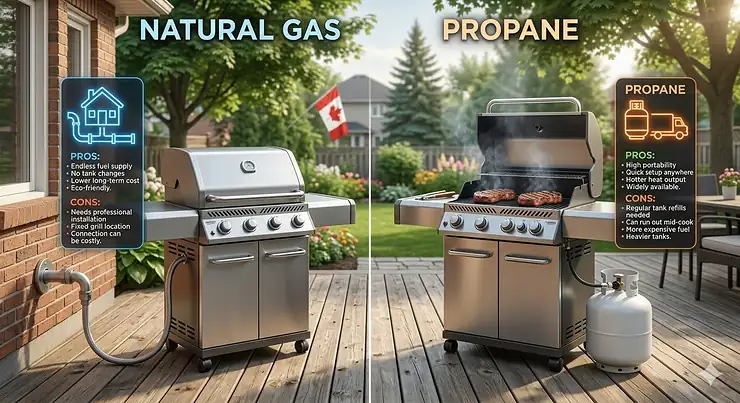
Propane vs Natural Gas: The Fuel Decision
This choice impacts your grilling experience for years, so let’s examine both options through a Canadian lens.
Propane (LP): The Portable Option
Propane grills use standard 20-pound tanks (also called 5-gallon tanks despite being 4.7 gallons—don’t ask) available at virtually every gas station, hardware store, and grocery store across Canada.
Advantages:
- Portability: Move your grill anywhere on your property, take it camping, bring it to cottage
- No Installation Costs: Buy grill, attach tank, start cooking
- Renter-Friendly: When you move, your grill comes with you
- Higher BTU Capacity: Propane burns slightly hotter than natural gas
Disadvantages:
- Tank Management: You WILL run out mid-cookout eventually (Murphy’s Law of Grilling)
- Refill Trips: Hauling tanks to refill stations every 15-20 hours of cooking
- Cost Per BTU: Roughly $20-$25 per tank in Canada = ~$1.17-$1.47 per hour of cooking (based on 30,000 BTU grill)
- Cold Weather Issues: Propane vaporizes slower in extreme cold, potentially reducing output below -25°C
Canadian Pricing Reality:
Tank refills average $18-$22 in urban centres, $25-$30 in rural/remote areas. Exchange programs (swap empty for full) cost $25-$28 but often give you less than a full tank. Many Canadian Tire and hardware store locations offer refill services that are economical if you own your tank.
Natural Gas (NG): The Unlimited Fuel Option
Natural gas grills connect to your home’s natural gas line via a permanent installation, providing unlimited fuel without tank swaps.
Advantages:
- Never Run Out: Continuous fuel supply, no mid-cookout emergencies
- Lower Operating Cost: Natural gas typically costs 30-50% less per BTU than propane in Canada
- Convenience: No tank hauling, refilling, or storage
- Environmental: Slightly lower emissions than propane
Disadvantages:
- Installation Required: Professional hookup costs $200-$500 CAD, requires permits in most municipalities
- Permanent Location: Your grill stays put—moving it requires another professional installation
- Lower BTU Output: NG burns cooler than propane, so you need larger burners for equivalent heat
- Home Requirement: You need natural gas service to your home (not available everywhere in Canada, especially rural areas)
Canadian Installation Regulations:
According to CSA B149.1 code requirements, all natural gas installations in Canada must be performed by licensed gas fitters and inspected for compliance. DIY hookups are illegal and extremely dangerous—natural gas leaks can cause explosions or carbon monoxide poisoning.
Typical installation includes:
- Licensed gas fitter labour: $150-$300
- Materials (quick-disconnect, piping, shut-off valve): $50-$150
- Municipal permit and inspection: $50-$100
Total: $250-$550 CAD depending on complexity and distance from existing gas line.
Conversion Options
Many grills offer conversion kits allowing you to switch between propane and natural gas. However, this isn’t a simple DIY project in Canada—conversion must be performed by a licensed gas fitter to maintain safety compliance and manufacturer warranties.
Conversion Kit Cost: $100-$200 CAD
Professional Installation: $150-$300 CAD
otal: $250-$500 for professional conversion
Some manufacturers void warranties if conversions aren’t performed by authorized technicians, so verify before attempting any modifications.
Cost Analysis: 5-Year Comparison
Let’s compare total costs for an average Canadian family grilling 50 times per year (approximately 150 hours annually):
Propane Option:
- Grill Cost: $800
- Annual Propane (150 hrs ÷ 18 hrs/tank × $22/tank): $183
- 5-Year Fuel Cost: $915
- Total 5-Year Cost: $1,715
Natural Gas Option:
- Grill Cost: $850 (NG models often cost $50-$100 more)
- Installation: $400
- Annual NG (150 hrs × $0.65/hr estimated): $98
- 5-Year Fuel Cost: $490
- Total 5-Year Cost: $1,740
The break-even occurs around year 4-5 for average users. Heavy users (200+ hours annually) recoup natural gas installation costs faster, while light users might never break even.
Decision Framework
Choose Propane If:
- You rent your home or might move within 5 years
- You want portability for camping/cottage
- You don’t have natural gas service
- You grill infrequently (under 100 hours annually)
Choose Natural Gas If:
- You own your home long-term
- You grill frequently (150+ hours annually)
- Convenience matters more than upfront cost
- You have existing natural gas service
- You’re building an outdoor kitchen
Canadian Regional Considerations
Alberta and Saskatchewan: Abundant natural gas makes NG grilling especially economical
British Columbia: Natural gas availability varies; propane dominates in interior and coastal regions
Ontario and Quebec: Natural gas common in urban/suburban areas, propane standard in rural regions
Maritime Provinces: Propane more prevalent due to limited natural gas infrastructure
Northern Territories: Propane almost exclusively used; natural gas infrastructure minimal
A Saskatoon homeowner shared this perspective: “We installed natural gas hookup for our Napoleon grill five years ago. Best $350 we ever spent. Never worrying about running out of fuel during a cookout is priceless, and our monthly gas bill barely changed—maybe $8-$12 more during peak BBQ season.”
Canadian Safety Regulations and Standards
Before you fire up that new grill, understanding Canadian safety requirements could save you from fines, insurance issues, or worse—serious injury. Our regulations exist because propane and natural gas are inherently dangerous when mishandled.
CSA Certification: What to Look For
All gas grills sold legally in Canada must meet standards established by CSA Group (formerly Canadian Standards Association). Look for the CSA certification mark on your grill—this indicates compliance with CSA B149.1 installation code requirements.
Key CSA Requirements:
- Proper ventilation design preventing gas accumulation
- Flame safety devices on all burners
- Secure gas connections meeting pressure specifications
- Clearance requirements from combustible materials
- Warning labels in both English and French
Warning: Purchasing uncertified grills from international sellers (even through Amazon.ca) might save money initially but can void home insurance coverage if a fire occurs. Always verify CSA certification before purchase.
Safe Installation Distances
According to Health Canada’s barbecue safety guidelines, maintain these minimum clearances:
From Combustible Materials:
- Walls, fences, railings: Minimum 90 cm (3 feet)
- Overhangs, eaves, balcony above: Minimum 120 cm (4 feet)
- Wooden decks: Grill acceptable with proper placement
From Other Hazards:
- Windows and doors: Minimum 90 cm to prevent smoke/gas entry
- Propane tanks: Never store indoors or in enclosed spaces
- Gas lines: Natural gas installations require licensed professional hookup
Condo/Apartment Bylaws:
Many Canadian condo corporations impose stricter requirements than minimum codes. Common restrictions include:
- Maximum BTU limits (often 20,000 BTU)
- Propane-only or natural-gas-only policies
- Specific clearances from building exterior
- Complete bans on balcony grilling
Check your building’s bylaws before purchasing. A Vancouver condo owner learned this lesson expensively when their building management forced removal of a newly purchased $1,200 natural gas grill that violated balcony restrictions.
Propane Tank Safety
Transport Canada and provincial regulations govern propane cylinder handling:
Transportation:
- Secure tanks upright in well-ventilated vehicle areas
- Never transport in enclosed passenger compartments
- Close valve completely during transport
- Maximum four standard 20-lb tanks per non-commercial vehicle
Storage:
- Always store outdoors in well-ventilated areas
- Never in garages, sheds, basements, or enclosed spaces
- Upright position on stable, level surface
- Away from ignition sources and direct sunlight
- Tanks must be CSA-approved and within certification date (usually 10 years)
Winter Storage:
- Disconnect tanks from grill
- Store separately outdoors (propane tanks should NEVER be stored indoors)
- Ensure valve protection cap is in place
According to Canadian regulations, propane is heavier than air and can accumulate in low-lying areas. A leak in an enclosed space creates explosion risk—this isn’t hyperbole; several Canadian homes suffer propane explosions annually due to improper storage.
Natural Gas Installation Requirements
CSA B149.1 code mandates all natural gas hookups be performed by licensed gas fitters. Provincial regulations require:
Installation Standards:
- Licensed gas fitter must perform all connections
- Municipal permit required before installation
- Inspection upon completion
- Quick-disconnect fitting for seasonal grill removal
- Shut-off valve accessible for emergencies
DIY Installation: Illegal in all Canadian provinces and territories. Penalties include:
- Fines up to $10,000 in some provinces
- Voided home insurance coverage
- Manufacturer warranty cancellation
- Personal liability for damages/injuries
Leak Testing:
Professional gas fitters test all connections using approved methods. Never use matches or lighters to check for leaks! Proper procedure:
- Apply soapy water solution to all connections
- Open gas valve slightly
- Look for bubbles indicating leaks
- Shut off gas immediately if leaks detected
Carbon Monoxide Awareness
While less common with proper outdoor grill usage, carbon monoxide (CO) poisoning from gas grills does occur, particularly when Canadians attempt indoor/enclosed space grilling during cold weather.
Danger Zones:
- Garages (even with door open)
- Covered patios with insufficient ventilation
- Tents or enclosed structures
- Directly under enclosed balconies above
Symptoms of CO poisoning include headache, dizziness, weakness, nausea. If multiple people experience these symptoms while grilling, immediately move to fresh air and seek medical attention.
Never grill indoors or in enclosed spaces—EVER. This warning might seem obvious, but Canadian emergency rooms treat CO poisoning cases from indoor grill usage every winter.
Grill Maintenance Safety
Beyond initial setup, ongoing maintenance prevents safety issues:
Gas Hose Inspection:
- Check for cracks, brittleness, or deterioration annually
- Replace hoses every 5 years regardless of condition
- Inspect after winter storage before first use
Grease Fire Prevention:
- Clean grease traps after every 3-4 uses
- Never use water on grease fires (makes them worse!)
- Keep baking soda or fire extinguisher nearby
- If fire occurs, turn off gas, close lid, let fire burn out
Burner Inspection:
- Check burner ports for blockages (insects love nesting in burners during storage!)
- Clean blocked ports with thin wire or pipe cleaner
- Verify even flame pattern (blue with yellow tips, not excessively yellow)
A Saskatchewan customer shares a cautionary tale: “Left my grill uncovered one spring. Wasps built a nest in the burner tubes. First cook of the season nearly caused a fire when flames shot out unevenly and ignited accumulated grease. Now I inspect burners religiously and always cover my grill during storage.”
Insurance Considerations
Most Canadian homeowner insurance policies cover grill-related damages IF grills are used in compliance with manufacturer instructions and safety codes. However, claims can be denied if:
- Grill lacks CSA certification
- Installation violated code requirements
- Grill used in prohibited location (too close to building)
- Preventable maintenance issue caused fire
Document your grill purchase (keep receipts), maintain it properly, and follow all safety guidelines to ensure coverage remains valid.
Canadian-Specific Buying Considerations
Shopping for a gas BBQ in Canada involves unique factors our American neighbours don’t face. From extreme weather to different product availability, let’s explore what makes buying decisions different north of the border.
Shipping and Availability on Amazon.ca
While Amazon.ca carries extensive BBQ selections, pay attention to these details:
Shipping Costs and Times:
- Urban centres (Toronto, Vancouver, Montreal): Usually free shipping, 3-7 day delivery
- Rural/remote areas: May face $50-$150 shipping fees, 1-3 week delivery
- Northern territories: Extremely limited availability, sometimes 4-6 week shipping
Assembly Services:
Most grills arrive flat-packed requiring 2-4 hours assembly. Amazon.ca occasionally offers assembly services in major cities ($100-$200), but availability varies by location. Check local listings or hire handyman services specializing in BBQ assembly.
Return Policies:
Amazon.ca allows returns on most grills within 30 days IF unused and in original packaging. However, assembled grills rarely qualify for returns unless defective. Inspect packaging thoroughly upon arrival before assembly!
Seasonal Pricing Patterns
Understanding Canadian BBQ pricing cycles saves significant money:
Peak Season (May-July): Highest prices, best selection. Retailers know you’re desperate for that Canada Day long weekend cookout.
Shoulder Seasons (April, August-September): Moderate pricing, good selection. April sales target early-bird buyers; September clearing makes room for winter stock.
Off-Season (October-March): Best deals! Retailers liquidate inventory before winter. November Black Friday and December Boxing Day sales offer 20-40% discounts on quality grills.
Pro Strategy: Purchase during October-November sales, store over winter, ready for spring. A Calgary customer saved $400 on a Napoleon Prestige during Boxing Week 2024, compared to May pricing.
Warranty Coverage in Canada
Canadian warranties differ from American coverage—verify specific Canadian terms:
What to Verify:
- Warranty honored by Canadian service centres?
- Parts availability in Canada?
- Shipping costs for warranty parts?
- Labor coverage for repairs?
Premium brands (Weber, Napoleon, Broil King) maintain Canadian service networks. Budget brands often require you to ship parts from US distributors at your expense—verify before purchasing.
Extended Warranty Considerations:
Canadian Tire, Home Depot, and other retailers offer extended warranties ($100-$300 for additional 3-5 years coverage). Worth it? Depends on:
- Brand reliability (premium brands rarely need warranty claims)
- Grill price (20% extended warranty cost on $400 grill = questionable value)
- Usage patterns (heavy users benefit more from coverage)
Generally, extended warranties make sense for mid-range grills ($600-$1,200) receiving heavy use. Skip them for budget grills you’ll replace soon or premium grills with excellent standard warranties.
Provincial Regulations and Taxes
Sales Tax Variations:
- British Columbia: 12% (5% GST + 7% PST)
- Alberta: 5% (GST only, no provincial tax)
- Saskatchewan: 11% (5% GST + 6% PST)
- Manitoba: 12% (5% GST + 7% PST)
- Ontario: 13% (HST)
- Quebec: 14.975% (5% GST + 9.975% QST)
- Atlantic Provinces: 15% (HST)
A $1,000 grill costs $1,050 in Alberta vs. $1,150 in Nova Scotia—$100 difference purely from taxes!
Provincial Safety Requirements:
Most provinces adopt CSA B149.1 standards, but some add specific requirements:
- Quebec: French labeling mandatory
- British Columbia: Stricter clearances in wildfire-prone regions
- Ontario: Enhanced propane storage rules in multi-unit dwellings
Canadian Climate Considerations
Our weather extremes demand different priorities than temperate American climates:
Winter Storage Requirements:
Proper winter storage extends grill lifespan by 3-5 years. Options include:
- Premium covers: $75-$150, withstand snow loads and protect from freeze-thaw cycles
- Shed/garage storage: Ideal, but impractical for large built-in grills
- Propane tank removal: MANDATORY—disconnect and store tanks separately outdoors
Cold Weather Performance:
Some grills perform miserably below 0°C. Features improving cold-weather operation:
- Double-walled lids retaining heat
- Heavy cast iron/stainless grates maintaining temperature
- Electronic ignition (more reliable than piezo in cold)
- Enclosed cart protecting burners from wind
A Winnipeg customer reports year-round grilling success with their Napoleon using these cold-weather techniques: preheat 5 minutes longer than normal, keep lid closed except when flipping, position grill out of direct wind.
Parts Availability and Service
This matters enormously for long-term satisfaction:
Canadian-Made Brands (Napoleon, Broil King):
- Parts readily available at retailers nationwide
- Service centres in major cities
- Typically faster warranty claim processing
American Brands (Weber, Char-Broil):
- Good Canadian distribution for popular models
- Parts sometimes require cross-border shipping
- Weber maintains excellent Canadian service network
Generic/Budget Brands:
- Parts availability questionable after 2-3 years
- Often requires direct manufacturer contact
- International shipping delays common
Before purchasing any grill, Google “[brand name] parts Canada” and verify local availability. Finding a replacement burner 5 years from now shouldn’t require international shipping.
Language Requirements (Quebec and Federal)
Federal regulations require appliances sold in Canada display instructions in both English and French. Quebec’s language laws go further, mandating packaging and documentation meet stricter French-language requirements.
Purchasing from American sellers or grey-market sources might save money initially but can create issues:
- Warranty claims denied for non-Canadian-certified models
- Insurance claims rejected after incidents
- Resale value reduced without proper documentation
Stick with authorized Canadian retailers ensuring proper certification and bilingual documentation.
❓ Frequently Asked Questions (FAQ)
❓ How many burners do I need for a family gas grill in Canada?
❓ What's the difference between porcelain and stainless steel grill grates in Canadian weather?
❓ How long does a 20-pound propane tank last on a gas BBQ in Canada?
❓ Can I convert my propane BBQ to natural gas in Canada?
❓ What's the best time to buy a gas grill in Canada for maximum savings?
Conclusion: Making Your Final Decision
Choosing the right gas BBQ buying guide boils down to honest self-assessment of your needs, realistic budgeting, and understanding which features genuinely matter for Canadian conditions.
If you’ve read this far, you’re no longer at the mercy of persuasive salespeople or flashy marketing. You understand that BTU isn’t everything, that burner materials dramatically impact longevity, and that ignition system types can mean the difference between frustrated fiddling and instant reliability during that surprise -15°C April snowstorm.
Here’s my final framework for making your decision:
Start with basics:
- How many people do you typically cook for?
- What’s your realistic budget including fuel costs?
- Where will you use and store this grill?
Prioritize Canadian-critical features:
- Reliable ignition in cold weather
- Quality construction withstanding freeze-thaw cycles
- Rust-resistant materials for humid coastal or winter storage
- CSA certification for safety and insurance coverage
Choose your champions:
For budget-conscious families ($300-$500 CAD): Char-Broil Performance or Nexgrill 4-burner models deliver solid performance without breaking the bank. Accept shorter lifespan and plan to replace every 4-5 years.
For mid-range quality seekers ($600-$1,000 CAD): Weber Spirit E-310, Napoleon Freestyle 365, or Broil King Baron series represent the sweet spot between performance and value. Expect 8-10 years service with proper maintenance.
For serious grill masters ($1,200-$2,000+ CAD): Napoleon Prestige series or Weber Genesis deliver professional-grade features, exceptional durability, and cooking versatility that rewards your investment for 15+ years.
Final wisdom from the trenches:
The perfect grill for your neighbour might disappoint you. A Yellowknife customer who cooks year-round in -40°C swears by their heavy-duty Napoleon with double-walled construction. A Vancouver condo dweller couldn’t be happier with their compact Napoleon Freestyle 365 fitting perfectly on their limited balcony.
Your perfect match exists within your budget if you prioritize honestly. Don’t overspend on features you’ll rarely use, but equally, don’t compromise on essentials that affect every single cookout.
When in doubt, remember this: Canadians are resourceful people who’ve been grilling in challenging conditions for generations. Our grandfathers produced incredible meals on basic equipment because they understood fundamentals: good heat control, quality ingredients, and practice. Your fancy new grill simply makes their wisdom easier to execute.
Now stop overthinking, choose your grill, and start creating those summer memories. Your backyard beckons, and perfectly seared steaks await. Happy grilling, Canada! 🇨🇦🔥
Recommended for You
- Kamado vs Offset Smoker: 7 Best Picks for Canadians in 2026
- Pellet Grill vs Gas Grill: 7 Best Picks for Canada 2026
- Propane vs Natural Gas BBQ: 7 Best Grills in Canada 2026
Disclaimer: This article contains affiliate links to Amazon.ca. If you purchase products through these links, we may earn a small commission at no additional cost to you.
✨ Found this helpful? Share it with your friends! 💬🤗
