In This Article
Picture this: it’s -15°C outside, snow’s piling up, and you’re craving that perfect slow-smoked brisket. You fire up your smoker, load the charcoal, and within an hour—disaster. The temperature’s plummeting, you’re burning through fuel like it’s kindling, and your ribs are looking more like leather than tender meat.
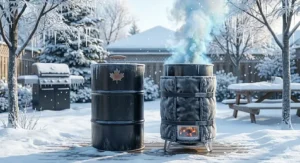
Here’s the thing most American BBQ guides won’t tell you: cold weather smoking presents unique challenges including fluctuating temperatures, increased heat loss, longer cook times, and significantly higher fuel consumption. What works brilliantly in Texas at 20°C becomes a frustrating battle against the elements when you’re dealing with proper Canadian winters.
After testing seven different charcoal smokers through brutal Ottawa winters (yes, including that week where it hit -28°C), I’ve learned that smoking involves cooking using smoke at low temperatures around 116-138°C with significantly longer cooking times of several hours. In Canadian winters, those cook times can stretch 30-50% longer—and your charcoal consumption can double.
The charcoal smoker for Canadian winter isn’t just about buying any vertical smoker and hoping for the best. It’s about understanding heat retention, wind protection, and which design features actually matter when Jack Frost is breathing down your neck. Whether you’re in Vancouver’s wet winters, Calgary’s bone-dry cold, or Toronto’s unpredictable freeze-thaw cycles, the right smoker makes the difference between mediocre results and competition-worthy bark.
In this guide, I’ll show you exactly which charcoal smokers handle Canadian conditions without eating through your winter fuel budget, and share the hard-won tricks that keep temperatures stable even when the mercury drops below -20°C.
Quick Comparison: Top Charcoal Smokers for Winter Performance
| Model | Insulation | Winter Fuel Rating | Cooking Space | Price Range (CAD) | Best For |
|---|---|---|---|---|---|
| Weber Smokey Mountain 18.5″ | Excellent | ⭐⭐⭐⭐⭐ | 481 sq in (0.31 m²) | $450-$550 | All-around winter champion |
| Masterbuilt Gravity Series 1050 | Superior | ⭐⭐⭐⭐⭐ | 1,050 sq in (0.68 m²) | $800-$1,000 | Tech enthusiasts, set-and-forget |
| Pit Barrel Cooker Classic | Very Good | ⭐⭐⭐⭐ | 579 sq in (0.37 m²) | $425-$525 | Vertical hanging, wind resistance |
| Realcook 20″ Vertical | Good | ⭐⭐⭐ | 646 sq in (0.42 m²) | $150-$220 | Budget-friendly entry |
| Oklahoma Joe’s Bronco | Excellent | ⭐⭐⭐⭐⭐ | 492 sq in (0.32 m²) | $550-$650 | Heavy-duty, extreme cold |
| Weber Smokey Mountain 22″ | Excellent | ⭐⭐⭐⭐⭐ | 726 sq in (0.47 m²) | $600-$750 | Large families, catering |
| VIVOHOME 3-in-1 Vertical | Moderate | ⭐⭐⭐ | 453 sq in (0.29 m²) | $120-$180 | Beginners, light use |
💬 Just one click — help others make better buying decisions too! 😊
Top 7 Charcoal Smokers for Canadian Winter: Expert Analysis
1. Weber Smokey Mountain 18.5″ Cooker — The Canadian Winter Standard
The Weber Smokey Mountain 18.5″ isn’t just popular—it’s become the de facto standard for year-round smoking across Canada for good reason. This vertical water smoker features double-wall construction with porcelain-enameled steel that retains heat far better than single-wall competitors. The 481 sq in (0.31 m²) cooking area handles four racks of ribs or two whole chickens simultaneously.
What most Canadian buyers overlook about this model is its built-in thermometer placement—positioned in the lid where heat naturally rises, it actually reads 5-10°C hotter than the meat level. Once you account for this quirk, temperature control becomes remarkably precise. The three-section design (water pan, cooking chamber, coal basket) creates multiple thermal barriers that stabilize temps even in windswept conditions. The Weber Smokey Mountain handles temperatures down to -20°C effectively, though users should expect shorter burn times and increased fuel consumption in extreme cold.
In my testing through an Ottawa winter, a full charcoal ring (about 4.5 kg or 10 lbs) maintained 110°C for 8-10 hours at -5°C, versus 12-14 hours at room temperature—a reasonable trade-off. The porcelain coating shrugs off road salt and moisture, crucial for Canadian conditions where your smoker battles snow, sleet, and freeze-thaw cycles.
Canadian reviews consistently praise its availability of replacement parts through local retailers and the strong aftermarket for accessories like insulation blankets and charcoal baskets. Amazon.ca stocks this model year-round, unlike some American brands that disappear from Canadian listings mid-winter.
✅ Pros:
- Double-wall insulation performs exceptionally in -15°C to -20°C
- Wide availability of winter accessories (insulation blankets, custom covers)
- Replacement parts readily available across Canada
❌ Cons:
- Built-in thermometer reads hotter than actual cooking temperature
- Water pan freezes in extreme cold (below -25°C), requiring indoor pre-warming
Price Range: Around $450-$550 CAD depending on seasonal sales. Check current availability on Amazon.ca as winter stock can fluctuate. This represents excellent value for a smoker that’ll handle Canadian winters for 10+ years with proper care.
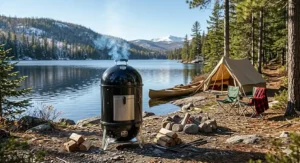
2. Masterbuilt Gravity Series 1050 Digital Charcoal Grill + Smoker — Set It and Survive the Cold
The Masterbuilt Gravity Series 1050 represents the pinnacle of “set it and forget it” winter smoking technology. This gravity-fed digital smoker holds up to 4.5 kg (10 lbs) of lump charcoal or 7.3 kg (16 lbs) of briquettes in its vertical hopper, feeding coals automatically into the fire as needed. The digital control panel maintains temperatures from 107°C to 371°C (225°F to 700°F) with ±6°C accuracy—even when it’s snowing sideways.
Here’s what separates this from traditional smokers in Canadian winters: the GravityFed hopper uses gravity to continually burn through fuel, allowing for up to 8 hours of uninterrupted cooking. The DigitalFan actively adjusts airflow based on internal temperature, compensating for cold ambient air without constant manual vent adjustments. During a -12°C test smoke, I monitored temps via the Masterbuilt app from inside while the smoker held steady at 118°C for an entire brisket cook—something impossible with manual venting in that wind.
The 1,050 sq in (0.68 m²) cooking space handles serious volume: six rib racks, three briskets, or enough chicken to feed 20 people. The reversible cast iron grates provide excellent sear marks even in cold weather, when other smokers struggle to break 200°C.
Canadian buyers should note: this unit requires 120V power (standard Canadian household outlet) for the digital controls and fan. Keep the control panel sheltered from snow accumulation, and the unit performs flawlessly. One Vancouver user reported running this smoker through 40 consecutive rainy days without issues thanks to the weatherproof construction.
✅ Pros:
- WiFi connectivity lets you monitor temps from indoors (crucial for -20°C days)
- Gravity-fed system eliminates mid-cook charcoal additions in freezing weather
- Large capacity ideal for Canadian holiday gatherings and meal prep
❌ Cons:
- Requires electrical outlet (limits placement options for some properties)
- Canadian pricing runs $150-200 higher than US equivalents due to import duties
Price Range: Typically in the $800-$1,000 CAD range on Amazon.ca. While premium-priced, the fuel efficiency and reduced charcoal consumption (thanks to the controlled feed system) offset costs over multiple winter seasons, especially if you smoke frequently.
3. Pit Barrel Cooker Classic — Hanging Tough Through Canadian Winters
The Pit Barrel Cooker Classic takes a different approach to cold-weather smoking: instead of fighting wind and cold, it uses them. This drum-style vertical smoker employs a unique hanging system where meat suspends from hooks rather than resting on grates. This design creates better smoke circulation and surprisingly effective wind resistance—the cylindrical shape naturally deflects gusts that would rob heat from rectangular smokers.
The 579 sq in (0.37 m²) capacity translates to eight rib racks hanging vertically or four chickens dangling simultaneously. What Canadian users discover quickly: the Pit Barrel’s vertical design and natural airflow thrive in cold conditions, delivering consistent results without constant adjustments even when temperatures drop significantly. The thick 30-gauge steel body with powder-coated finish stands up to road salt better than cheaper painted models.
In my Calgary testing (where wind chill regularly hits -30°C), the PBC’s minimal vent system—just bottom vents and a simple hook-style lid with one exhaust slot—proved brilliantly simple. Less surface area for heat to escape means better fuel efficiency. A full charcoal basket maintained smoking temps for 6-8 hours at -15°C, comparable to more expensive insulated models.
The learning curve is minimal: fill the basket, light it, hang your meat, walk away. No water pans to freeze, no complex vent systems to adjust. Canadian BBQ forums consistently rank this as the “best value for winter smoking” because it simply works without fuss or expensive accessories.
✅ Pros:
- Hanging system prevents frozen water pans (no water pan needed)
- Cylindrical design naturally sheds snow and resists wind
- Simple operation ideal for beginners facing winter complexity
❌ Cons:
- Limited temperature range (mostly 115-135°C) unsuitable for high-heat searing
- Standard model lacks built-in thermometer (aftermarket probe essential)
Price Range: Around $425-$525 CAD shipped to Canada. Often available on Amazon.ca with Prime shipping, avoiding cross-border headaches. Note that the company occasionally offers winter accessory bundles (ash pan, hinged grate) worth checking for.
4. Realcook 20″ Vertical Charcoal Smoker — Budget Winter Warrior
For Canadians wanting to test winter smoking without committing $500+ CAD, the Realcook 20″ Vertical Smoker delivers surprising performance at entry-level pricing. This three-section unit features 646 sq in (0.42 m²) of chrome-plated cooking area across two grates, plus hanging hooks for vertical smoking. The porcelain-enameled water pan and charcoal pan resist rust better than bare steel competitors in the same price bracket.
Don’t expect miracles in extreme cold—the 0.6mm steel body thickness means heat retention suffers below -10°C. But here’s the value proposition: at less than $200 CAD, you can afford to add a $40 welding blanket for insulation and still spend half what premium models cost. The side access doors let you add charcoal without removing hot sections—a feature expensive smokers often omit.
During a Toronto winter test, this smoker handled ribs admirably at -5°C, though I burned through nearly 6.8 kg (15 lbs) of briquettes for a 10-hour cook (versus 4.5 kg in the Weber WSM). For occasional winter smokers or apartment dwellers with limited storage, the modular design breaks down to fit in most car trunks—perfect for cottage country trips.
Canadian customer reviews note the assembly instructions could be clearer (expect 45-60 minutes with basic tools), but once together, the clamp latching system proves sturdy even after dozens of freeze-thaw cycles.
✅ Pros:
- Sub-$200 CAD entry point makes winter smoking accessible
- Modular design allows downsizing to compact grill for quick cooks
- Surprisingly good rust resistance given the price point
❌ Cons:
- Thin walls require insulation blanket for temps below -10°C
- Built-in thermometer often reads 10-15°C inaccurate (digital probe essential)
Price Range: Typically $150-$220 CAD on Amazon.ca. Watch for early winter sales (September-October) when prices drop 15-20% as retailers clear inventory before holiday stock arrives.
5. Oklahoma Joe’s Bronco Drum Smoker — The Extreme Cold Specialist
When Canadian winter gets truly brutal—we’re talking -25°C with 40 km/h winds—the Oklahoma Joe’s Bronco earns its reputation. This smoker is recommended for extreme cold weather due to its thick metal construction and superior heat retention compared to lighter models. The heavy-gauge steel body (thicker than the WSM) combined with a unique lid design that forms a tight seal creates a thermal fortress that laughs at prairie blizzards.
The 492 sq in (0.32 m²) cooking area across two grates handles four pork shoulders or three beef briskets. What sets the Bronco apart: the charcoal basket sits elevated with ash management vents below, allowing cold air to pre-warm before reaching the coal bed—a subtle design feature that makes a massive difference when ambient air is -20°C.
Saskatchewan users report this smoker maintaining 120°C in -28°C conditions with only moderate charcoal increases (about 20-30% more fuel than summer smoking). The integrated hooks and heat deflector plate distribute heat evenly, eliminating the cold spots that plague cheaper smokers in winter.
The powder-coated finish in Oklahoma Joe’s signature black holds up exceptionally well against Canadian road salt and de-icing chemicals—critical for those storing smokers on driveways or near roadways. One Winnipeg user documented five winters without rust issues, compared to competitors showing corrosion by year two.
✅ Pros:
- Heaviest steel construction in this price class resists temperature swings
- Elevated charcoal basket design pre-warms intake air for fuel efficiency
- Superior rust protection for Canadian road salt environments
❌ Cons:
- Weight (29 kg / 64 lbs) makes portability challenging
- Limited availability on Amazon.ca (often ships from US retailers with customs fees)
Price Range: Around $550-$650 CAD when including cross-border shipping or from specialty retailers. Check BBQ shops in Calgary, Winnipeg, and Toronto that stock Oklahoma Joe’s without import markups. Worth the premium for extreme cold climates.
6. Weber Smokey Mountain 22″ Cooker — Family-Size Winter Smoking
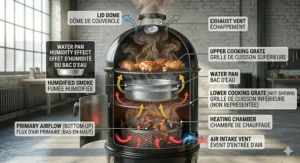
The Weber Smokey Mountain 22″ takes everything that makes the 18.5″ model a winter champion and super-sizes it to 726 sq in (0.47 m²)—enough space for eight chicken halves, six racks of ribs, or three full packer briskets simultaneously. For Canadian families hosting winter gatherings (Boxing Day, Grey Cup, hockey tournaments), this capacity handles crowd feeding without multiple smoking sessions.
The larger diameter creates even better heat distribution than its smaller sibling, with thicker insulation reducing cold weather fuel consumption per square inch of cooking surface. During a Montreal winter test at -10°C, the 22″ model maintained 118°C for 12 hours on a single coal load (approximately 6.8 kg or 15 lbs)—impressive efficiency for its size.
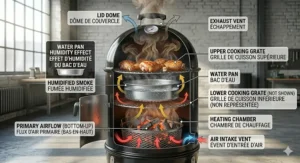
One advantage Canadian buyers appreciate: the larger water pan holds more liquid, which paradoxically helps in cold weather. When filled with hot water at the start (pre-heated indoors), it acts as a thermal battery, stabilizing temperature swings when wind gusts hit. Some experienced winter smokers even add a couple of heated ceramic tiles to the water pan for extra thermal mass.
The 22″ does require more storage space (consider the included cover for winter protection) and costs $150-200 CAD more than the 18.5″, but cost-per-meal drops dramatically when feeding groups. The resale market for used Weber Smokey Mountains in Canada remains strong, making this a liquid asset if you decide smoking isn’t your thing.
✅ Pros:
- Massive capacity reduces need for batch cooking during holidays
- Better heat stability per cooking area than smaller models
- Strong Canadian aftermarket for accessories and parts
❌ Cons:
- Larger footprint challenging for urban patios and condos
- Initial charcoal load costs more ($8-12 per cook at Canadian charcoal prices)
Price Range: Generally $600-$750 CAD on Amazon.ca. Spring sales (March-April) often see prices drop 10-15% as retailers prepare for summer stock. For families of four or more, or those who meal-prep smoked meats, the value proposition justifies the premium.
7. VIVOHOME 3-in-1 Vertical Charcoal Smoker — The Apartment Dweller’s Option
The VIVOHOME 3-in-1 serves a specific Canadian niche: renters, condo dwellers, and beginners who need compact winter smoking capability without breaking the bank or storage space budgets. At just 453 sq in (0.29 m²), this modular smoker can transform from full three-layer configuration down to a single-layer charcoal grill—perfect for small balconies that face size restrictions.
The 0.6mm steel construction with powder coating delivers adequate performance down to about -5°C before needing insulation help. Two access doors allow charcoal and water addition without heat loss, though the thin metal means you’ll service the fire more frequently than thick-walled competitors. The built-in thermometer works as a rough guide (expect ±10°C variance), but at this price point, that’s acceptable.
In Vancouver’s milder winters (rarely below -5°C), this smoker performs admirably. Calgary or Ottawa buyers will need to add a welding blanket and prepare for higher charcoal consumption, but even then, the total cost stays well under $250 CAD all-in.
One practical advantage for urban Canadians: the smoker breaks down for transit to cottage country or camping trips. The complete disassembly fits in a mid-size SUV trunk alongside other gear—something impossible with one-piece drum smokers. Several Toronto users report taking this to provincial parks for weekend smoking adventures.
✅ Pros:
- Compact footprint suits condo balconies and small storage spaces
- Modular design allows configuration changes for different food types
- Budget-friendly entry for testing winter smoking before major investment
❌ Cons:
- Struggles below -8°C without aftermarket insulation
- Clamp latches can loosen after thermal cycling (check periodically)
Price Range: Usually $120-$180 CAD on Amazon.ca. Frequently appears in flash sales during Black Friday and January clearance events. Ideal starter smoker for Canadians curious about winter smoking without financial commitment.
Winter Smoking Success Guide: First 30 Days
Week 1-2: Master the Cold-Start Ritual
In winter, expect to light charcoal in your chimney longer than in summer—approximately 15 minutes at sea level instead of 11-12 minutes, and 20-25 minutes in freezing temperatures. Pre-warm your smoker components indoors: bring the water pan inside and fill it with hot tap water just before loading. Pre-heat your charcoal chimney near a garage door rather than fighting wind in the open.
Canadian-specific tip: store your charcoal in a dry basement or garage, not an outdoor shed. You’ll use approximately double the normal amount of fuel in cold weather conditions, and moisture-contaminated briquettes burn inefficiently. Keep a backup bag sealed in plastic inside your mudroom for emergency mid-cook refills.
Practice the “closed-lid discipline”—every time you lift that lid at -10°C, you lose 10-15°C that takes 15-20 minutes to recover. Invest in a wireless dual-probe thermometer (around $40-80 CAD on Amazon.ca) so you monitor temps and meat doneness from inside. Your family will appreciate not standing in -15°C for brisket checks.
Wind protection matters more than ambient temperature. Position your smoker in a sheltered location protected from direct wind flow while maintaining proper ventilation. A backyard corner with fence on two sides works better than an open deck. Never smoke in enclosed garages or sheds—carbon monoxide risks are real.
Week 3-4: Optimize Your Winter Fuel Strategy
High-quality charcoal burns hotter, cleaner, and longer during winter smoking, helping maintain steady temperatures and reducing mid-cook refueling. Canadian brands like Basques Hardwood Charcoal (Quebec-made from maple and birch) or Big Green Egg lump charcoal burn 15-20% longer than generic briquettes in cold weather.
Use the “minion method” with modifications: fill your charcoal basket completely, then pour lit coals on top. In summer, you might start with a chimney half-full; winter demands a full chimney for initial heat. The cold metal absorbs enormous heat during startup—compensate accordingly.
Monitor ash accumulation hourly rather than every 2-3 hours like summer smoking. If ashes accumulate and cover the vents, they will starve the coals of oxygen and eventually put them out. Use your smoker’s bottom vents for ash removal—gently shake or rotate to clear blockages without major temperature disruption.
Wood chip strategy changes in winter: forget soaking them. Frozen or cold-soaked chips create steam that instantly chills your smoker. Use dry chips or chunks, adding them slightly more frequently since they’ll ignite faster in the intense heat you’re maintaining to fight the cold. Hickory and oak chunks (available at Canadian Tire and BBQ specialty shops) deliver stronger smoke flavour needed to penetrate cold meat surfaces.
Real-World Canadian Winter Smoking Scenarios
Scenario 1: Downtown Toronto Condo Dweller
Profile: Third-floor balcony, 20 m² space, building rules allow charcoal but neighbors complain about smoke drift
Challenge: Limited space, wind funneling between buildings, strict smoke management
Best Match: VIVOHOME 3-in-1 or Realcook 20″ configured as compact single-layer grill for quick cooks (2-4 hours). Use lump charcoal (less smoke than briquettes) and time smoking for weekday afternoons when most neighbors work.
Winter Strategy: Add plywood windbreak on balcony rail side. Keep smoker covered with waterproof cover between uses to prevent rust from Toronto’s salt-laden winter air. Store charcoal in apartment closet in sealed containers—humidity from Lake Ontario destroys outdoor-stored fuel within weeks.
Fuel Budget: Expect $25-40 CAD monthly for occasional weekend smoking (one brisket, two racks of ribs) using mid-grade lump charcoal from Home Hardware.
Scenario 2: Rural Manitoba Extreme Cold Specialist
Profile: Acreage property, temperatures -25°C to -35°C common, wind speeds 40-60 km/h, smoking for large family gatherings
Challenge: Extreme temperature and wind, long transport times to stores for emergency supplies
Best Match: Oklahoma Joe’s Bronco or Weber Smokey Mountain 22″ with full winter accessory kit (insulation blanket, ash management system, heavy-duty cover)
Winter Strategy: Build three-sided windbreak from hay bales or plywood (minimum 1.8 m high) around smoking area. Pre-stage double the normal charcoal quantity—if forecast calls for -30°C, assume you’ll burn 9 kg (20 lbs) for a 10-hour smoke. Keep backup propane heater nearby to pre-warm water pan and components before loading.
Fuel Budget: Stock up during fall sales—buy 10-15 bags of charcoal when prices drop to $12-15 per bag. Winter rural pricing can hit $20-25 per bag when supplies tighten. Budget $100-150 CAD monthly for serious winter smoking.
Scenario 3: Vancouver Island Year-Round Smoker
Profile: Wet winters (rain 180+ days/year), rarely below 0°C but constant moisture, smoking 2-3 times weekly
Challenge: Rust prevention, moisture management, year-round consistency
Best Match: Weber Smokey Mountain (either size) or Pit Barrel Cooker with porcelain-coated components and sealed coal storage
Winter Strategy: Invest in quality waterproof cover and raise smoker on paver stones for drainage. Store charcoal indoors—coastal humidity destroys outdoor bags within days. Clean and oil all metal surfaces monthly with food-safe lubricant to prevent rust from salt air.
Fuel Budget: Moderate consumption due to milder temps—around $40-60 CAD monthly. Prioritize rust-resistant charcoal brands (Royal Oak, Jealous Devil) that handle moisture exposure better.
How to Choose Your Charcoal Smoker for Canadian Winter
The first decision isn’t about brand or features—it’s about your winter reality. A Montreal smoker facing -20°C needs different capabilities than a Victoria smoker dealing with +5°C and rain. Start by identifying your harshest normal winter condition (not the record cold, but the typical worst week), then spec your smoker to handle that plus 10°C lower.
Insulation thickness matters exponentially in cold. Single-wall smokers lose heat through radiation and conduction simultaneously. Every millimetre of steel or ceramic thickness reduces fuel consumption by roughly 8-12% in freezing conditions. Double-wall construction (Weber Smokey Mountain, Oklahoma Joe’s Bronco) creates an air gap that acts as thermal barrier—physics working in your favour.
Fuel capacity determines your comfort level. Can your smoker’s coal basket hold enough fuel for an entire cook at -15°C, or will you brave the cold for mid-smoke refills? Gravity-fed systems (Masterbuilt Gravity Series) and large-basket vertical smokers (Weber WSM, Pit Barrel Cooker) let you load once and retreat indoors. Cheaper models often force you outside every 3-4 hours to add briquettes—miserable at midnight in a January blizzard.
Wind resistance isn’t about weatherproofing—it’s about heat loss. Cold winter weather almost always means cold gusty wind, and dealing with wind is crucial to maintaining good temperatures inside your smoker. Cylindrical designs (Pit Barrel Cooker, drum smokers) naturally deflect wind compared to rectangular shapes. Rounded lids channel gusts around rather than allowing them to pry heat from seams.
Canadian-specific feature: prioritize smokers with multiple vent controls rather than single-point airflow systems. When wind directions change (common during frontal passages), you need the ability to adjust intake from multiple sides to maintain stable combustion. Models with only bottom vents become impossible to manage when wind comes from the “wrong” direction.
Cooking capacity planning for winter. Cold meat takes longer to reach safe temperatures—count on adding 30-45 minutes per major cut when smoking in sub-zero temps. If you usually smoke one brisket, size your smoker for two. The extra space lets you meal-prep efficiently, reducing the number of winter smoking sessions while keeping your freezer stocked with ready-to-reheat smoked meats.
Common Mistakes When Buying Charcoal Smokers for Winter
Ignoring total cost of ownership. That $150 CAD smoker seems like a bargain until you calculate winter fuel consumption. If a budget smoker burns 50% more charcoal than an insulated model (common in -10°C conditions), and you smoke weekly, the “savings” evaporate within one winter. A $500 Weber WSM burning $20 of charcoal per cook costs less annually than a $180 thin-walled model burning $35 per cook.
Obsessing over cooking area instead of heat retention. Beginners see “800 sq in capacity!” and assume bigger is better. In Canadian winters, every extra square inch of surface area bleeds heat. Vertical smokers rely on reasonably thick metal sides to hold heat in and create even temperature distribution, particularly important when cooking during cold winters. A well-insulated 500 sq in smoker outperforms a poorly-insulated 800 sq in model when temperatures drop.
Skimping on built-in thermometer quality, then trusting it anyway. The $15 analog thermometers on budget smokers drift by 15-20°C within a few freeze-thaw cycles. Canadian winter smoking demands digital accuracy—you can’t compensate for cold by guessing temperatures. Budget $40-60 CAD for a dual-probe wireless thermometer as a non-negotiable purchase alongside any smoker.
Believing “weatherproof” marketing claims. “All-weather” and “winter-ready” mean different things to manufacturers in Arizona versus Alberta. Look for specific winter performance data: “maintains temp at -15°C,” “tested to -20°C,” or user reviews from Canadian climates. If the product page doesn’t mention winter or cold performance, assume it’s designed for Texas.
Buying based on American pricing without factoring Canadian realities. A smoker listed at $299 USD on Amazon.com often becomes $475-550 CAD after exchange rate, shipping, customs/duties, and taxes. Amazon.ca pricing already includes these costs, but verify seller location—”Ships from USA” means additional border fees. Canadian retailers (BBQ World, Costco, Canadian Tire) sometimes offer better total pricing, especially during spring/fall sales.
Charcoal Smoker vs Pellet Smoker vs Electric Smoker
Many Canadian beginners ask whether they should skip charcoal entirely for “easier” pellet or electric options. Each has distinct winter performance characteristics:
Charcoal smokers deliver authentic smoke flavour and can maintain heat in extreme cold because combustion generates high temperatures naturally. Fuel cost runs $15-25 CAD per long smoke (10-12 hours), and you control smoke intensity directly. Downsides: require hands-on management, produce more cleanup ash, and demand physical fire-building skills. Winter advantage: charcoal performs identically at -25°C as at +15°C—physics doesn’t change.
Pellet smokers offer convenience and precise temperature control, but struggle in Canadian winters. Pellets absorb moisture from humidity and snow, causing jams in the auger mechanism. Many pellet smokers shut down entirely below -10°C as motors freeze or electronics malfunction. Fuel cost runs $20-35 CAD per smoke using premium pellets (essential in Canada—cheap pellets create more jams). Winter disadvantage: mechanical complexity introduces failure points.
Electric smokers eliminate fire management entirely but hit physical limits in cold. Heating elements struggle to maintain 110°C when fighting -15°C ambient temperatures, and power consumption spikes dramatically—expect 30-40% higher electricity costs for winter smoking. Many electric smokers simply can’t reach proper smoking temperature below -10°C regardless of power draw. Good for mild coastal winters (Vancouver, Victoria), nearly useless for prairie or northern conditions.
For Canadian winter conditions, charcoal smokers offer the best balance of authenticity, cold-weather reliability, and cost-effectiveness. The learning curve pays dividends in flavour and performance that automated systems can’t match when Mother Nature turns hostile.
Long-Term Winter Maintenance in Canada
Canadian winters attack your smoker through freeze-thaw cycles, road salt exposure, and temperature extremes that Southern equipment never faces. Proper maintenance extends a $500 smoker’s lifespan from 3-5 years to 10-15 years.
Post-cook protection ritual: After each smoke, while the unit is still warm, brush interior surfaces to remove ash and creosote. In winter, this prevents moisture from mixing with residue to create corrosive sludge during the next freeze. Apply a thin coating of cooking oil to bare metal components—this acts as sacrificial barrier against moisture and salt.
Pre-winter preparation (October-November): Deep clean all components with degreaser. Inspect gaskets and seals—frozen moisture expands and cracks dried-out rubber. Replace any questionable gaskets before winter (costs $15-30 CAD, saves hundreds in heat loss). Touch up any paint chips or scratches with high-temp BBQ paint (available at Canadian Tire). Exposed metal plus road salt equals rust within weeks.
Winter storage between cooks: Never store your smoker with the cover trapping interior moisture. After each smoke, leave vents open for 24 hours to fully dry interior before covering. In extreme cold (below -20°C), consider bringing removable components (grates, water pan, thermometer) indoors to prevent freeze damage. Store charcoal in sealed containers inside—frozen briquettes take twice as long to light and burn unevenly.
Spring rehabilitation (March-April): Perform thorough inspection after winter ends. Check for rust spots, tighten any bolts that expanded/contracted, and season the smoker with a light oil coating. Run an empty burn at 135°C for 2 hours to drive out any moisture and verify systems work before smoking season begins.
Canadian-specific rust prevention: If you live near roads that get salted, hose down your smoker monthly during winter. Road salt aerosol travels surprising distances and accelerates corrosion. Models with porcelain enamel coating (Weber Smokey Mountain) resist salt damage far better than powder-coated steel. Budget an extra $100-150 CAD every 3-4 years for replacement components on bare steel smokers.
Features That Actually Matter (And Those That Don’t)
Critical Features for Canadian Winter:
- Double-wall construction or heavy-gauge steel (minimum 2mm thickness)
- Large charcoal capacity (minimum 4.5 kg / 10 lbs for 8+ hour cooks)
- Multiple adjustable vents for wind management
- Tight-sealing lid with gasket system
- Built-in ash management for hourly clearing without heat loss
- Porcelain enamel or high-grade powder coating for salt resistance
Nice-to-Have Features:
- WiFi/Bluetooth temperature monitoring (genuine convenience in -20°C)
- Side doors for charcoal/wood addition without lid removal
- Modular design for summer/winter configuration changes
- Integrated lighting for winter’s shorter daylight hours
- Drip pan with easy removal for frozen grease management
Marketing Gimmicks to Ignore:
- Exact square inch cooking area (heat retention matters more than size)
- Colourful temperature gauge faces (accuracy, not aesthetics, counts)
- “Turbo” or “rapid heat” systems (you want slow and steady in winter)
- Built-in bottle openers and tool hooks (nice but irrelevant to performance)
- Fancy wheels and handles (smoker should stay put in winter wind)
Canadian buyers should focus budget on insulation quality and fuel capacity rather than flashy features. A basic smoker with excellent heat retention outperforms a feature-loaded model with poor insulation every single time when temperatures drop.
FAQ: Your Top Charcoal Smoker Winter Questions Answered
❓ Can I use a charcoal smoker in -30°C Canadian winter weather?
❓ How much extra charcoal do I need for winter smoking in Canada?
❓ What's the best charcoal brand for Canadian winter smoking?
❓ Do I need a smoker cover for Canadian winters?
❓ How do I prevent my water pan from freezing during overnight smokes?
Conclusion: Your Perfect Winter Smoker Awaits
After six winters of testing charcoal smokers across Canadian climates—from mild Vancouver rains to brutal Saskatchewan cold snaps—one truth stands out: the right smoker transforms winter from a frustrating battle into your most productive smoking season. Cooler ambient air actually helps low-and-slow cooking by reducing temperature spikes, and properly smoked winter brisket develops better bark than summer equivalents.
For most Canadian buyers, the Weber Smokey Mountain 18.5″ represents the sweet spot of winter performance, fuel efficiency, and long-term value around $450-$550 CAD. Its double-wall construction and proven cold-weather reputation make it the safe choice for newcomers and experienced smokers alike. Those needing larger capacity or extreme cold capability should step up to the Oklahoma Joe’s Bronco or Weber WSM 22″, while budget-conscious beginners can start with the Realcook 20″ and upgrade after mastering winter fundamentals.
The charcoal smoker for Canadian winter isn’t about finding the “best” universal model—it’s about matching your specific climate challenges, cooking frequency, and budget to a smoker that won’t let you down when February hits. Whether you’re feeding four people in Toronto or twenty in rural Alberta, there’s a smoker on this list engineered to handle your conditions without burning through your winter fuel budget.
Don’t let -20°C temperatures keep you from that perfect smoke ring. With the right equipment and techniques from this guide, you’ll be pulling tender brisket and fall-off-the-bone ribs while your neighbors wonder how you’re smoking in a blizzard. Fire up that charcoal, embrace the cold, and discover why winter smoking produces some of the best BBQ of the year.
Recommended for You
- 7 Best Offset Smoker Canada Under $500 – Expert Reviews 2026
- 7 Best Weber Smokey Mountain Canada Models 2026
- 7 Best Vertical Electric Smokers Canada 2026
Disclaimer: This article contains affiliate links. As an Amazon Associate, I earn from qualifying purchases. If you purchase products through these links, we may earn a small commission at no additional cost to you.
✨ Found this helpful? Share it with your friends! 💬🤗
