
In This Article
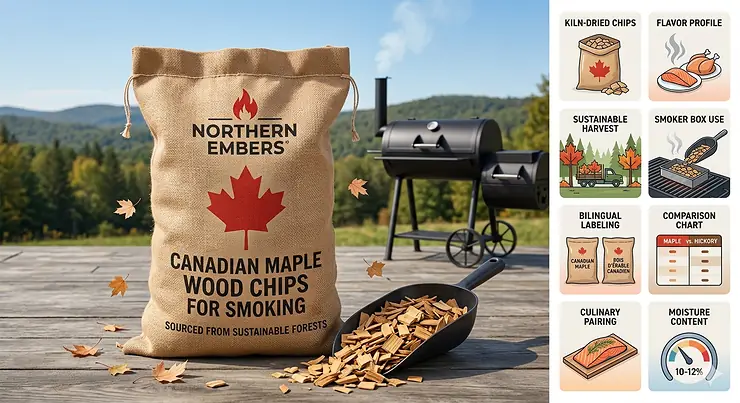
When you think of Canada, maple immediately comes to mind—and for good reason. The same trees that produce our world-famous maple syrup also deliver some of the finest smoking wood available anywhere. Canadian maple wood chips for smoking offer a unique flavour profile that’s impossible to replicate with any other hardwood: a delicate sweetness balanced with mild smokiness that enhances rather than overpowers your food.

What most beginners don’t realize is that maple smoking wood differs dramatically based on the species. Sugar maple (Acer saccharum), which dominates eastern Canadian forests from Nova Scotia to Manitoba, produces the most sought-after chips with concentrated natural sugars. According to the Canadian Encyclopedia, 10 maple species are native to Canada, but sugar maple remains the gold standard for smoking applications because its dense wood fibre creates consistent, clean smoke even at low temperatures.
Here’s what makes Canadian maple special for smoking: the short growing season and harsh winters force Canadian maples to develop denser wood with higher sugar concentration than their southern counterparts. This translates directly to better smoke quality and more nuanced flavour in your finished product. Whether you’re smoking salmon on the West Coast or bacon in Quebec, understanding how to select and use genuine Canadian maple wood chips separates amateur backyard cooks from serious pitmasters.
Quick Comparison: Top Canadian Maple Wood Chips at a Glance
| Product | Form | Weight | Best For | Price Range (CAD) | Prime Eligible |
|---|---|---|---|---|---|
| Camerons Maple Chunks | Chunks | 4.5 kg (10 lbs) | Long smoking sessions | $35-$50 | Yes |
| Camerons Maple Coarse Chips | Coarse chips | 0.9 kg (2 lbs) | Gas/charcoal grills | $15-$25 | Yes |
| Old Smokey Sugar Maple Chips | Fine chips | 0.9 kg (2 lbs) | Traditional smoking | $18-$28 | Yes |
| Napoleon Maple Chips | Medium chips | 0.9 kg (2 lbs) | All-purpose smoking | $20-$30 | Yes |
| Camerons Extra Fine Sawdust | Sawdust | 0.47 L (1 pint) | Smoking guns, cold smoking | $12-$18 | Yes |
💬 Just one click—help others make better buying decisions too! 😊
Top 7 Canadian Maple Wood Chips for Smoking: Expert Analysis
1. Camerons All Natural Maple Wood Chunks (10 lb/4.5 kg)
For serious Canadian pitmasters who measure smoking time in hours rather than minutes, these fist-sized chunks are the workhorse choice. Each piece measures roughly 5-8 cm, designed specifically for offset smokers and charcoal grills where you need sustained smoke production without constant refilling.
What separates these from cheaper alternatives is the kiln-drying process—Camerons brings moisture content down to 12-15%, which means the wood ignites quickly and combusts cleanly without producing the bitter creosote that ruins low-and-slow cooks. The larger chunk size creates a slow, steady burn that’s particularly valuable during Canadian winter smoking when you’re fighting temperature fluctuations. I’ve used these for 14-hour brisket sessions in -5°C February weather, and they maintain consistent smoke output where smaller chips would burn out or smoulder unevenly.
The maple variety delivers that signature sweet-smoke profile without the aggressive punch of hickory. It’s subtle enough for delicate proteins like trout or chicken but substantial enough to stand up to pork ribs with heavy rubs. Many Canadian reviewers specifically praise how well these pair with Quebec-style smoked meat and Montreal-spiced brisket—the maple sweetness balances the peppery spice blend perfectly.
Pros:
✅ Large chunk size means fewer refills during long smokes
✅ Kiln-dried for immediate use, no soaking required
✅ Consistent smoke production in cold Canadian weather
Cons:
❌ Too large for standard smoker boxes on gas grills
❌ Takes longer to ignite than chips or pellets
Available on Amazon.ca in the $35-$50 CAD range depending on current stock. Prime members get free shipping, which matters when you’re hauling 10 pounds of wood.
2. Camerons All Natural Maple Wood Chips (2 lb/0.9 kg Coarse Cut)
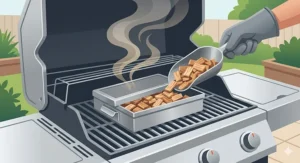
This is the Goldilocks option for most Canadian backyard smokers: not too big for your equipment, not too small to maintain smoke, priced right for regular use. The coarse cut means chips measure roughly 1-2 cm, ideal for standard smoker boxes on gas grills or scattered directly on charcoal.
The real advantage here is versatility. Unlike the chunks above, these ignite within 5-10 minutes of hitting heat, giving you smoke right when you need it without the long pre-heat period. For weekend cooks who are smoking chicken thighs or salmon fillets—meals that finish in 90-120 minutes—this bag delivers exactly the right amount of fuel. One reviewer from British Columbia noted she gets four complete smoking sessions from a single bag when doing whole chickens, which works out to roughly $5 CAD per cook in smoking wood cost.
Camerons recommends soaking these for 20-40 minutes before use, though I’ve found that unnecessary if you’re using them in a smoker box with indirect heat. Dry chips create a cleaner-flavoured smoke and don’t drop your grill temperature by releasing steam. The real insight Canadian users share is that these work exceptionally well with locally-caught salmon—the maple sweetness complements the fish’s natural oils without masking that fresh West Coast or Great Lakes flavour.
Pros:
✅ Perfect size for standard gas grill smoker boxes
✅ Ignites quickly for shorter smoking sessions
✅ Resealable bag maintains freshness in humid climates
Cons:
❌ Burns faster than chunks, requiring mid-session refills on long cooks
❌ Can produce bitter smoke if packed too densely in smoker box
Price range around $15-$25 CAD on Amazon.ca, often available with Subscribe & Save discounts.
3. Old Smokey Sugar Maple Smoking Chips (2 lb/0.9 kg)
Here’s the Canadian-made option that deserves more attention. Old Smokey is a brand from Hallman Wood Products, a sixth-generation family operation in Walters Falls, Ontario (near Blue Mountain). Since 1878, they’ve been processing locally-sourced hardwoods, and their sugar maple chips come from trees harvested within 200 km of their facility.
What makes this product distinct is the regional sourcing—these are Ontario sugar maples, the same species used for syrup production, harvested from mature trees in the Niagara Escarpment region. The flavour profile skews slightly sweeter than western Canadian or imported maple because Ontario’s growing conditions produce trees with higher sap sugar content. If you’ve ever noticed that Quebec maple syrup tastes different from Vermont syrup, the same principle applies to smoking wood.
The chips are cut to medium-coarse size (similar to Camerons), and Canadian buyers specifically note the freshness—you can smell the sweet maple aroma immediately upon opening the bag, a sign the wood hasn’t been sitting in a warehouse for months. For anyone in southern Ontario or Quebec, this is your “buy local” option that actually delivers quality rather than just appealing to regional pride. The company’s eco-friendly harvesting practices also align with Canadian environmental values, which matters to many buyers.
Pros:
✅ Locally sourced from Ontario sugar maples for authentic Canadian flavour
✅ Sixth-generation Canadian family business with sustainable practices
✅ Noticeably fresh aroma indicates recent processing
Cons:
❌ Slightly higher price point than mass-market brands
❌ Availability can be inconsistent on Amazon.ca (check Canadian Tire as alternative)
Pricing typically runs $18-$28 CAD, positioning it as a premium option justified by the local sourcing and quality.
4. Napoleon Maple Wood Smoking Chips (2 lb/0.9 kg)
Napoleon, the Canadian BBQ equipment manufacturer based in Barrie, Ontario, extends their brand into smoking accessories with these chips. What you’re paying for here isn’t just the wood—it’s Napoleon’s quality control standards and the assurance that these chips are specifically sized and processed to work optimally with Napoleon’s line of gas grills and smoker boxes.
The chip size runs slightly finer than Camerons coarse cut, which means faster ignition and more intense smoke bursts over shorter periods. This makes them particularly well-suited for foods that need strong smoke flavour in under an hour: think cheese smoking, nuts, or cocktail ingredients. Several Canadian home cooks report using these successfully with Napoleon’s stainless steel smoker box accessory, where the finer chips fill the perforated box more completely and generate smoke more evenly across the surface area.
The maple they use produces a classic mild-sweet profile, though some reviewers note it’s not quite as distinctively “maple” as the Old Smokey chips—likely because Napoleon sources from multiple regions to maintain consistent supply. For reliability and knowing exactly what you’re getting every time, that consistency is actually valuable. If you own Napoleon equipment, these chips are the safe choice that eliminates any guesswork about compatibility.
Pros:
✅ Optimized for Napoleon smoker boxes and equipment
✅ Finer cut creates intense smoke quickly for short sessions
✅ Consistent quality batch-to-batch
Cons:
❌ Burns through quickly on longer cooks
❌ Slightly less distinctive maple character than specialty brands
Price range around $20-$30 CAD on Amazon.ca, often bundled with Napoleon accessories.
5. Camerons Extra Fine Maple Sawdust (1 Pint/0.47 L)
This is the specialist product in the lineup, designed for cold smoking applications and smoking guns rather than traditional hot smoking. The extra-fine grind (almost powder-like consistency) ignites instantly and smoulders at low temperatures, making it perfect for cheese smoking, cocktail smoke infusion, or cold-smoking salmon in the Pacific Northwest tradition.
What Canadian buyers need to understand is that this product serves a completely different purpose than chips or chunks. You’re not throwing this on hot coals—you’re using it in controlled smoking devices where the goal is aromatic smoke without heat. Toronto-based cocktail enthusiasts use this with handheld smoking guns to add maple smoke to whisky cocktails, while BC salmon smokers pack it into smoke generators for traditional cold-smoking that doesn’t cook the fish. One reviewer from Montreal described using it to cold-smoke cheese curds for an elevated poutine experience, which is exactly the kind of creative Canadian application this product enables.
The pint size seems small compared to the 2-pound chip bags, but a little goes a long way—you measure this in tablespoons, not handfuls. A single pint provides 30-40 smoking sessions depending on your application, which actually makes it quite economical for its specialized use case.
Pros:
✅ Perfect for cold smoking and smoking guns
✅ Ignites instantly for precise smoke control
✅ Compact size doesn’t take up storage space
Cons:
❌ Not suitable for traditional hot smoking applications
❌ Higher per-pound cost due to specialized processing
Price typically $12-$18 CAD per pint on Amazon.ca, a premium you pay for the extra processing.
6. Quebec Maple Whisky Barrel Chips (300 g)
Now we’re getting into boutique territory. These chips are upcycled from oak whisky barrels that previously aged Quebec maple syrup, giving them a unique triple-flavour profile: the natural maple wood, residual maple syrup sugars, and whisky notes from the barrel’s previous life. It’s a Canadian specialty product you won’t find anywhere else.
The sustainability story here appeals to environmentally-conscious Canadian buyers—these barrels would otherwise be discarded after their syrup-aging cycle, but instead they’re repurposed into premium smoking wood. The flavour impact is noticeably different from straight maple: there’s a subtle whisky complexity that works beautifully with pork (especially bacon and ribs), and the concentrated maple-syrup sweetness is more pronounced than regular maple chips. Several Quebec-based pitmasters report using these specifically for competition BBQ because the unique flavour profile helps their entries stand out.
The catch is the price and quantity. At 300 grams, you’re getting about 1/3 the volume of standard chip bags, and the premium pricing reflects both the specialized sourcing and the artisanal nature of the product. This isn’t your everyday smoking wood—it’s what you pull out for special occasions or when you want to create something memorable. Think of it as the craft beer equivalent in the wood chip world.
Pros:
✅ Unique flavour profile from whisky barrel aging and maple syrup residue
✅ Sustainable upcycling of Quebec’s signature industry byproducts
✅ Distinctive enough to differentiate competition BBQ entries
Cons:
❌ Premium pricing limits this to special-occasion use
❌ Small quantity means frequent reordering if you smoke regularly
Pricing around $20-$30 CAD for 300 grams on Amazon.ca, positioning this firmly in the premium segment.
7. Bradley Maple Bisquettes (24-pack)
Bradley’s disc-shaped “bisquettes” represent a completely different approach to wood smoking, designed specifically for Bradley’s line of electric smokers that automatically feed these pucks into the smoke generator. Each bisquette burns for exactly 20 minutes before being automatically advanced, eliminating the guesswork and babysitting required with traditional chips.
For Canadian users who’ve invested in Bradley’s made-in-Canada smoking systems, these bisquettes are mandatory—the equipment won’t work with standard chips. But that closed ecosystem also delivers remarkable consistency. The maple bisquettes are compressed and formed under precise conditions, ensuring each one burns identically and produces the same smoke volume and flavour. This level of control is particularly valuable for Canadian commercial operations or serious home processors making large batches of sausage or smoked fish where flavour consistency batch-to-batch is critical.
Canadian reviewers especially appreciate Bradley bisquettes during winter smoking. Traditional chips can be finicky in sub-zero temperatures, but Bradley’s automated system maintains perfect smoke production regardless of ambient conditions—crucial when you’re smoking in Edmonton in January. The maple variety works excellently for the long, low-temperature smokes that define Canadian-style peameal bacon and Montreal smoked meat.
Pros:
✅ Automatic feeding eliminates manual intervention during smokes
✅ Precise 20-minute burn time for predictable smoke production
✅ Performs consistently in extreme Canadian winter conditions
Cons:
❌ Only compatible with Bradley electric smokers
❌ Higher per-use cost than loose chips
Price around $25-$35 CAD per 24-pack on Amazon.ca, which works out to roughly $1-1.50 per hour of smoking.
How to Choose Canadian Maple Wood Chips: Expert Decision Framework
Before you click “add to cart” on any maple smoking wood, answer these three questions to identify the right product for your specific Canadian smoking setup.
Question 1: What’s Your Primary Smoking Equipment?
Your smoker type dictates wood form factor more than any other consideration. Offset smokers and charcoal grills need chunks or coarse chips that maintain structure during long burns. Gas grills require chips sized to fit smoker boxes (typically 2-3 cm maximum). Pellet smokers demand food-grade pellets, while Bradley electric smokers only accept bisquettes. Electric smokers with chip trays work best with medium-to-fine chips. Cold smoking applications call for extra-fine sawdust. Using the wrong size creates either insufficient smoke (pieces too large, won’t ignite) or bitter creosote (pieces too small, smoulder rather than burn cleanly).
Question 2: How Long Are Your Typical Smoking Sessions?
Match wood volume to cook duration. For quick cooks under 90 minutes (chicken pieces, fish fillets, vegetables), a 2-pound bag of chips delivers 3-5 sessions—plenty for most casual smokers. Mid-length sessions of 3-6 hours (whole chickens, pork ribs, turkey) benefit from chunks that burn slower and require fewer refills. Marathon sessions exceeding 8 hours (brisket, pork shoulder, Montreal smoked meat) justify the 10-pound chunk bags purely from a convenience standpoint. Nothing kills the zen of low-and-slow smoking like refilling chips every hour when you should be relaxing with a beverage.
Question 3: What’s Your Climate and Storage Situation?
This is the Canadian-specific consideration that American guides miss entirely. If you’re in coastal BC or Atlantic Canada where humidity is high year-round, buy smaller quantities more frequently—once maple chips absorb moisture, they produce steam instead of smoke and drop your grill temperature. Prairie smokers in Alberta or Saskatchewan can stock larger volumes because the dry climate naturally preserves wood. Urban condo dwellers in Toronto or Vancouver need compact storage, favouring 2-pound bags over 10-pound bulk. If you smoke year-round including winter, prioritize kiln-dried products that ignite reliably in cold weather rather than cheaper air-dried alternatives that struggle below freezing.
Understanding Maple Flavour Profile: What Makes It Uniquely Canadian
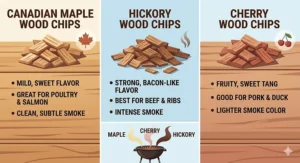
Maple wood’s reputation as a “mild” smoking wood undersells its complexity. Yes, it won’t punch you in the face like mesquite, but dismissing it as simply “not strong” misses the nuanced flavour chemistry that makes Canadian sugar maple unique among hardwoods.
Wikipedia notes that maple trees belong to the genus Acer and contain natural sugars in their wood fibre, not just their sap. When maple wood combusts during smoking, these sugars caramelize and release aromatic compounds similar to what you’d experience reducing maple syrup—think subtle caramel notes layered over a clean wood-smoke base. The key difference between maple and fruitwoods like apple or cherry is that maple’s sweetness reads as more savory-sweet (like brown sugar) rather than fruity-sweet.
Canadian sugar maples develop this profile more intensely than southern or imported maples because our harsh winters and short growing seasons force trees to concentrate sugars as frost protection. A sugar maple from Ontario or Quebec will deliver more pronounced sweetness than the same species grown in Tennessee, purely due to environmental stress. This is why serious Canadian pitmasters seek out domestically-sourced maple chips rather than settling for generic “maple” products that might source wood from anywhere.
The smoke colour maple produces is deceptively dark—a deep mahogany that gives food an almost lacquered appearance. This visual impact matters for presentation, especially if you’re serving smoked salmon or competition ribs where appearance scores points. The flavour intensity remains mild even as the colour deepens, an unusual combination that lets you achieve that coveted smoke ring and bark without overwhelming delicate proteins.
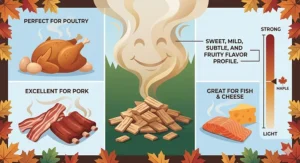
For protein pairing, maple excels with: poultry (the sweetness balances chicken’s blandness), pork (classic pairing, especially bacon and ham), fish (particularly salmon and trout where you want smoke presence without aggression), and vegetables (maple is the only wood truly recommended for smoking vegetables because its mild character doesn’t compete with their natural flavours). Where maple struggles is with bold red meats like beef brisket smoked solo—many Canadian pitmasters blend maple with oak or hickory for brisket to add complexity while maintaining that signature smoke sweetness.
Canadian Winter Smoking: Adapting Your Wood Strategy for Cold Weather
Here’s the reality American smoking guides don’t address: maintaining consistent smoke production when it’s -15°C outside requires different tactics than summer smoking. Canadian maple wood chips help, but you need the complete strategy.
The primary challenge is temperature. Wood combustion requires sustained heat to produce clean smoke rather than bitter white creosote. In winter, your charcoal or gas grill loses heat faster to the environment, which means your wood chips receive less consistent heat and produce unreliable smoke. The solution is threefold: use kiln-dried chips (12-15% moisture) that ignite with less heat, place chips closer to your direct heat source, and increase chip quantity by 20-30% to account for slower, less complete combustion.
Canadian pitmasters also adapt by switching from soaked chips (a summer technique to slow burning) to bone-dry chips in winter. Wet wood requires extra BTUs to evaporate moisture before combustion begins—BTUs your grill is already struggling to maintain against freezing air. Dry chips ignite immediately and hold temperature better. The trade-off is faster burn-through, but that’s manageable with proper chunk sizing.
Insulation matters more than most realize. Welding blankets wrapped around offset smoker bodies, water pan adjustments, and wind breaks all help your smoking wood perform consistently. I’ve done successful winter brisket cooks in Calgary chinook weather (-10°C to +5°C swings) purely by managing heat retention and using larger maple chunks that could weather the temperature fluctuations without burning out or smouldering.
Storage is the final piece. Never store maple chips in an unheated garage or shed—the freeze-thaw cycle introduces condensation that destroys their smoking quality. Keep chips in a sealed container inside your heated space, or if outdoor storage is unavoidable, use airtight plastic bins with desiccant packs to control moisture.
Maple Wood Chips vs. Pellets vs. Chunks: Which Form Factor Wins?
Canadian BBQ stores stock maple in multiple forms, and the choice matters more for practical success than most beginners realize. Let’s cut through the marketing and talk real-world performance.
Wood Chips (2-3 cm pieces): The Swiss Army knife of smoking woods. Work in smoker boxes on gas grills, scattered on charcoal, or loaded into electric smoker trays. Ignite within 5-10 minutes, burn for 30-60 minutes depending on size and heat. Best for cooks under 3 hours. The practical advantage is flexibility—you can use them across multiple smoker types. The disadvantage is management overhead; you’ll refill 2-3 times on a standard rib cook. Canadian pricing sits around $15-25 CAD per kilogram.
Wood Chunks (5-8 cm pieces): The long-haul specialist. These are for offset smokers and large charcoal grills where you need sustained smoke over 4+ hours. Take 15-20 minutes to fully ignite but then burn steadily for 90-120 minutes per chunk. You’ll use 3-4 chunks for a 12-hour brisket versus constantly refilling chips. The trade-off is equipment specificity—chunks don’t fit smoker boxes and are overkill for gas grill smoking. Canadian pricing runs $30-50 CAD for a 4.5 kg bag, which pencils out cheaper per smoking hour than chips if you’re doing long cooks.
Pellets: The automation play. Designed for pellet grills with auger-fed hoppers, these compressed wood cylinders deliver precise smoke through computer-controlled feeding. Burn cleaner and more completely than chips, producing consistent smoke flavour. The catch is the closed ecosystem—you need a pellet grill, and you’re paying $20-35 CAD for 9 kg bags. Many pellets labelled “maple” are actually oak or alder base wood with maple flavouring added, so verify “100% maple” on the label if authenticity matters to you. For Canadian pellet grill owners, these are mandatory, but they’re not interchangeable with chips for other smoking methods.
The verdict for most Canadian backyard smokers: start with 2-pound chip bags to understand maple’s flavour profile and how it works with your equipment. Graduate to chunks if you regularly do long smokes. Add pellets only if you own a pellet grill. The specialty forms (sawdust, bisquettes) come later once you’re chasing specific techniques.
Common Mistakes Canadian Maple Wood Chip Users Make (And How to Fix Them)
Mistake #1: Soaking Chips for Gas Grill Smoking
The old advice to “soak wood chips 30 minutes before use” comes from charcoal smoking traditions and actively sabotages gas grill smoke production. When soaked chips hit the heat, they release steam for the first 10-15 minutes instead of smoke. That steam drops your grill temperature 25-40°F (about 15-20°C), extending cook times and producing inferior bark formation. The fix: use bone-dry chips in your gas grill smoker box. They ignite faster, maintain temperature, and produce cleaner-flavoured smoke. Save soaking only for direct-on-coals applications with charcoal grills where slowing the burn prevents flare-ups.
Mistake #2: Overfilling Smoker Boxes
Cramming your smoker box tight with chips seems logical—more wood equals more smoke, right? Wrong. Densely-packed chips choke off oxygen, causing incomplete combustion that produces thick white smoke (creosote) instead of the thin blue smoke you want. That white smoke deposits bitter compounds on food and creates “over-smoked” results. The fix: fill smoker boxes only 2/3 full, leaving air gaps between chips. This allows proper airflow for complete combustion and clean smoke production. You’ll actually get better smoke flavour from less wood properly burned than from more wood smouldering poorly.
Mistake #3: Ignoring Storage in Canadian Humidity
Coastal Canadians in Vancouver or Halifax often complain their maple chips “don’t smoke like they used to” after a few weeks. The culprit is moisture absorption—wood is hygroscopic, pulling humidity from air until it reaches equilibrium with the environment. In coastal regions, chips can go from kiln-dried 12% moisture to unusable 20%+ moisture in a month of storage in a paper bag. The fix: transfer chips to airtight plastic containers (Rubbermaid works perfectly) immediately after opening. For long-term storage, add desiccant packs (the silica gel packets from shipping boxes). This maintains the chips at optimal smoking moisture regardless of your local climate.
Mistake #4: Expecting Hickory-Level Smoke Visibility
Canadian maple produces subtle smoke, both in flavour and visual production. Beginners see minimal smoke wisping from their vents and panic, adding more chips when everything is actually working perfectly. Maple combusts so cleanly that you often can’t see heavy smoke, just light haze and a sweet aroma. The fix: trust your nose over your eyes. If you smell that characteristic maple-sweet smoke, your chips are working. Use a meat thermometer to track cooking progress rather than smoke production. The best maple-smoked foods often come from sessions where you barely saw smoke but tasted it clearly in the finished product.
❓ Frequently Asked Questions
❓ Can I use maple wood chips in a pellet grill designed for pellets?
❓ Are Canadian maple chips worth the premium over generic 'maple' products?
❓ How many times can I reuse maple wood chips during a smoking session?
❓ Do I need to remove bark from maple chunks before smoking?
❓ Can maple wood chips go bad or expire if stored properly?
Conclusion: Choosing Your Perfect Canadian Maple Wood Chips
Canadian maple wood chips for smoking represent more than just fuel for your grill—they’re a direct connection to Canada’s signature tree and the flavour profile that defines our culinary identity. Whether you’re starting with a modest 2-pound bag of Camerons coarse chips to test maple’s sweet smoke on weekend chicken cooks, or investing in 10-pound bags of Old Smokey sugar maple chunks for serious competition BBQ, you now understand the critical factors that separate excellent results from disappointing ones.
The decision framework is simpler than it first appears. Match wood form to your equipment type, select quantity based on smoking frequency and storage capacity, prioritize Canadian-sourced products when flavour authenticity matters, and store chips properly for your local humidity. Everything else is refinement.
For most Canadian backyard smokers reading this, the Camerons 2-pound coarse chips at around $20 CAD deliver the best balance of value, versatility, and proven Amazon.ca availability. BC coastal smokers working with salmon should strongly consider the Old Smokey option for its authentic Ontario sugar maple provenance. Winter smoking enthusiasts or anyone fighting temperature inconsistency will appreciate the larger Camerons chunks that burn steady regardless of weather.
The real insight here isn’t which specific product to buy—it’s understanding that Canadian maple brings unique characteristics to smoking that no other wood replicates. Use that knowledge to elevate your backyard BBQ from “tastes good” to “tastes distinctly Canadian.”
Recommended for You
- 7 Best Masterbuilt Propane Smokers for Canadian BBQ Lovers 2026
- 7 Best Propane Smokers in Canada 2026
- 7 Best Kamado Grill Accessories Canada 2026 (Winter-Ready!)
Disclaimer: This article contains affiliate links. As an Amazon Associate, I earn from qualifying purchases. If you purchase products through these links, we may earn a small commission at no additional cost to you.
✨ Found this helpful? Share it with your friends! 💬🤗
