
In This Article
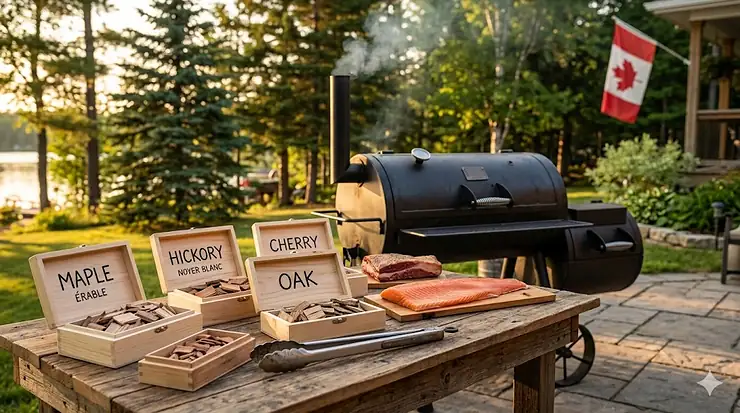
Ever wonder why your neighbour’s smoked brisket tastes like it came straight from a Texas pitmaster, while yours tastes like, well, meat that happened to be near fire? The secret isn’t some magical rub or expensive smoker—it’s understanding the wood chip flavor guide for smoking meat properly.
After spending countless summers experimenting in my backyard (and enduring more than a few disappointing dinners), I’ve learned that choosing the right smoking wood is the difference between “that’s nice” and “can I have the recipe?” Most Canadian home cooks overlook this critical step, grabbing whatever’s on sale at Canadian Tire without realizing that mesquite and brisket don’t always play nice, or that apple wood can turn your pork ribs into something your guests will actually remember.
In this comprehensive guide, you’ll discover how to match wood chips with specific proteins, understand flavour intensity scales, avoid common mistakes that plague Canadian backyard pitmasters, and navigate the unique challenges of smoking in our climate—from dealing with cold-weather battery drain in electric smokers to managing moisture levels during those unpredictable prairie springs. Whether you’re smoking salmon on Vancouver Island or perfecting brisket in southern Ontario, this wood chip flavor guide for smoking meat will help you create restaurant-quality results every single time.
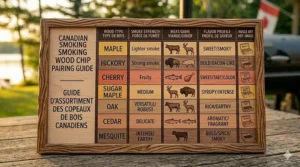
Quick Comparison: Wood Chip Flavours at a Glance
| Wood Type | Flavour Profile | Smoke Strength | Best Protein Matches | Ideal For Canadian Climate |
|---|---|---|---|---|
| Apple | Mild, sweet, fruity | Light | Pork, poultry, fish | Year-round; gentle enough for short Canadian summer smoking sessions |
| Cherry | Sweet, slightly tart, fruity | Medium | Pork, beef, poultry, game | Excellent for cold-smoking in cooler months; adds beautiful mahogany colour |
| Hickory | Bold, bacon-like, sweet | Strong | Pork ribs, beef, bacon | Perfect for long winter smokes; stands up to wind and temperature fluctuations |
| Mesquite | Intense, earthy, bold | Very Strong | Beef (steaks, burgers) | Best for quick, hot smokes; overwhelming on longer cooks |
| Oak | Moderate, clean, versatile | Medium | Beef brisket, lamb, game | The workhorse for Canadian pitmasters; reliable in all seasons |
| Maple | Sweet, subtle, mild | Light-Medium | Poultry, pork, vegetables | Quintessentially Canadian; pairs beautifully with locally-sourced proteins |
| Pecan | Rich, nutty, sweet | Medium | Pork, poultry, fish | Southern cousin to hickory; less aggressive, more forgiving |
💬 Just one click — help others make better buying decisions too! 😊
Top 7 Wood Chips for Smoking Meat: Expert Analysis (Available on Amazon.ca)
1. Camerons Products Hickory Wood Chunks
When most Canadian pitmasters think “smoking,” they think hickory—and for good reason. The Camerons Products Hickory Wood Chunks deliver that classic, bold bacon-like flavour that transforms ordinary pork ribs into something your guests will request at every summer gathering.
This 4.5 kg (10 lb) bag offers coarse-cut, kiln-dried chunks rather than fine chips, which means they burn slower and produce steadier smoke—crucial when you’re managing temperature in a Canadian spring where it’s 18°C one hour and 8°C the next. The larger chunk size also means less frequent refilling, which matters when you’re doing a 12-hour brisket smoke in October and don’t want to keep opening your smoker in cold weather. Hickory’s phenol content creates that quintessential smoke ring Canadian BBQ enthusiasts obsess over, and it penetrates deeply enough that even a thick-cut Alberta beef roast gets flavoured throughout.
In my experience, what separates good hickory from mediocre is moisture content—wet or improperly dried wood produces acrid, bitter smoke that ruins meat. Camerons kiln-dries their chunks to around 8-10% moisture, which is the sweet spot for clean-burning smoke. Canadian reviewers consistently mention the chunks ignite predictably and don’t produce the creosote buildup that cheaper alternatives cause.
Pros:
✅ Slower burn rate than chips—ideal for low-and-slow Canadian smokes
✅ Bold flavour stands up to wind and temperature fluctuations
✅ Larger 4.5 kg bag means fewer Amazon.ca reorders
Cons:
❌ Can overpower delicate proteins like trout if you’re not careful
❌ Chunks require slightly more heat to get smoldering than fine chips
Price Range: Around $35-$45 CAD
Value Verdict: For serious Canadian pitmasters doing regular long smokes, this bag delivers better cost-per-smoke than smaller chip packets.
2. Western BBQ Smoking Wood Chips Variety Pack (4-Pack)
Starting out and not sure which wood flavour you’ll prefer? The Western BBQ Smoking Wood Chips Variety Pack solves the beginner’s dilemma by giving you apple, mesquite, hickory, and cherry—essentially covering the entire flavour spectrum from mild to intense.
Each variety comes in separate 1.8 lb (approximately 800g) bags, which might seem small compared to bulk options, but here’s why that matters for Canadian users: our smoking season is compressed. Unless you’re in southern BC, you’re likely doing most of your smoking from May through September, maybe stretching into October if you’re determined. Smaller bags mean you can experiment without committing to 5 kg of a wood type you might not love, and they don’t go stale sitting in your garage through a six-month winter.
The apple in this pack gives you that gentle, fruity sweetness perfect for pork tenderloin or chicken thighs. Mesquite brings the intensity—I’d reserve it exclusively for quick beef cooks like tri-tip or burgers; any longer and it gets aggressive. Hickory delivers reliable boldness for ribs, while cherry adds a gorgeous reddish hue to brisket while keeping flavours balanced. Canadian Amazon.ca reviewers specifically praise this pack for helping them discover that cherry-hickory blends (roughly 60% cherry, 40% hickory) create incredible depth on pulled pork.
Pros:
✅ Perfect starter pack for experimenting with different flavours
✅ Smaller bags stay fresh through Canada’s short smoking season
✅ Ships reliably across Canada with Prime eligible
Cons:
❌ Slightly higher cost-per-kilogram than buying single-flavour bulk
❌ Fine chips burn faster than chunks—more frequent refilling needed
Price Range: Around $30-$40 CAD
Value Verdict: Ideal for beginners or anyone wanting to explore flavour combinations before committing to bulk purchases.
3. Napoleon Applewood Smoking Chips
As a Canadian company, Napoleon understands our climate challenges better than most American brands—and their Applewood Smoking Chips reflect that knowledge. These chips are specifically cut and dried to handle the moisture variability Canadian smokers face, from humid Ontario summers to bone-dry Alberta conditions.
Apple wood produces a mild, slightly sweet smoke with subtle fruity notes that enhance rather than dominate your meat. This makes it extraordinarily forgiving—you’d have to try pretty hard to over-smoke something with apple. It’s particularly brilliant with pork (the classic pairing), poultry, and delicate fish like Arctic char or trout. What most people don’t realize is that apple wood also works beautifully for cold-smoking cheese, which is practical in Canadian climates where maintaining the 15-25°C sweet spot for cold smoking is actually easier than in warmer regions.
Napoleon chips are cut slightly coarser than many American brands, which gives you 15-20% longer burn time—not a huge difference, but it adds up over a 6-hour pork shoulder smoke. They’re also readily available at Canadian Tire, Home Hardware, and Home Depot if you run out mid-smoke and need emergency supplies (though Amazon.ca usually offers better pricing). Canadian reviewers note these chips produce thin blue smoke rather than thick white smoke, which is exactly what you want—thick white smoke means incomplete combustion and bitter flavours.
Pros:
✅ Made by a Canadian company that understands our smoking conditions
✅ Forgiving flavour profile—difficult to overdo
✅ Available at multiple Canadian retailers for emergency restocking
Cons:
❌ Mild flavour won’t satisfy those who want aggressive smoke
❌ Lighter smoke can struggle in windy prairie conditions
Price Range: Around $15-$22 CAD for 900g
Value Verdict: Premium pricing for Canadian-engineered reliability, worth it if you value consistency.
4. Wood Smoking Chips Kit with 4 Flavours (Oak, Cherry, Hickory, Apple)
For the Canadian home cook who wants versatility without breaking the bank, this 4-flavour smoking chips kit delivers practical portions of the four most useful woods. Each 16 oz (approximately 450g) tin gives you enough for 3-4 smoking sessions, and the resealable metal tins actually matter in Canadian climates where basement storage can get damp.
What sets this kit apart is the oak inclusion—often overlooked but absolutely essential for Canadian beef smoking. Oak provides a medium, clean smoke that lets the natural beef flavour shine through, which is crucial when you’re working with premium AAA Alberta beef that cost you $18/lb CAD. It doesn’t compete with the meat; it complements it. The cherry adds colour and gentle sweetness, hickory brings boldness for pork, and apple handles poultry and fish duties.
Canadian Amazon.ca reviewers mention this kit works exceptionally well for urban condo dwellers using electric smokers on balconies—the smaller tins store easily, and the chips’ fine cut means they smolder quickly even in lower-wattage electric units that struggle to maintain heat in cooler weather. One Toronto reviewer noted using this exclusively on their 11th-floor balcony without neighbor complaints, suggesting the smoke output is manageable for close-quarters Canadian living.
Pros:
✅ Metal tins protect chips from Canadian basement dampness
✅ Includes oak—often missing from variety packs but essential for beef
✅ Fine-cut chips work well in electric smokers popular in Canadian condos
Cons:
❌ Smaller portions mean more frequent reordering
❌ Fine chips can produce heavier smoke if you’re not careful with quantity
Price Range: Around $35-$48 CAD
Value Verdict: Excellent for apartment and condo dwellers with space constraints and electric smoker setups.
5. Camerons Products Cherry Wood Chunks
If you could only buy one wood type for the rest of your Canadian smoking career, cherry might be the smartest choice—and Camerons Products Cherry Wood Chunks represent the gold standard for this versatile wood.
Cherry produces a fruity, slightly sweet smoke that’s stronger than apple but gentler than hickory, landing perfectly in the middle of the intensity scale. More importantly for Canadian pitmasters, cherry imparts a stunning mahogany-red colour to your bark that makes your brisket or ribs look like they came from a competition team. That visual appeal matters when you’re serving smoked meats at family gatherings—presentation counts.
The 4.5 kg (10 lb) bag gives you serious value, especially if you’re smoking regularly. Based on typical usage (about 300-400g per smoking session), this bag covers roughly 12-15 smokes. For the price point around $35-$45 CAD, you’re looking at under $3 per smoke for fuel—less than what you’d spend on a beer while tending your smoker. Cherry also mixes brilliantly with other woods: try 70% cherry with 30% hickory for pork ribs, or blend with oak for beef. Canadian smokers in colder climates appreciate that cherry chunks maintain steady smoke output even when ambient temperatures drop—I’ve successfully smoked in 5°C October weather with consistent results.
Pros:
✅ Versatile enough for pork, beef, poultry, and game
✅ Produces beautiful mahogany bark colour
✅ Excellent mixing wood for creating custom flavour profiles
Cons:
❌ Larger chunks mean slightly longer to reach proper smoldering temperature
❌ Sweet notes might not appeal to those who prefer purely savoury smoke
Price Range: Around $35-$45 CAD
Value Verdict: Best all-around wood for Canadian pitmasters who want one reliable go-to option.
6. RONYX Wood Chips for Cocktail Smoker – 8 Flavours
While primarily marketed for cocktail smoking, the RONYX 8-Flavour Wood Chips Variety Pack deserves attention from meat smokers because it includes some unusual woods you won’t find elsewhere on Amazon.ca—walnut, sophora, pear, and peach alongside the classics.
Each 1 oz (approximately 28g) tin might seem tiny, but for experimenting with unconventional flavours before committing to bulk purchases, it’s perfect. Walnut produces an intense, slightly bitter smoke that works beautifully with game meats like venison or wild boar that many rural Canadians hunt. Pear gives similar results to apple but with slightly more complexity. Peach offers delicate sweetness ideal for fish. The inclusion of sophora (Japanese pagoda tree) is genuinely unusual—it produces a subtle, almost tea-like smoke that I’ve found works surprisingly well with duck.
The airtight tins are brilliantly designed for Canadian storage conditions. Anyone who’s dealt with basement humidity ruining wood chips will appreciate this. That said, the fine sawdust cut means these burn fast—you’re looking at 20-30 minutes per tin, not hours. This makes them more suitable for quick cold-smoking applications or for adding finishing smoke in the last 30 minutes of a cook rather than all-day smoking marathons.
Pros:
✅ Access to unusual wood varieties not readily available in Canada
✅ Perfect for experimentation without bulk commitment
✅ Excellent airtight storage for Canadian climates
Cons:
❌ Tiny portions mean you’ll need dedicated bulk woods for actual smoking
❌ Sawdust-fine cut burns too quickly for low-and-slow methods
Price Range: Around $30-$42 CAD
Value Verdict: Specialized tool for adventurous Canadian smokers wanting to expand beyond traditional flavours.
7. Premium Hickory Wood Chips for BBQ Smoking – 1 Kg (David’s Pantry)
For Ontario and Quebec smokers specifically, David’s Pantry Premium Hickory Wood Chips deserve mention because they’re Canadian-sourced and often available through regional distributors with faster shipping to eastern Canada than western-based suppliers.
The 1 kg bag hits a sweet spot for occasional smokers—enough for 5-7 smoking sessions but won’t sit in your garage for two years going stale. These chips are kiln-dried to approximately 10% moisture content, which is slightly higher than Camerons but still well within the acceptable range for clean smoke. The slightly higher moisture actually benefits electric smoker users who struggle with chips igniting too quickly in lower-temperature smoking scenarios.
What eastern Canadian reviewers specifically mention is the consistent chip size—no excessive sawdust that can clog smoker boxes, and no oversized chunks that won’t fit in smaller units. If you’re using a Masterbuilt electric smoker (extremely popular in Canadian suburban yards), these chips fit the loading tray perfectly. The hickory flavour leans slightly sweeter than mesquite but bolder than oak, making it ideal for St-Louis style ribs or Montreal-style smoked meat if you’re doing your own pastrami.
Pros:
✅ Canadian-sourced with often faster eastern Canada shipping
✅ Perfect size for Masterbuilt and similar popular electric smokers
✅ Intermediate bag size prevents waste for occasional smokers
Cons:
❌ Limited to hickory—no variety options
❌ Slightly higher per-kilogram cost than bulk bags
Price Range: Around $18-$25 CAD
Value Verdict: Excellent choice for eastern Canadian casual smokers who don’t need bulk quantities.
Understanding Wood Smoke Science: How Flavour Actually Develops
Here’s something most backyard BBQ guides won’t tell you: smoke is produced by burning or smoldering plant materials, most often wood, and optimal smoke flavor occurs at low, smoldering temperatures between 300 and 400°C for the wood itself—not the cooking chamber temperature, which is much lower. When you understand this distinction, you’ll realize why soaking your chips (a controversial practice) affects smoke production so dramatically.
Wood contains three main components that matter for smoking: cellulose, hemicellulose, and lignin. When burned, lignin breaks down and produces syringol and guaiacol—the two key compounds responsible for that smoky taste you enjoy. Different wood species contain varying ratios of these compounds, which is exactly why cherry tastes different from mesquite. Cherry wood has higher syringol content, producing sweeter, fruitier notes. Mesquite contains more guaiacol, resulting in that bold, earthy intensity.
Canadian smokers face a unique challenge that Texas pitmasters don’t: temperature instability. When you’re smoking in Alberta in May and the temperature drops from 15°C to 5°C overnight, your wood combustion changes. Colder ambient temperatures mean you need to increase your heat source to maintain proper wood smoldering temperatures, which is why propane consumption spikes during shoulder-season smoking. Electric smoker users particularly struggle—many budget electric units can’t generate enough heat in temperatures below 8°C to properly smolder chips, resulting in heavy white smoke instead of the thin blue smoke you want.
The “smoke ring”—that pink layer beneath the meat’s surface—isn’t actually smoke flavour, despite what many believe. It’s caused by a chemical reaction between nitric oxide gas in smoke and myoglobin in meat, keeping that red colour from turning brown. While it looks impressive on Instagram, it contributes virtually nothing to taste. What does matter is smoke penetration, and this is where Canadian climate becomes relevant. Moist meat surfaces grab smoke better than dry surfaces, and our higher average humidity (particularly in Ontario, Quebec, and coastal BC) actually benefits smoke adhesion compared to drier American states.
One critical insight from research: nearly 80% of smoked fish in most African nations uses hot smoking methods, with the flavor preferred by local consumers, demonstrating that cultural preferences around smoke intensity vary dramatically. Canadian palates tend toward moderate smoke—we’re not Texas (heavy smoke) or California (light smoke). This middle-ground preference makes cherry, oak, and maple particularly well-suited for Canadian tastes, while mesquite often gets described by Canadian reviewers as “too much” unless used sparingly.
For Canadian regulations, it’s worth noting that the Canadian Food Inspection Agency defines cold smoke temperatures as generally less than 30°C, and products that are cold smoked and have the appearance of being ready-to-eat must meet specific labelling requirements under the Meat Inspection Regulations. If you’re cold-smoking salmon or making your own bacon, understanding these temperature thresholds matters for food safety.
Apple Wood vs Cherry Wood: The Great Canadian Smoking Debate
Ask ten Canadian pitmasters their preferred fruitwood and you’ll get a surprisingly even split between apple and cherry. Both produce sweet, fruity smoke, but the differences matter more than you might think.
Apple wood delivers extremely mild, almost delicate sweetness with faint fruity notes. It’s the gentlest mainstream smoking wood, which makes it nearly foolproof—you’d have to leave meat smoking for 20+ hours to risk over-smoking with apple. This forgiveness appeals to beginners and to Canadian cooks working with expensive proteins where you can’t afford mistakes. A $45 CAD organic chicken from your local farm deserves wood that won’t overpower it. Apple’s lighter smoke also penetrates less deeply, meaning the outer bark gets most of the flavour while the interior meat retains more of its natural taste. This works beautifully for pork chops or chicken breasts where you want smoke as an accent, not the dominant flavour.
Apple wood’s subtlety becomes a liability in windy conditions common across prairie provinces. Light smoke simply blows away before adequately penetrating meat, leaving you with inconsistent flavour distribution. Manitoba and Saskatchewan smokers frequently report this frustration—you get great flavour on the windward side and virtually nothing on the leeward side. The solution is either using more apple wood (expensive) or switching to a bolder variety.
Cherry wood brings noticeably more intensity while maintaining fruity character. The smoke is still sweet but with subtle tartness that adds complexity. More importantly, cherry produces significantly better bark colour—that gorgeous mahogany-red exterior that makes your meat photogenic. For Canadian competition teams, cherry is almost mandatory because judges expect that visual.
The flavour difference is most apparent on longer smokes. On a 4-hour chicken smoke, apple and cherry taste fairly similar. But on a 12-hour brisket smoke, cherry develops layered complexity that apple simply can’t match. You get the initial sweet hit, followed by subtle fruity notes, finishing with a hint of tartness that cuts through beef fat beautifully. Apple stays one-dimensional by comparison.
Cherry also holds up better in Canadian weather extremes. The slightly more robust smoke penetrates more reliably, meaning wind and temperature fluctuations affect it less. Vancouver Island smokers particularly appreciate this—coastal winds can be brutal, and cherry persists where apple would fade.
My recommendation for Canadians: Start with cherry as your default fruitwood. It’s more forgiving than hickory while being more reliable than apple in our variable conditions. Reserve apple for delicate fish or situations where you explicitly want minimal smoke presence. And if you’re serious about pork ribs, try blending 60% cherry with 40% hickory—it creates a sweet-smoky balance that Canadian palates consistently love.
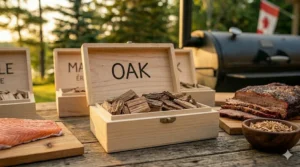
Best Wood Chips for Pork Ribs: A Canadian Pitmaster’s Guide
Pork ribs represent the quintessential North American smoking challenge, and Canadian pitmasters have refined some specific approaches that differ from American traditions. The wood you choose dramatically affects whether your ribs taste like backyard BBQ or competition-worthy.
The Classic: Hickory remains the default choice for Canadian pork ribs, and there’s good reason this tradition persists. Hickory’s bold, bacon-like smoke penetrates pork fat beautifully, creating that familiar BBQ taste everyone expects when they bite into ribs. The smoke intensity stands up to heavy rubs—if you’re using a Montreal-style spice blend or anything with significant pepper and garlic, hickory won’t get lost. It also handles the 3-2-1 method (3 hours smoke, 2 hours wrapped, 1 hour sauced) that many Canadian backyarders use, maintaining flavour presence even after wrapping.
The downside? Hickory can become overwhelming if you’re heavy-handed. I’ve made this mistake more than once—assuming “more smoke = better” and ending up with ribs that taste like an ashtray. With hickory, less is genuinely more. Use approximately 200-250g for a typical 4-5 hour rib smoke, not the full smoker box.
The Sweet Spot: Cherry has become my personal favourite for pork ribs over the last five years. It delivers sweet, fruity complexity that enhances pork’s natural flavour without dominating it. The mahogany bark colour it produces makes your ribs look professional even if you’re just feeding the family. More importantly, cherry is forgiving—you can run a bit heavy on chips without ruining the meat.
Cherry shines particularly bright when paired with fruit-based sauces or glazes. If you’re finishing your ribs with a peach-bourbon glaze or apple cider reduction (both popular in Ontario and Quebec), cherry wood creates flavour harmony instead of competition. It’s also my go-to when cooking for people who aren’t huge smoke fans—it gives them “BBQ taste” without the aggressive smoke punch that puts some folks off.
The Wild Card: Maple deserves more attention from Canadian rib smokers. As our national tree, maple produces characteristically Canadian results—sweet, mild, and utterly distinct from American BBQ traditions. Maple smoke has almost caramel-like qualities that work beautifully with pork, especially when you’re using Canadian-sourced heritage breed pork that has more natural sweetness than commodity pork.
The challenge is finding quality maple chips. Many sold on Amazon.ca are actually American soft maple, which produces inconsistent results. Look specifically for Canadian hard maple (sugar maple) for best results. Quebec smokers have an advantage here—local access to genuine sugar maple sawdust and chips means you’re getting the real thing.
My Three-Rib Formula for Canadians:
- Competition ribs (when you need to impress): 70% cherry, 30% hickory
- Traditional BBQ ribs (for the purists): 100% hickory, but use restraint
- Uniquely Canadian ribs (for adventurous eaters): 60% maple, 40% cherry
Temperature control matters more in Canadian climates than Americans realize. When you’re smoking ribs in 12°C spring weather versus 25°C summer conditions, your wood consumption changes by 30-40%. Colder smoking requires more frequent chip additions to maintain steady smoke, which is why I always keep extra bags on hand during shoulder seasons.
Mesquite Wood Chips for Beef: When and How to Use This Intense Smoke
Mesquite occupies a controversial position in Canadian smoking circles. American BBQ traditionalists swear by it for beef. Many Canadian cooks try it once, declare it “too strong,” and never touch it again. Both groups are partially right—mesquite is all about proper application.
What Makes Mesquite Different: Mesquite is categorized among woods with a strong flavor, producing the most intense smoke of any commonly available wood. The flavour profile is earthy, bold, and slightly sweet with almost resinous notes. It comes from the harsh, arid conditions where mesquite trees grow—primarily southwestern United States and Mexico. Those environmental stressors create dense wood with high lignin content, resulting in powerful smoke compounds.
For Canadians used to milder woods like maple or apple, mesquite can shock the palate. The first time I used it on a brisket, I thought I’d ruined $80 worth of AAA Alberta beef—the exterior bark tasted like I’d licked a campfire. The problem wasn’t the mesquite itself but my application: I’d used it like hickory, running a full smoker box for a 14-hour cook. Mesquite requires completely different handling.
The Right Way to Use Mesquite in Canada:
For Burgers and Steaks: This is where mesquite genuinely shines. Quick, hot cooks over direct heat allow mesquite to add bold smoke character without becoming overwhelming. A 1.5-inch thick ribeye cooked over mesquite-fueled charcoal develops incredible crust with deep smoky flavour that complements beef fat perfectly. Budget 30-45 minutes maximum smoke exposure.
For Brisket (Advanced Technique): If you’re determined to mesquite-smoke brisket Canadian-style, use what Texas pitmasters call the “mesquite fade” method. Start your smoke with mesquite for the first 2 hours only, then switch to oak or hickory for hours 3-12. This gives you mesquite’s signature flavour in the bark without the bitterness that develops with prolonged exposure.
Blending Approach: Mix mesquite with milder woods at 25% mesquite, 75% oak or apple. This lets you introduce mesquite character while the other wood moderates intensity. I’ve found this works exceptionally well for tri-tip—a cut that benefits from bold flavour but can’t handle full mesquite’s intensity.
Canadian Climate Considerations: Mesquite’s intensity actually makes it somewhat weather-resistant—even in windy prairie conditions, the smoke is strong enough to penetrate reliably. However, the same boldness that helps in wind becomes problematic in enclosed smoking environments. Urban Canadian smokers using electric units on apartment balconies should be cautious; mesquite produces heavier smoke that neighbors notice (and sometimes complain about).
When to Avoid Mesquite:
- Delicate proteins (chicken, fish, pork) unless you enjoy campfire-flavoured food
- Long, low-and-slow cooks exceeding 6 hours
- When serving people unfamiliar with bold smoke (your in-laws probably won’t appreciate it)
- Cold-smoking applications—the intensity ruins rather than enhances
Bottom Line for Canadians: Mesquite deserves a place in your wood arsenal, but it’s a specialized tool, not your everyday workhorse. Buy a small bag, use it for burgers and steaks, and reserve it for moments when you explicitly want aggressive smoke. For most Canadian smoking applications, oak or hickory delivers better, more crowd-pleasing results.
Wood Pairing with Protein: The Complete Canadian Guide
Matching wood to protein isn’t arbitrary tradition—it’s chemistry and texture interaction. Understanding why certain pairings work helps you make informed choices rather than blindly following rules.
Beef
Best Woods: Oak (primary), hickory (traditional), mesquite (advanced)
Why It Works: Beef contains high fat content and robust flavour that stands up to bolder smoke. Oak is versatile and rich, best for beef, pork, poultry, sausage, wild game with strong smoke strength. The moderate oak smoke lets premium Canadian beef’s natural flavour shine while adding smoky depth. Brisket, in particular, needs wood that penetrates deeply through thick fat caps—oak delivers this reliably over 12-14 hour smokes common in Canadian backyards.
Canadian AAA and Prime beef grades have more marbling than American Select beef, which means they can handle slightly heavier smoke without becoming overwhelmed. If you’re working with grass-fed Alberta beef, consider going 10-15% lighter on smoke—grassfed has more pronounced natural flavour that lighter smoke complements better.
Avoid: Apple, maple—too mild for beef’s intensity
Pork
Best Woods: Cherry (premium choice), apple (classic), hickory (traditional)
Why It Works: Pork’s sweet, mild flavour accepts nearly any wood, making it the most forgiving protein for experimentation. Cherry wood chips add delicate, fruity notes and a hint of red color to meats, with versatile and rich flavor profile. This colour development matters for pork aesthetics—a gorgeous mahogany bark elevates presentation dramatically.
Canadian pork, particularly heritage breeds from Ontario and Quebec farms, tends toward higher fat content than commodity pork, which means it benefits from slightly longer smoke exposure. Sweet fruitwoods penetrate this fat beautifully, creating layered complexity. For pulled pork specifically, I recommend cherry as your base with 20-30% hickory added during the final 3 hours of smoking for traditional BBQ depth.
Pro Tip: Pork butt and ribs can handle heavier smoke than pork chops or tenderloin. Adjust wood quantity accordingly.
Poultry
Best Woods: Apple (safest), cherry (for colour), maple (Canadian twist)
Why It Works: Apple wood wafts a mildly sweet and fruity essence that works wonderfully with chicken and turkey, imbuing the food with light, refreshing zest. Chicken and turkey have delicate flavour that heavy smoke overwhelms easily—I’ve ruined more than one holiday turkey by over-smoking with hickory.
The key challenge with poultry is skin. Chicken skin gets rubbery and unpleasant when over-smoked, which is why you want lighter woods that flavour the meat without destroying texture. Canadian climate affects this—if you’re smoking in humid conditions (Ontario summers, coastal BC), moisture helps prevent skin from getting too tough. In dry prairie climates, you’ll need water pans and lighter smoke to avoid leather-like skin.
Avoid: Mesquite, heavy hickory—too aggressive for delicate poultry flavour
Fish
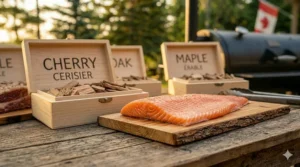
Best Woods: Alder (Pacific Northwest tradition), apple (gentle), maple (Canadian specialty)
Why It Works: Alder will typically give you the least amount of smoke but adds a nice sweet profile to more delicate types of meat, great for and primarily used on fish. Pacific salmon, Arctic char, and lake trout all benefit from alder’s subtle sweetness that enhances rather than masks delicate fish oils.
Canadian fish smoking divides regionally. West coast smokers follow Pacific Northwest traditions using alder almost exclusively. Eastern Canadian smokers working with Atlantic salmon or Great Lakes trout often prefer apple or maple. Both approaches work—the question is whether you want traditional “smoked salmon” flavour (alder) or something uniquely Canadian (maple).
Critical Warning: Fish over-smokes faster than any other protein. Limit smoking time to 2-3 hours maximum, and use approximately 30-40% less wood than you’d use for equivalent meat weight.
Game Meats (Venison, Wild Boar, Duck)
Best Woods: Hickory (traditional), cherry (modern), oak (reliable)
Why It Works: Wild game carries stronger, sometimes gamey flavours that benefit from bolder smoke to balance those notes. Venison’s lean composition means limited fat to carry smoke flavour, so you need slightly more smoke penetration than with comparable beef cuts.
Many rural Canadians hunt, making game smoking practically relevant. Duck breast responds beautifully to cherry wood—the sweet-tart smoke cuts through duck’s richness while the mahogany colour makes it visually stunning. Wild boar sits somewhere between domestic pork and beef flavourwise; treat it like pork with 20% more smoke intensity.
Canadian Twist: Try maple with venison for distinctly Canadian results—the subtle caramel notes complement venison’s natural sweetness surprisingly well.
Smoking Wood Strength Chart: From Gentle to Intense
Understanding smoke strength hierarchy helps you make confident wood choices without trial-and-error waste. Here’s the spectrum from mildest to strongest:
Ultra-Mild (Barely There):
- Alder: Almost neutral, delicate sweetness
- Use for: Fish, cheese, very delicate proteins
- Canadian Climate Notes: Works year-round; won’t penetrate in windy conditions
Mild (Gentle Accent):
- Apple: Sweet, fruity, light
- Maple: Sweet, subtle, caramel-like
- Use for: Poultry, pork chops, fish
- Canadian Climate Notes: Best in calm conditions; prairie wind reduces effectiveness
Medium (Balanced Smoke):
- Cherry: Sweet-tart, fruity, versatile
- Pecan: Nutty, sweet, complex
- Use for: Pork ribs, chicken, turkey, lighter beef
- Canadian Climate Notes: Handles moderate wind; reliable across Canadian climates
Medium-Strong (Traditional BBQ):
- Oak: Clean, earthy, moderate
- Hickory: Bold, bacon-like, sweet
- Use for: Pork ribs, beef brisket, heavy meats
- Canadian Climate Notes: Weather-resistant; maintains presence in temperature fluctuations
Strong (Aggressive Smoke):
- Mesquite: Intense, earthy, almost resinous
- Walnut: Strong, slightly bitter, complex
- Use for: Beef (short cooks), game meats
- Canadian Climate Notes: Wind-resistant but easily overwhelms in longer smokes
The 50% Rule for Canadian Conditions: Whatever wood strength you’d use in ideal calm, 20°C conditions, drop down one level if you’re smoking in windy or cold weather. Wind disperses smoke before it adequately penetrates, while cold temperatures slow smoke compound absorption. This means your “medium” hickory needs to become “medium-strong” intensity through increased quantity to achieve similar results.
Blending for Custom Strength: You don’t need to stick with single woods. Create custom strength levels by blending:
- 75% mild + 25% strong = medium result (e.g., 75% apple + 25% hickory)
- 60% medium + 40% strong = medium-strong (e.g., 60% cherry + 40% hickory)
- 50% strong + 50% mild = balanced medium (e.g., 50% oak + 50% apple)
Canadian Pitmaster’s Secret: Keep three woods on hand—one mild (apple/maple), one medium (cherry/oak), and one strong (hickory). This trio covers 95% of smoking situations and allows limitless blending combinations.
Mixing Wood Flavours: Advanced Techniques for Canadian Smokers
Once you’ve mastered single-wood smoking, blending opens entirely new flavour dimensions. But mixing isn’t random—there are principles that separate brilliant combinations from muddled messes.
The 60/40 Rule: Your dominant wood should comprise 60-70% of the blend, with complementary wood making up the remaining 30-40%. This ensures a clear flavour profile rather than confused smoke. Example: 60% cherry (sweet, fruity baseline) + 40% hickory (bold, savoury depth) creates cherry-forward ribs with BBQ backbone.
Complementary vs. Contrasting Blends:
Complementary blends use woods from similar flavour families. Apple + cherry (both fruity) creates intensified fruitiness with cherry’s tartness preventing cloying sweetness. Hickory + oak (both traditional BBQ) produces classic smoke flavour with hickory’s boldness softened by oak’s neutrality.
Contrasting blends pair opposite flavour profiles for complexity. Mesquite + apple sounds bizarre but works brilliantly on beef tri-tip—mesquite’s intensity cut by apple’s sweetness creates balanced results neither achieves alone. Maple + hickory gives you sweet-smoky contrast perfect for Canadian-style pulled pork.
Regional Canadian Blends Worth Trying:
The Ontario Mix: 50% maple + 30% cherry + 20% oak
Why it works: Quintessentially Canadian flavour (maple) balanced with fruity sweetness (cherry) and traditional BBQ depth (oak). Excellent for pulled pork or chicken.
The Prairie Blend: 60% hickory + 40% mesquite
Why it works: Both woods resist wind effectively, creating reliable smoke penetration in Alberta/Saskatchewan conditions. Bold enough for thick-cut beef but not overwhelming.
The Coastal BC Formula: 70% alder + 30% apple
Why it works: Traditional Pacific salmon smoke (alder) brightened with apple’s subtle fruitiness. Stays delicate enough for fish while adding complexity.
The Quebec Twist: 60% maple + 40% cherry
Why it works: Local maple dominance with cherry’s colour and tart notes. Creates distinctly French-Canadian flavour profile different from American BBQ.
Timing Your Wood Additions: Don’t assume you need consistent wood blend throughout the smoke. Many Canadian competition teams use what’s called “front-loading”—heavier, bolder woods (hickory, mesquite) for the first 25% of cook time to establish smoke ring and bark, then switching to milder woods (apple, cherry) for the remaining 75% to add complexity without bitterness.
For a 12-hour brisket smoke: Hours 1-3 use 100% hickory, hours 4-8 use 60% cherry + 40% oak, hours 9-12 use 100% cherry. This creates layered complexity impossible to achieve with single-wood smoking.
Canadian Climate Mixing Consideration: Cold weather changes how smoke compounds interact with meat. In temperatures below 10°C, phenol absorption slows by approximately 15-20%, meaning you need either longer smoke exposure or slightly heavier wood to achieve equivalent flavour. When mixing in cold conditions, bias toward stronger woods in your blend. Your typical 60% cherry + 40% hickory becomes 50% cherry + 50% hickory in October smoking.
The Forbidden Combinations: Some wood mixes genuinely don’t work:
- Mesquite + maple: Overly sweet-aggressive confusion
- Multiple fruitwoods (apple + cherry + peach): Muddled fruitiness with no definition
- Hickory + mesquite + oak: Too many strong voices competing
My Go-To Blends by Protein:
- Pork ribs: 60% cherry + 40% hickory
- Beef brisket: 50% oak + 30% cherry + 20% hickory
- Whole chicken: 70% maple + 30% apple
- Pulled pork: 50% hickory + 30% cherry + 20% maple
- Salmon: 80% alder + 20% apple
Experimentation is encouraged, but keep notes. Canadian smoking season is short—you don’t want to waste precious summer weekends relearning what worked last year.
Common Mistakes Canadian Smokers Make (And How to Avoid Them)
Mistake #1: Soaking Wood Chips in Water
The Myth: Soaking chips prevents them from burning too quickly and produces more smoke.
The Reality: Wet wood doesn’t produce smoke—it produces steam. When you soak chips for hours then throw them on hot coals, they spend the first 20-30 minutes evaporating water before they begin smoldering. This delays smoke production and can create heavy white smoke (incomplete combustion) rather than thin blue smoke.
What Actually Happens: The water on the surface of the chips keeps the wood below its combustion temperature temporarily. Once it evaporates, the chips ignite normally—meaning you’ve gained nothing except delayed smoke and wasted time.
The Canadian Exception: In extremely dry prairie conditions (humidity below 20%), a 15-20 minute soak can slow combustion slightly. But even then, using larger wood chunks achieves the same result more reliably without the steaming phase.
Better Approach: Use dry chips but control their burn rate through quantity and placement. Smaller amounts smolder longer than large handfuls that ignite quickly.
Mistake #2: Ignoring Canadian Winter Performance Effects
The Problem: Many Canadian smokers assume techniques that work in July will work identically in October. Temperature and humidity dramatically affect wood combustion and smoke penetration.
Cold Weather Reality: When ambient temperature drops below 10°C, several things happen:
- Wood requires more heat to reach proper smoldering temperature
- Smoke compounds absorb 15-20% slower into cold meat
- Electric smokers struggle to maintain heat, producing inconsistent smoke
- Propane consumption increases 30-40%
The Fix: In cold weather, increase wood quantity by 20-25% and expect longer overall cook times. Use insulation blankets for smokers, and consider switching to larger chunks that hold heat better than fine chips. Alberta smokers doing winter brisket know this well—what takes 12 hours in July might need 14-15 hours in November.
Mistake #3: Over-Smoking Fish
The Problem: Treating fish like meat leads to bitter, unpleasant results. Fish has delicate proteins and higher moisture content that absorbs smoke much faster than beef or pork.
Canadian Context: Many Canadians smoke salmon, trout, or pickerel without realizing they need completely different approach. A 6-hour pork smoke translates to maximum 2-3 hours for fish, often less.
The Fix: For hot-smoked fish, limit smoke exposure to 1.5-2 hours maximum. For cold-smoked fish (popular in Canadian traditions), use ultra-mild woods like alder and monitor carefully. If the fish tastes bitter, you over-smoked it—there’s no fixing that.
Mistake #4: Using Softwoods or Treated Lumber
The Danger: Pine, cedar, fir, spruce contain high resin content that produces acrid, terrible-tasting smoke. Worse, treated lumber contains chemicals that are genuinely dangerous when combusted.
Canadian Confusion: Many Canadians have abundant access to pine and spruce (our dominant forest species) and assume “local = better.” It doesn’t work that way with smoking wood. Hardwoods only.
The Fix: Stick exclusively to hardwoods: oak, hickory, maple, cherry, apple, mesquite. If you’re harvesting your own wood in rural Canada, identify the species properly before using it. When in doubt, buy commercially prepared chips from Amazon.ca—the cost is trivial compared to ruining expensive meat.
Mistake #5: Neglecting Canadian Regulations for Home Smoking
The Issue: Cold smoke temperatures are generally less than 30°C, and products that are cold smoked and have the appearance of being ready-to-eat must meet specific Canadian Food Inspection Agency labelling requirements. If you’re smoking for personal consumption, this matters less, but if you’re considering selling smoked meats at farmers markets or giving them as gifts, you need awareness.
The Canadian Reality: Provincial regulations vary. Quebec has stricter requirements for home food preparation than Alberta. If you’re smoking commercially or semi-commercially, consult your provincial health department.
The Fix: For home smoking, focus on proper food safety: maintain safe internal temperatures (63°C for pork, 74°C for poultry), use proper refrigeration, and don’t cut corners on cook times.
Mistake #6: Choosing Wood Based on Price Alone
The Temptation: Amazon.ca shows you hickory chips ranging from $12 to $45 CAD, and you assume they’re basically equivalent.
The Reality: Cheap wood chips often contain excessive bark, sawdust, or moisture. Bark produces bitter smoke. Excessive sawdust ignites too quickly. High moisture creates steam and delays smoke.
Canadian Quality Markers: Look for “kiln-dried,” moisture content ratings below 12%, and Canadian brands like Napoleon that understand our climate. Read reviews from Canadian buyers specifically—they’ll mention whether chips work in cold weather or windy conditions.
The Fix: Budget approximately $20-$40 CAD per kilogram for quality smoking wood. This seems expensive until you realize a kilogram covers 4-6 smoking sessions—less than the cost of one restaurant smoked brisket.
Mistake #7: Not Adjusting for Altitude
The Hidden Factor: If you’re smoking in the Canadian Rockies or high-elevation areas, reduced atmospheric pressure affects combustion. Wood burns differently at 1,500 metres elevation than at sea level.
The Fix: High-elevation smokers may need to increase wood quantity slightly (10-15%) and accept longer ignition times. This affects Calgary and mountain town smokers more than coastal or prairie residents.
How to Choose Wood Chips for Smoking in Canada: The Seven-Point Framework
1. Match Wood Intensity to Protein Type
Start by identifying your primary protein, then select wood strength accordingly. Delicate proteins (fish, chicken breast) demand mild woods (apple, alder, maple). Heavy proteins (brisket, pork shoulder, game) can handle strong woods (hickory, mesquite, oak).
Canadian Climate Adjustment: If smoking in windy conditions (common across prairies), move up one strength level to compensate for smoke dispersal. Your “mild” apple becomes “medium” cherry in 40 km/h winds.
2. Consider Your Smoker Type
Electric smokers (popular in Canadian suburban yards and condos) require finer chips that ignite at lower temperatures. Charcoal and wood-fired smokers can handle chunks and larger pieces. Pellet smokers obviously use pellets, but many owners supplement with chips for flavour variety.
The Canadian Condo Factor: If you’re smoking on an apartment balcony, stick with milder woods (apple, cherry, maple) that produce less visible smoke. Mesquite and heavy hickory create thick smoke that bothers neighbors and potentially violates condo bylaws.
3. Evaluate Flavour Preference
Be honest about your palate. If you think Texas brisket tastes too smoky, you won’t suddenly love mesquite. Canadian tastes trend toward moderate smoke—we’re not Memphis (heavy) or California (light). Cherry and oak typically hit our sweet spot.
Regional Canadian Patterns: Prairie smokers tend toward bolder smoke (hickory, oak). Coastal BC leans milder (alder, apple). Ontario and Quebec split the middle (cherry, maple). These aren’t rules, just patterns worth knowing.
4. Factor in Cook Duration
Long, low-and-slow cooks (10+ hours) accumulate smoke continuously, meaning you want milder woods to prevent bitterness. Short, hot cooks (2-3 hours) can handle stronger woods since exposure time is limited.
Canadian Temperature Reality: Our cooler climate extends cook times. A brisket that takes 10 hours in Texas might need 12-13 hours in Alberta in October. Plan wood selection accordingly—what Americans consider “long smoke” is standard here.
5. Account for Canadian Availability
Exotic woods like cherrybark oak or whiskey barrel oak are hard to source on Amazon.ca and expensive when available. Building your smoking practice around rare woods creates logistical headaches.
Practical Canadian Wood Hierarchy:
- Always Available: Hickory, apple, cherry, mesquite, oak
- Usually Available: Maple, pecan, alder
- Sometimes Available: Walnut, peach, pear
- Rarely Available: Specialty woods (whiskey barrel, wine barrel, etc.)
Focus on the “always available” tier until you’re experienced enough to justify hunting specialty woods.
6. Calculate Cost-per-Smoke
Don’t just look at bag price—calculate actual cost per smoking session. A $45 CAD 4.5 kg bag that lasts 15 sessions ($3 per smoke) is cheaper than a $25 CAD 1 kg bag that lasts 4 sessions ($6.25 per smoke).
Canadian Shipping Consideration: Amazon.ca often offers free shipping over $35. Bundle wood chip purchases with other items to cross this threshold and avoid paying $10+ shipping on a $20 bag of chips.
7. Plan for Storage
Canadian basements and garages experience humidity fluctuations that can ruin wood chips if improperly stored. Wood that absorbs moisture produces terrible steam-heavy smoke.
Canadian Storage Solutions:
- Sealed plastic containers (Rubbermaid totes work perfectly)
- Original bags with chip clips in dry areas
- Vacuum-sealed bags for long-term storage
- Avoid damp basements—store in climate-controlled areas when possible
Wood properly stored in dry Canadian conditions lasts 2-3 years without degradation. Improperly stored wood becomes useless in 6-12 months.
Building Your Canadian Wood Chip Arsenal: The Starter Kit
If you’re new to smoking or want to streamline your collection, here’s the minimum viable wood chip arsenal for Canadian conditions:
Essential #1: Cherry Wood (2-3 kg supply) Your versatile workhorse covering pork, poultry, beef, and game. Buy this first, use it for everything while learning, then branch out.
Essential #2: Hickory (1-2 kg supply) Traditional BBQ backbone for when you want classic smoke flavour. Also essential for blending with milder woods.
Essential #3: Apple or Maple (1-2 kg supply) Your mild option for delicate proteins and situations requiring subtle smoke. Choose apple if you want traditional American BBQ versatility, maple if you want distinctly Canadian flavour.
Optional #4: Oak (1 kg supply) The beef specialist. If you regularly smoke brisket, tri-tip, or steaks, oak is non-negotiable. Otherwise, skip until you’re more experienced.
Optional #5: Mesquite (500g trial bag) Buy small quantities only. Perfect for burgers and quick beef cooks, but easy to overdo. Many Canadian smokers never progress beyond occasional mesquite use—and that’s fine.
Total Investment: Approximately $80-$120 CAD for this complete starter kit, which provides 25-35 smoking sessions. That’s $2.30-$4.80 per smoke—less than a beer while tending your smoker.
Canadian Shopping Strategy:
- Add multiple woods to Amazon.ca cart
- Wait for total to exceed $35 for free shipping
- Check for Subscribe & Save discounts (often 10-15% off)
- Buy larger quantities of your primary wood (cherry or hickory)
- Buy smaller trial quantities of woods you’re unsure about
Frequently Asked Questions About Wood Chips for Smoking in Canada
❓ Can you smoke meat in winter in Canada without special equipment?
❓ Do you need to soak wood chips before smoking meat?
❓ What's the best wood chip for beginners smoking in Canada?
❓ How much wood chips do I need for a typical 6-hour smoke in Canada?
❓ Are Canadian-sourced wood chips better than American imports for smoking?
Conclusion: Your Path to Perfect Canadian Smoked Meat
The wood chip flavor guide for smoking meat isn’t about memorizing complicated charts or following rigid rules—it’s about understanding fundamental principles that let you make confident choices in Canadian conditions. Whether you’re smoking salmon on a Vancouver balcony, perfecting brisket in an Alberta backyard, or exploring maple-smoked pork in Quebec, the right wood transforms good meat into extraordinary meals your family will request repeatedly.
Start simple with cherry or hickory, master the basics in your specific climate, then expand your wood collection as your palate develops. Pay attention to how wind, temperature, and humidity affect your results. Keep notes on what works—Canadian smoking season is too short to waste weekends relearning forgotten lessons.
Remember that expensive smokers and premium meat matter far less than proper wood selection and technique. I’ve eaten $12/kg grocery store pork shoulder smoked over quality cherry wood that put $25/kg heritage breed pork smoked over cheap, wet chips to shame. The wood makes that much difference.
Most importantly, embrace the learning process. Every smoke teaches something—even the failures where you over-smoke chicken or let mesquite run too long on brisket. Those mistakes build the intuition that eventually lets you smoke confidently without constantly second-guessing wood choices.
The Canadian BBQ community is welcoming and generous with advice. Join local smoking groups on Facebook, attend regional competitions, and share your results. We’re all figuring this out together, adapting American traditions to Canadian realities while developing our own distinctive approach to smoked meats.
Now get that smoker fired up—Canadian summer is short, and there’s meat to smoke.
Recommended for You
- Best BBQ Pellets for Brisket Canada 2026: 7 Expert-Tested Picks
- 7 Best Canadian Maple Wood Chips for Smoking (Expert Guide 2026)
- 7 Best Masterbuilt Propane Smokers for Canadian BBQ Lovers 2026
Disclaimer: This article contains affiliate links. As an Amazon Associate, I earn from qualifying purchases. If you purchase products through these links, we may earn a small commission at no additional cost to you.
✨ Found this helpful? Share it with your friends! 💬🤗
