
In This Article
If you’ve invested in a kamado grill, you already know the magic of ceramic cooking—but here’s what most Canadian grillers overlook: your kamado is only as versatile as the accessories you pair with it. While these egg-shaped wonders excel at heat retention and temperature control, the right kamado grill accessories unlock capabilities that turn a good grill into a year-round outdoor kitchen powerhouse, even through Ottawa’s frigid winters or Vancouver’s rainy springs.
The kamado grill traces its roots back over 3,000 years to ancient Chinese ceramic cooking vessels, evolving through Japanese mushikamado rice steamers before American servicemen discovered them after World War II. Today’s ceramic kamados represent the pinnacle of this evolution, combining space-age materials with ancient design principles. But without proper accessories like heat deflectors, quality grates, and protective covers, you’re leaving performance on the table—especially in Canada’s demanding climate where temperature swings and harsh winters test equipment limits.
What makes accessorising a kamado different from a standard gas grill? The ceramic shell’s superior heat retention means accessories must withstand extreme temperatures (up to 750°F) while complementing airflow dynamics. Canadian buyers face additional considerations: winter storage requirements, shorter grilling seasons in some regions, and the reality that not every Amazon.com product ships north of the border. This guide cuts through the noise with real products available on Amazon.ca, honest pricing in CAD, and expert commentary shaped by actual Canadian grilling conditions.
Quick Comparison: Top Kamado Grill Accessories at a Glance
| Accessory Type | Best For | Price Range (CAD) | Winter-Worthy |
|---|---|---|---|
| Heat Deflector Stone | Low & slow smoking, pizza baking | $45-$85 | Yes—store indoors |
| Cast Iron Grate | Searing steaks, grill marks | $65-$120 | Yes—requires seasoning |
| Waterproof Cover | Year-round protection | $50-$95 | Essential for Canadian winters |
| Rotisserie Kit | Whole chickens, roasts | $180-$280 | Remove for winter storage |
| Pizza Stone | Artisan pizza, bread | $40-$75 | Store indoors when freezing |
| Ash Tool & Basket | Easy cleanup | $30-$55 | Year-round use |
| Temperature Controller | Precision smoking | $150-$220 | Protect from moisture |
💬 Just one click — help others make better buying decisions too! 😊
Top 7 Kamado Grill Accessories: Expert Analysis for Canadian Grilling
1. Onlyfire Smokin Stone Heat Deflector — 17.5-Inch
The Onlyfire heat deflector is the workhorse accessory that converts your kamado from direct grilling to low-and-slow smoking or convection baking. Made from cordierite ceramic, this 17.5-inch stone withstands temperatures exceeding 1,450°F—crucial for Canadian grillers who push their kamados hard in cold weather when maintaining stable temps requires hotter fire beds. The stone sits in the fire bowl below your cooking grate, creating an indirect heat barrier that turns your grill into a wood-fired oven.
Here’s what the spec sheet won’t tell you: cordierite’s thermal shock resistance matters more in Canada than warmer climates. When you’re grilling at -15°C in January and need to open the lid to add wood chunks, cheaper ceramic deflectors crack from the temperature differential. The Onlyfire model handles these transitions without developing stress fractures. Compatibility is straightforward—it fits Large Big Green Egg, Kamado Joe Classic, and most 18-inch kamados including Char-Griller Akorn models commonly available at Canadian Tire.
Canadian reviewers consistently praise the dual-purpose functionality: it’s a heat deflector for brisket one weekend, a pizza stone the next. The 0.75-inch thickness provides enough thermal mass to even out hot spots while staying light enough for one-handed installation—important when you’re wearing winter grilling gloves. The main trade-off? No built-in legs means you’ll need a rack or spacers to create drip-pan clearance underneath, but this keeps the price point competitive.
Customer Feedback: Buyers appreciate the snug fit in Large BGE and Kamado Joe Classic setups, with several noting it survived two Canadian winters stored in unheated sheds. One Toronto reviewer mentioned it cracked after being left on the grill through a rain-to-freeze transition—reinforcing the indoor storage rule.
Pros:
✅ Withstands 1,450°F+ temperatures
✅ Dual heat deflector and pizza stone functionality
✅ Thermal shock resistant for Canadian climate swings
Cons:
❌ No built-in legs—requires separate spacers
❌ Hand-wash only (dishwasher will strip seasoning)
Price & Verdict: Around $60-$75 CAD on Amazon.ca. For the price, this is your entry point to indirect cooking—essential if you’re moving beyond burgers into ribs, whole chickens, or sourdough loaves. Budget-conscious Canadians won’t find better value in this category.
2. Kamado Joe Half-Moon Cast Iron Cooking Grate
Cast iron is the secret weapon for sear marks that actually seal in juices—and the Kamado Joe half-moon grate delivers restaurant-quality results without the restaurant price tag. This grate fits the Divide & Conquer cooking system (sold separately on larger setups) and offers 9 inches of pure cast iron surface for direct, high-heat grilling. The material’s heat retention means you get consistent contact even when flipping multiple steaks, and the half-moon design lets you run dual zones: cast iron searing on one side, stainless steel indirect on the other.
What most Canadian buyers don’t realise until their first winter: cast iron requires active maintenance in our climate. The factory pre-seasoning helps, but road salt blown onto patios and moisture from snow melt will rust unseasoned spots within weeks if you don’t re-oil after each use. The payoff? That seasoning layer is naturally non-stick and gets better with age—my two-year-old grate releases salmon fillets that would cement to stainless steel.
The weight is noticeable—this isn’t flimsy stamped metal. At roughly 2.3 kg for the half-moon, you’re committing to proper storage (never leave it in the grill over winter) and regular seasoning with high-smoke-point oils like grapeseed or avocado oil. Compatibility extends beyond Kamado Joe—it fits Large Big Green Egg and any 18-inch kamado with the right rack system.
Customer Feedback: Calgary users rave about the sear quality on Alberta beef, while a Vancouver reviewer noted it took three seasonings before achieving true non-stick performance. Common complaint: the included lifter tool works but feels flimsy—consider upgrading to a heavier gripper if you’ll be repositioning hot grates mid-cook.
Pros:
✅ Superior heat retention for consistent searing
✅ Develops natural non-stick patina over time
✅ Half-moon design enables two-zone cooking
Cons:
❌ Requires regular seasoning—especially in humid coastal climates
❌ Heavy (2.3 kg)—awkward to manoeuvre when hot
Price & Verdict: In the $95-$120 CAD range on Amazon.ca. If you’re serious about steaks or want those iconic crosshatch marks on grilled vegetables, this is non-negotiable. Beginners might want to master basic grilling before committing to cast iron maintenance, but intermediate grillers will appreciate the control.
3. Wavecover Heavy-Duty Waterproof Kamado Grill Cover
A quality cover isn’t glamorous, but it’s the difference between a kamado that lasts 20 years and one that needs ceramic repairs after five Canadian winters. The Wavecover model (33-inch diameter, 43-inch height) is engineered specifically for Large Big Green Egg and Kamado Joe Classic dimensions, with 600D Oxford fabric that laughs at our weather extremes—from UV-intense summer sun in the Prairies to ice-pellet storms in the Maritimes.
The construction details matter here: double-stitched seams with waterproof tape prevent the seepage that ruins cheaper covers, while the silver-coated inner lining reflects heat to prevent fabric degradation when your grill is still warm. Canadian-specific value? The adjustable drawstring and four bottom buckles create a seal tight enough to survive Chinook winds in Alberta or nor’easters in Atlantic Canada. Ventilation holes on both sides prevent moisture accumulation—critical because trapped condensation will rust metal bands and degrade gaskets even on ceramic grills.
What separates this from the $30 covers sold at big-box stores? Fabric density. The 600D rating means 600 denier thread count—nearly double the 300-400D you’ll find on budget options. That translates to UV resistance that prevents the brittleness you see on covers left out for two summers, plus tear resistance when removing the cover in -20°C when fabric becomes rigid.
Customer Feedback: Winnipeg buyers report two-winter durability with no fade or tearing, while a Montreal reviewer appreciated that it fits over their Classic Joe even with side shelves attached (folded down). One note: the fit is snug when new—expect a break-in period before it slides on easily.
Pros:
✅ 600D Oxford fabric withstands Canadian UV and freeze cycles
✅ Waterproof seams and adjustable fit for high-wind areas
✅ Ventilation prevents condensation and gasket damage
Cons:
❌ Snug fit requires break-in period
❌ Not suitable for table-mounted kamados (check dimensions)
Price & Verdict: Around $70-$85 CAD on Amazon.ca. This is insurance, not an expense. Divide the cost over 5+ years of protection and you’re paying roughly $15/year to prevent a $2,000 grill from deteriorating. Skip the cheap covers—they’ll cost you more in kamado repairs than you save upfront.
4. Skyflame Stainless Steel Rotisserie Kit with Motor
The rotisserie transforms your kamado into a self-basting vertical roaster—perfect for whole chickens, pork loins, and holiday prime rib. The Skyflame kit includes a 4-watt electric motor (110V Canadian standard), 34-inch hexagon spit rod, premium forks, mounting brackets, and counterbalance weight. What makes this kamado-specific? The adjustable connecting tubes accommodate both Large BGE (21.5-23-inch outer diameter) and Kamado Joe Classic (28-29.5-inch models)—addressing the fitment frustration that plagues universal kits.
Here’s the Canadian reality check: rotisserie motors aren’t winter accessories. The 110V motor is waterproof-rated but not freeze-proof—moisture infiltration at sub-zero temps will short the electronics. Store the motor indoors October through April in most Canadian regions. The stainless steel components (spit rod, forks, brackets) can winter-over in a garage, but the motor needs room-temperature storage. The auto-reverse function prevents wind-up stress on the gearbox—useful during 4-6 hour cooks when the charcoal bed shifts and load distribution changes.
The 50-pound capacity handles everything from a 12-pound turkey to a tri-tip roast, but here’s what experienced users know: balance is everything. The included counterweight helps, but irregular-shaped roasts (looking at you, bone-in pork shoulder) require strategic trussing to prevent wobble. The hexagon spit rod prevents meat from slipping during rotation—a common problem with round spits when fat renders and lubrication occurs.
Customer Feedback: Ontario buyers praise the even browning on chickens cooked at 350°F, with several noting the motor runs quietly enough for backyard conversations. A Halifax reviewer mentioned the mounting brackets fit their Large BGE perfectly but required spacer adjustment on a Pit Boss K22—confirming the “near-universal” rather than truly universal fit.
Pros:
✅ Adjustable tubes fit multiple kamado sizes (18-inch and 24-inch models)
✅ Auto-reverse motor protects gearbox during long cooks
✅ Hexagon spit prevents meat rotation slippage
Cons:
❌ Motor requires indoor storage in Canadian winters
❌ Balancing irregular roasts takes practice
Price & Verdict: In the $210-$260 CAD range on Amazon.ca. This is a special-occasion accessory—if you’re doing rotisserie chickens monthly, it pays for itself in restaurant savings within a year. Occasional users might find better value renting rotisserie time at a friend’s kamado, but holiday hosts will appreciate the showmanship of a spinning prime rib.
5. Kamado Joe 15-Inch Ceramic Pizza Stone
Pizza perfection on a kamado requires a dedicated stone, and the Kamado Joe 15-inch model is engineered specifically for their Classic Joe (though it fits Large BGE and most 18-inch kamados). Made from heavy-duty ceramic, this stone distributes heat evenly while absorbing excess moisture from pizza dough—the key to crispy crusts without burnt bottoms. The 15-inch diameter leaves about an inch of clearance inside an 18-inch grill, allowing heat circulation around the stone edges.
The Canadian advantage? Kamado-style pizza baking works year-round because the ceramic shell maintains 650-750°F even in sub-zero weather—try that with a backyard wood-fired oven. The stone’s thermal mass preheats in about 20 minutes and holds temperature through multiple pizzas, making it ideal for family pizza nights or entertaining. Unlike deflector stones that pull double-duty, this is a dedicated pizza stone—don’t use it as a heat deflector for smoking because grease absorption will taint future pizzas with brisket flavours.
Storage is critical in Canadian climates: never leave this stone in the grill through freeze-thaw cycles. Moisture absorbed during humid summer grilling will expand when frozen, causing micro-cracks that eventually fracture the stone. Store indoors during winter months, and always let it cool gradually after use—shocking a 700°F stone with cold water guarantees a crack.
Customer Feedback: Toronto reviewers consistently mention 90-second Neapolitan-style pizzas at 700°F, with blistered crusts and leopard-spotted char. A Victoria buyer noted it took four uses to fully season the stone (the initial white surface darkens with use—this is normal and enhances non-stick properties). One caution: a Saskatoon reviewer cracked their stone by leaving it in the grill through a September cold snap—reinforcing the indoor storage rule.
Pros:
✅ Even heat distribution prevents hot spots and burnt crusts
✅ Absorbs moisture for crispy, artisan-quality results
✅ 15-inch size fits most 18-inch kamados with proper clearance
Cons:
❌ Single-purpose—grease absorption makes it unsuitable for smoking
❌ Requires gradual heating/cooling to prevent thermal shock
Price & Verdict: Around $65-$85 CAD on Amazon.ca. If you’re making pizza more than once a month, this pays for itself in saved takeout orders within a few months. Casual users can get by with a deflector stone, but pizza enthusiasts will taste the difference—that crispy-yet-chewy crust texture is impossible without proper thermal mass.
6. Onlyfire Charcoal Ash Basket with Handles
The unsung hero of kamado maintenance, a quality ash basket transforms cleanup from a frustrating 20-minute chore into a 2-minute lift-and-dump operation. The Onlyfire stainless steel basket fits Kamado Joe Classic, Large BGE, and other 18-inch models, with a perforated design that allows ash to fall through while containing unburned charcoal chunks for reuse—a money-saver when quality lump charcoal runs $30-$40 CAD per bag in Canada.
Here’s what makes this essential for Canadian grillers: ash removal in sub-zero weather is miserable without proper tools. Standard ash scoops require you to reach deep into the fire bowl, often while kneeling on frozen patio stones. The basket’s handles let you lift out the entire charcoal bed in one motion, shake off ash over a metal bucket, then reload remaining lump charcoal for the next cook. The 304-grade stainless steel resists corrosion from road salt and moisture—important if your patio is near a driveway treated with winter de-icer.
The perforated pattern serves dual purposes: ash sifting during use and airflow enhancement during cooking. Unlike solid baskets that choke airflow at the coal bed, the Onlyfire design maintains oxygen circulation for cleaner burns and easier temperature control. The trade-off? Smaller pieces of lump charcoal (under 2 inches) can fall through the holes—not a dealbreaker, but worth noting if you prefer crushed lump over large chunks.
Customer Feedback: Calgary buyers appreciate the time savings during frequent cold-weather grilling, with several mentioning it paid for itself in recovered charcoal within a month. An Edmonton reviewer noted the handles stay cool even after high-heat searing sessions—important for safety. One complaint: the basket doesn’t fit MiniMax or Joe Jr models despite product photos suggesting compatibility—always verify dimensions before ordering.
Pros:
✅ Stainless steel handles enable one-motion ash removal
✅ Perforated design allows charcoal reuse and enhances airflow
✅ Corrosion-resistant for Canadian winters
Cons:
❌ Small charcoal pieces fall through perforations
❌ Not compatible with MiniMax/Jr models despite some product listings
Price & Verdict: In the $45-$60 CAD range on Amazon.ca. This is the accessory that makes cold-weather grilling tolerable—cleanup takes minutes instead of frozen-finger agony. If you grill year-round in Canada, this is a quality-of-life upgrade that justifies the cost in time savings alone.
7. Kamado Joe JoeTisserie Rotisserie System
The premium rotisserie option, Kamado Joe’s JoeTisserie is purpose-built for their ceramic grills with features that justify the price premium over universal kits. The cast aluminum ring creates a wedge-shaped seal between the dome and base, maintaining the tight seal kamados are famous for—critical for low-and-slow rotisserie smoking where temperature stability makes the difference between tender and dry. The 304-grade stainless steel spit rod holds up to 50 pounds (think: two chickens or a bone-in leg of lamb), with quickly adjustable forks that lock meat securely.
What separates this from the Skyflame kit covered earlier? Engineering specificity. The JoeTisserie motor mounts directly to the kamado without adapters or brackets that can shift during cooking. The wedge ring maintains the self-draft airflow dynamics that make kamados efficient—something universal kits can’t replicate because they’re designed for multiple grill types. Canadian buyers benefit from this precision in winter: maintaining 300°F for four-hour rotisserie cooks when it’s -10°C outside requires airtight seals that generic brackets compromise.
The motor is powerful yet quiet—important for residential backyards where neighbour relations matter. It draws 120V Canadian standard power and includes a 10-foot cord, though you’ll need an outdoor-rated extension cord for most patio layouts. Winter storage applies here too: motor indoors, spit components in garage. The cast aluminum ring can winter-over on the grill if covered properly, but moisture in the wedge seal will freeze and potentially crack it—indoor storage is safer.
Customer Feedback: Vancouver Island buyers praise the even rotisserie action on whole salmon (yes, rotisserie fish is a thing), while a Quebec reviewer mentioned the system handles bone-in prime rib without wobble. The common trade-off mentioned: it’s a significant investment for a single-purpose accessory, though users who cook rotisserie weekly consider it worthwhile.
Pros:
✅ Wedge-ring design maintains kamado airflow and temperature control
✅ Purpose-built for Kamado Joe—no fitment adapters required
✅ 50-pound capacity handles large roasts and multiple items
Cons:
❌ Premium price for Kamado Joe branding
❌ Motor and ring require indoor winter storage
Price & Verdict: Typically $280-$330 CAD on Amazon.ca. This is the rotisserie for serious kamado enthusiasts who value engineering precision over budget flexibility. Occasional users will find better value in the Skyflame universal kit, but if you’re rotisserie-cooking monthly and own a Kamado Joe specifically, the seamless integration justifies the premium—no fiddling with brackets or worrying about seal integrity mid-cook.
How to Choose Kamado Grill Accessories for Canadian Conditions
Selecting kamado grill accessories in Canada requires thinking beyond product specs into real-world performance under our climate extremes. Start with material compatibility: ceramic and cordierite excel at thermal shock resistance (critical when opening a 600°F grill in -15°C weather), while cast iron demands active maintenance to prevent rust from road salt and humidity. Stainless steel (304-grade minimum) resists corrosion but costs more—worth it for year-round exposed components like ash baskets.
Size verification is non-negotiable. Kamados come in multiple diameters (13-inch, 18-inch, 24-inch), and accessories sized for Large BGE don’t automatically fit Kamado Joe Classic despite similar cooking surfaces. Measure your grill’s inner diameter and fire bowl depth before ordering—especially important when buying from Amazon.ca where return shipping on heavy ceramic can cost $30-$50. Most manufacturers list compatibility by brand and model, but trust measurements over marketing claims.
Seasonal storage planning separates Canadian buyers from warmer-climate counterparts. Pizza stones, heat deflectors, and rotisserie motors cannot survive freeze-thaw cycles—plan indoor storage space before purchasing. Waterproof covers need UV resistance rated for Canadian summer sun (we get intense UV despite cool temps) and tear-strength rated for winter ice removal. Budget $20-$40 annually for cover replacement if you’re in coastal regions where salt air degrades fabric faster.
Prioritise versatility when building your accessory collection. A quality heat deflector pulls double-duty as a pizza stone, while cast iron grates enable two-zone cooking that standard stainless can’t match. Start with essentials (deflector, cover, ash tool), then add specialised items (rotisserie, pizza stone) as your technique advances. Canadian-specific tip: accessories that reduce cook time (like pizza stones that hit temp in 20 minutes) are more valuable here because we grill in weather that fights temperature stability.
Amazon.ca availability varies seasonally—popular items sell out November through March when demand spikes for holiday grilling. Order early or accept longer wait times. Verify seller shipping to your province (remote areas may have restrictions) and check if products qualify for free shipping over $35. Some premium accessories ship from US warehouses with duties and delays—factor this into timeline expectations, especially for seasonal grilling events.
Setting Up Your First Kamado Accessory: Heat Deflector Installation Guide
Pre-Installation Checklist (5 minutes):
Verify your fire bowl is cool and ash-free before installing a heat deflector—residual ash buildup creates uneven surfaces that crack ceramic under thermal stress. Remove the cooking grate and note the fire bowl’s supporting ledge (some kamados have built-in deflector rests, others require aftermarket racks). If your model lacks deflector supports, install ceramic feet or a plate setter rack first—never balance deflectors directly on charcoal.
Installation Steps:
Position the deflector with legs facing down (if equipped) centered over the charcoal bed. For models without legs, use ceramic spacers to create 2-3 inches of clearance—this airspace allows drip pans to fit underneath and prevents direct heat transfer to the stone. Ensure the deflector sits level by testing with a small carpenter’s level; uneven placement creates hot spots that burn half your brisket while under-cooking the other half.
First-Use Seasoning:
Run your kamado at 250°F for 30 minutes with just the deflector installed (no food) to cure manufacturing oils and verify temperature stability. Canadian climate note: if installing in cold weather (below 5°C), warm the deflector indoors to room temperature first—placing freezing ceramic directly over hot coals invites thermal shock cracks.
Drip Pan Setup:
Position a disposable aluminum pan on the deflector before replacing the cooking grate. Fill halfway with water, apple juice, or beer to add moisture and catch drippings. The liquid also regulates temperature—evaporation creates a cooling effect that prevents overshooting your target temp during long smokes.
Temperature Adjustment:
With deflector in place, your kamado will run 25-50°F cooler at the dome thermometer compared to direct grilling. Compensate by opening bottom and top vents slightly wider than usual. Use a probe thermometer at grate level (not the dome gauge) for accurate readings—the deflector creates a temperature gradient that dome gauges don’t capture.
Post-Cook Care:
Let the deflector cool completely in the closed grill (2-4 hours). Never remove hot ceramic—temperature differentials when exposed to cold air cause cracks. Store deflectors indoors during Canadian winters; garage storage works if temperatures stay above -5°C, but basement or utility room storage is safer. Check for hairline cracks before each use—if present, retire the stone immediately to prevent mid-cook failures.
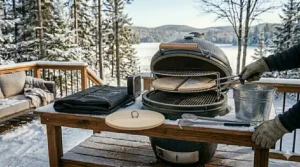
Kamado Grill Accessories vs Traditional Grill Add-ons: What’s Different?
The fundamental difference between kamado accessories and standard grill add-ons is material science—ceramic kamados operate in thermal extremes that would warp or fail conventional accessories. Gas grill deflector plates max out around 500°F; kamado heat deflectors routinely see 750°F for pizza and 1,200°F during self-cleaning burns. This demands cordierite or high-fire ceramic rather than the stamped aluminum used in propane grill flame tamers.
Temperature range shapes every accessory decision. Kamados maintain 225°F for 12-hour brisket smokes or spike to 700°F for Neapolitan pizza—often on the same weekend. Accessories must handle these swings without degrading. Cast iron grates work on both platforms, but kamado-specific grates are thicker (absorbing and redistributing the intense heat) while gas grill grates prioritise faster heat-up for quick-cooking foods.
Airflow dynamics are inverse: gas grills push heat via burners and baffles, while kamados pull air through charcoal via draft control. This means kamado rotisserie rings must seal tightly to preserve the convection current that makes indirect cooking work. Universal rotisserie kits designed for gas grills leak air at the mounting points—not a problem when you have unlimited propane, but catastrophic on charcoal where airflow = fuel consumption.
Fit tolerance is tighter on kamados because the ceramic dome and base create a precision-ground seal. Gas grill covers fit loosely (they’re basically tarps with elastic hems); kamado covers need exact dimensions because the dome’s curve creates fitment challenges. A cover 2 inches too small won’t stretch over a Classic Joe’s crown, while 2 inches too large creates wind-catch that tears fabric.
Material maintenance differs drastically. Gas grill stainless steel racks get sprayed with degreaser and hosed off; kamado pizza stones require gentle hand-washing and can never touch soap (the porous ceramic absorbs it). Cast iron on kamados needs vigilant seasoning to combat our Canadian moisture; the same grate on a gas grill benefits from residual propane moisture that prevents rust. Understanding these distinctions prevents expensive mistakes—like power-washing a ceramic deflector and watching it crumble from absorbed water expanding during the next cook.
Common Mistakes When Buying Kamado Grill Accessories in Canada
Mistake #1: Trusting “Universal Fit” Claims Without Measuring
The term “universal” on Amazon listings often means “fits most 18-inch grills”—but kamados vary in fire bowl depth, dome curve, and band placement. A deflector stone that’s “universal” for Large BGE might sit too high in a Kamado Joe Classic because the supporting ledge is positioned differently. Always measure your grill’s inner diameter and fire bowl depth, then cross-reference product dimensions. Canadian return shipping on heavy ceramic can cost $40-$60, making verification worth the effort upfront.
Mistake #2: Ordering from Amazon.com Instead of Amazon.ca
It’s tempting to buy from .com when Canadian stock is low, but you’ll pay duty fees, brokerage charges, and face extended delays at customs—often adding 30-40% to the listed price. Some accessories (like rotisserie motors with specific voltage) require Canadian electrical standards. Use Amazon.ca’s “Ships from Canada” filter to avoid surprise costs. If an accessory is truly unavailable here, factor realistic cross-border expenses into your budget before clicking “buy.”
Mistake #3: Buying the Cheapest Cover Available
Those $35 covers at big-box stores use 300D fabric that degrades in two Canadian seasons—you’ll replace it twice before a quality 600D cover needs replacement. The math is backwards: $35 × 3 replacements = $105 over six years, versus $75 for one durable cover that lasts the same period. Cheap covers also lack waterproof seams, allowing moisture infiltration that rusts metal bands and compromises gasket seals. Spend once on quality rather than repeatedly on disposable options.
Mistake #4: Ignoring Winter Storage Requirements
Leaving a pizza stone in your kamado through Canadian winter is expensive negligence. Moisture absorbed during summer grilling expands when frozen, creating micro-cracks that fracture the stone during spring’s first heat-up. Rotisserie motors contain lubricants that gel at sub-zero temps, shorting electronics when powered on cold. Budget 2-3 square feet of indoor storage space before buying accessories—a basement shelf or utility room rack prevents $200 worth of accessories from becoming trash by March.
Mistake #5: Overlooking Brand-Specific Ecosystem Lock-in
Kamado Joe’s Divide & Conquer system, Big Green Egg’s ConvEGGtor, and Primo’s proprietary racks create accessory ecosystems where mixing brands causes fitment issues. Before investing in premium accessories, research your grill’s ecosystem to avoid orphaned components. Example: the Kamado Joe half-moon cast iron grate requires their multi-level rack system—it won’t sit flat in a Large BGE without adapters. Plan your accessory path to avoid expensive compatibility surprises.
Mistake #6: Prioritising Novelty Over Fundamentals
Rotisserie kits and pizza ovens are exciting, but they’re useless without foundational accessories. Start with a heat deflector (enables indirect cooking), quality cover (protects your investment), and ash management tools (makes cleanup tolerable). Add specialty items after mastering the basics—you’ll appreciate a rotisserie more once you’ve conquered low-and-slow smoking, which requires the deflector you’d otherwise skip in favour of flashier gadgets.
Long-Term Cost Analysis: Kamado Grill Accessories ROI in Canada
Initial Investment Breakdown (Essential Accessories):
Heat deflector: $65
Waterproof cover: $75
Ash basket/tool: $50
Cast iron grate: $110
Total: $300 CAD
This baseline transforms a bare kamado into a year-round smoking, grilling, and baking machine. Spread over a conservative 10-year kamado lifespan (quality ceramic lasts 15-20 years with care), you’re paying $30 annually in accessories to protect and enhance a $1,500-$2,500 grill investment.
Operational Savings:
A heat deflector enables low-and-slow smoking that would otherwise require a separate $400+ pellet smoker. Cooking two briskets monthly at home ($40 each raw vs. $90 at restaurants) saves $1,200 annually—the deflector pays for itself in one month. Pizza stones facilitate $15 homemade pizzas that would cost $35 delivered; families making pizza weekly save $1,040/year, recovering the stone cost in three weeks.
Maintenance Cost Reality:
Quality accessories reduce maintenance expenses. A $75 waterproof cover prevents gasket degradation ($40-$60 replacement cost) and ceramic band rust ($150+ repair if severe). Over ten years, the cover prevents an estimated $300-$500 in repairs—nearly 5x its initial cost. Cast iron grates ($110) outlast stainless steel equivalents ($60 every 2-3 years) by remaining serviceable for 8+ years with proper seasoning, saving $80-$120 in replacement cycles.
Canadian Climate Tax:
Factor winter storage and seasonal replacement into long-term costs. Covers in coastal regions last 4-5 years vs. 7-8 years in dry Prairie climates. Budget $15-$20 annually for cover wear. Heat deflectors occasionally crack despite careful handling—expect one replacement every 6-8 years ($65). These climate-driven costs are unavoidable overhead for Canadian kamado ownership but remain fractional compared to repairing neglected grills.
ROI Tipping Point:
For casual grillers (8-12 cooks annually), accessory ROI occurs around year three when savings from DIY smoking and pizza offset the $300 initial investment. Enthusiast grillers (weekly use) hit ROI within 6-9 months through restaurant meal displacement. The calculus changes if you’re grilling primarily burgers and steaks—essential accessories still protect your investment, but premium items like rotisseries may never financially justify their cost beyond convenience and enjoyment value.
Frequently Asked Questions About Kamado Grill Accessories in Canada
❓ Can I leave my kamado grill accessories outside during Canadian winters?
❓ Do kamado grill accessories from Amazon.com work the same on Amazon.ca models?
❓ What's the difference between a heat deflector and a pizza stone for kamado grills?
❓ Are cast iron grates worth the extra cost compared to stainless steel for kamado grills?
❓ How do I know which size heat deflector fits my kamado grill?
Conclusion: Building Your Canadian Kamado Accessory Arsenal
The difference between good kamado grilling and exceptional results comes down to accessories that complement your grill’s capabilities while surviving our climate extremes. Start with the foundation—a quality heat deflector unlocks indirect cooking and smoking, while a waterproof cover protects your investment from spring slush to winter freeze. These aren’t luxuries; they’re maintenance essentials that prevent expensive repairs and expand your cooking repertoire beyond basic grilling.
From there, build strategically based on your cooking style. Sear-focused grillers benefit immensely from cast iron grates that lock in flavours stainless steel can’t capture. Pizza enthusiasts need dedicated stones that deliver crispy crusts impossible on makeshift deflectors. Year-round grillers in harsh climates should prioritise storage solutions and ash management tools that make cold-weather cooking tolerable rather than miserable.
The Canadian accessory consideration that separates us from warmer climates? Winter storage and seasonal maintenance aren’t optional—they’re survival requirements. Budget indoor space for ceramic components, plan for cover replacements every 4-7 years, and accept that motorised accessories need seasonal care. These climate-driven realities add modest long-term costs but prevent catastrophic failures that would cost hundreds in replacements.
Final verdict for Canadian kamado owners: invest $300-$400 in foundational accessories (deflector, cover, ash tool, quality grate) before chasing specialty items. This baseline setup delivers 90% of the versatility premium kamados offer, with specialty accessories like rotisseries and pizza ovens adding that final 10% for enthusiasts willing to commit. The ROI comes not just from money saved displacing restaurant meals but from the year-round grilling capability that transforms a seasonal hobby into a lifestyle—even when it’s -20°C and your neighbours think you’re crazy for grilling in a snowstorm.
Recommended for You
- 7 Best Affordable Kamado Grills Canada Under $600 | 2026
- 7 Best Charcoal Smokers for Canadian Winter 2026
- 7 Best Offset Smoker Canada Under $500 – Expert Reviews 2026
Disclaimer: This article contains affiliate links. As an Amazon Associate, I earn from qualifying purchases. If you purchase products through these links, we may earn a small commission at no additional cost to you.
✨ Found this helpful? Share it with your friends! 💬🤗
