In This Article
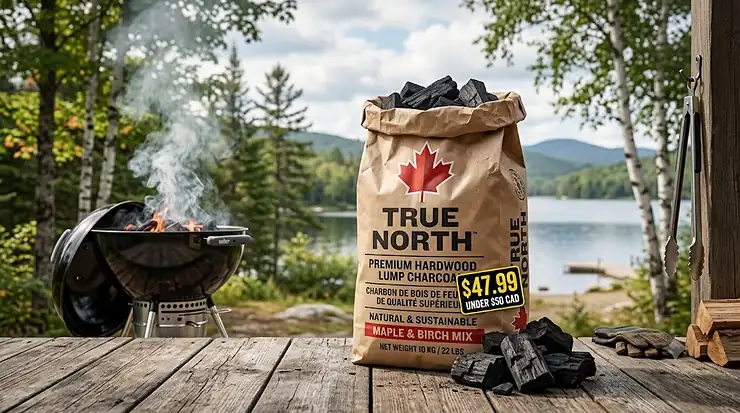
There’s a particular kind of heartbreak reserved for the backyard griller who tears open a bag of charcoal, dumps it in the chimney, and watches half of it turn to dust before it ever sees a flame. If you’ve ever paid good money for a bag that was mostly rubble, you already understand why hardwood lump charcoal under $50 CAD has become such a hunted-for phrase among Canadian barbecue folks. The good news: you don’t need to spend a fortune to get real, dense, clean-burning hardwood. You need to know what you’re actually buying.
Worth noting up front: the hardwood behind these bags mostly comes from responsibly managed forest operations, and Canada’s own sustainable forest management standards are among the strictest in the world — a small but real reason to feel good about a hobby that involves burning wood for fun. This guide breaks down seven real bags of hardwood lump charcoal you can find on amazon.ca, all priced well within that under-$50 CAD ceiling, and tells you honestly what each one is good for — not what the marketing copy claims. We’ll walk through cost per pound (because a “cheap” bag that burns out fast isn’t actually cheap), burn time, and how charcoal choice affects charcoal grill efficiency in ways most bags never mention on the label. Whether you’re feeding a Weber kettle every weekend or firing up a kamado twice a month, there’s a bag on this list built for your setup and your wallet.
Quick Comparison Table
Here’s the fast version for anyone standing in the aisle (or scrolling on their phone) who just wants the shorthand before diving deeper.
| Product | Wood Type | Bag Size | Price Range (CAD) | Best For |
|---|---|---|---|---|
| Royal Oak 100% All Natural Hardwood Lump Charcoal | Oak & hickory | 15.4 lb | Around C$25-C$32 | Everyday budget grilling |
| Cowboy Hardwood Lump Charcoal | Oak, hickory, maple | 8-17.2 lb | Under C$20 (small) to mid-C$30s | Fast lighting on a budget |
| B&B Charcoal Oak Lump Charcoal | Oak blend | 20 lb | C$28-C$38 | Long, steady smoking sessions |
| Rockwood Natural Lump Charcoal | Oak, hickory, cherry | 20 lb | C$32-C$42 | Flavour-forward everyday cooking |
| FOGO Premium Hardwood Lump Charcoal | Mixed hardwood | 17.6 lb | C$35-C$45 | Restaurant-style searing |
| Jealous Devil Hardwood Lump Charcoal | Quebracho blanco | 10 lb | Mid-C$30s to under C$50 | Dense, long, high-heat burns |
| Kamado Joe Big Block XL Lump Charcoal | Mixed hardwood | 20 lb | C$40-C$50 range | Ceramic and kamado grills |
Reading across that table, a pattern jumps out fast: price per bag has almost nothing to do with price per pound once you factor in bag weight, and neither number tells you how much of what you’re paying for will actually turn into usable heat. The Royal Oak and Cowboy bags sit at the affordable end and cover most weeknight grilling needs, while Jealous Devil and Kamado Joe Big Block XL justify their higher position with density and burn duration that budget bags simply can’t match lump for lump. We’ll unpack exactly why in the sections below.
💬 Just one click — help others make better buying decisions too!😊
Top 7 Hardwood Lump Charcoal Picks Under $50 CAD
Choosing the right bag isn’t really about finding “the best” charcoal — it’s about matching density, burn profile, and price to how you actually cook. Here’s the honest breakdown of seven real options, budget to premium.
1. Royal Oak 100% All Natural Hardwood Lump Charcoal — best all-around budget bag
The standout here is consistency at a price that doesn’t punish weeknight grilling. Royal Oak’s 15.4 lb bag is made from oak and hickory with no fillers or chemical binders, and it’s been a mainstay on hardware store shelves for decades — which matters, because a brand that survives that long in a commodity category is usually doing something right. In practice, that translates to a bag that lights within about 15 minutes using a chimney starter and holds a reasonably stable temperature through a typical burger-and-sausage cookout.
Based on the spec sheet and aggregated retail data, this bag runs somewhere in the high-90-cent to low-dollar range per pound depending on where you catch it, which puts it solidly in “don’t overthink it” territory for casual grillers. Reviewers consistently mention some popping and light sparking in the first few minutes of a burn — a known trait of oak-heavy lump — so it’s worth starting your chimney a comfortable distance from anything flammable. This is the bag for someone who grills two or three times a week and wants predictable results without researching wood density charts.
Pros:
- ✅ Widely available and consistently priced under $35 CAD
- ✅ Fast 15-minute light time with a standard chimney
- ✅ No chemical additives — straightforward oak and hickory
Cons:
- ❌ Noticeable popping and sparking during initial light
- ❌ Smaller, more irregular lump sizes than premium bags
Price sits around C$25-C$32 for the 15.4 lb bag, and for the money, it’s hard to argue with the value — this is the reliable Tuesday-night option, not the one you save for a 12-hour brisket.
2. Cowboy Hardwood Lump Charcoal — fastest lighting on a budget
Cowboy built its reputation on speed, and that’s exactly what stands out here: this oak, hickory, and maple blend catches flame noticeably quicker than denser competitors, which matters a lot if you’re the type who decides to grill 20 minutes before guests arrive. The mixed-hardwood composition means you’re not getting one dominant wood flavour, which honestly works in its favour — it reads as “classic barbecue smoke” rather than anything sharp or resinous.
Spec-wise, bag sizes range from smaller 8 lb options up through larger multi-pound bags, so you can buy exactly the volume you need instead of committing to a 20 lb bag for a single cookout. Aggregated retailer review data puts Cowboy consistently above 4.5 out of 5 stars across thousands of ratings, with reviewers frequently praising the quick light time and flagging that it runs a bit ashier than premium blends — a fair trade for the price. What most buyers overlook about this brand is that the smaller bag sizes actually make it a smarter buy for apartment-balcony grillers or anyone without much dry storage space, since you’re not stuck babysitting a half-used 20-pounder against humidity.
Pros:
- ✅ Among the quickest-lighting lump charcoals in its price class
- ✅ Available in smaller bag sizes for occasional grillers
- ✅ Balanced mixed-hardwood flavour, not overly smoky
Cons:
- ❌ Produces more ash than premium single-wood blends
- ❌ Lump sizes vary more, so airflow can be inconsistent
Depending on bag size, expect anywhere from under C$20 for the smaller format up to the mid-C$30s for larger bags — genuinely one of the better cost-per-cookout options for casual weekend use.
3. B&B Charcoal Oak Lump Charcoal — best value for long, steady sessions
B&B Charcoal markets itself as “the expert’s choice for the outdoor barbecuer,” and while marketing lines are marketing lines, the 20 lb oak lump bag does back it up with a genuinely long, stable burn. The oak-forward blend produces less popping and sparking than some competitors — a detail actual buyers comparing it directly against Cowboy have pointed out, describing it as calmer to work around during lighting, even if it doesn’t always reach quite the same peak searing temperature.
That trade-off is worth sitting with. If you’re doing a low-and-slow pulled pork or a multi-hour rib session, a slightly lower ceiling temperature paired with a longer, more even burn is often the better outcome than a hotter but shorter-lived bag. Here’s what to weigh: B&B rewards patience-based cooking styles more than high-heat searing. The 20 lb format also means a meaningfully lower cost per pound than smaller premium bags, assuming you have dry storage for the full bag.
Pros:
- ✅ Long, stable burn well-suited to smoking and slow cooks
- ✅ Minimal popping or sparking compared to oak-heavy rivals
- ✅ Strong cost per pound at the 20 lb size
Cons:
- ❌ Doesn’t hit quite the same peak searing heat as denser blends
- ❌ 20 lb bag needs proper dry storage to avoid moisture pickup
Typically priced around C$28-C$38 for the full 20 lb bag, this is the pick for anyone whose grill sessions run three-plus hours rather than thirty minutes.
4. Rockwood Natural Lump Charcoal — best blended flavour for everyday cooking
Rockwood takes a different approach than the single-note oak bags: its blend of oak, hickory, and cherry is aimed squarely at flavour, and the cherry component genuinely does show up as a subtle sweetness on longer cooks like chicken thighs or pork chops. It’s produced in smaller batches than the mass-market brands, which the company frames as a quality-control advantage — fewer inconsistent lumps slipping through.
What most buyers overlook about blended-wood charcoal like this is that it behaves less predictably than single-species oak, in a good way: the cherry component tends to burn slightly cooler and slower, which naturally moderates the hotter hickory chunks mixed in the same bag. The practical result is a burn that self-regulates a little, making it more forgiving for grillers who don’t obsessively manage vents. Aggregated reviewer sentiment describes it as consistently well-sized with minimal dust at the bottom of the bag — a common complaint with cheaper blends that this one seems to sidestep.
Pros:
- ✅ Genuine cherry-wood flavour notes on longer cooks
- ✅ Small-batch production means fewer undersized lumps
- ✅ Self-moderating burn temperature from mixed wood density
Cons:
- ❌ Costs more per pound than single-species budget bags
- ❌ Less widely stocked than major national brands
At around C$32-C$42 for a 20 lb bag, Rockwood sits in the sensible middle ground — noticeably better than entry-level oak but well short of premium South American hardwood pricing.
5. FOGO Premium Hardwood Lump Charcoal — best restaurant-style searing
FOGO built its name supplying restaurants, and the “large-sized lump” branding isn’t just marketing fluff — bigger, denser lumps genuinely do burn longer and hold heat more evenly than the fragmented pieces common in bargain bags. That density matters more than most spec sheets let on: a chunk the size of your fist holds and releases heat far more predictably than a handful of small chips, which is exactly what you want when searing a steak that needs consistent grate temperature from edge to edge.
Based on the spec comparison against the budget tier, FOGO trades some of that fast-lighting convenience for genuine high-heat performance — expect a slightly longer chimney time in exchange for a hotter, steadier plateau once it’s going. Reviewers consistently note less ash production compared to oak-only blends, which is a real time-saver on cleanup day. This is the bag for someone who’s graduated past “grilling is fine” into actually caring about sear marks and crust development.
Pros:
- ✅ Large, dense lumps hold heat evenly for searing
- ✅ Noticeably less ash residue than budget oak blends
- ✅ Restaurant-quality sourcing with consistent lump sizing
Cons:
- ❌ Takes longer to reach full temperature than budget bags
- ❌ Priced above entry-level options for the same bag weight
Expect to pay roughly C$35-C$45 for the 17.6 lb bag — a fair premium for buyers whose priority is searing performance over sheer convenience.
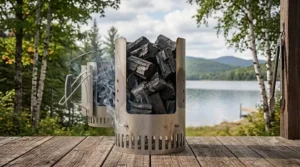
6. Jealous Devil Hardwood Lump Charcoal — best for dense, high-heat, long burns
If there’s one bag on this list that earns the word “premium” honestly, it’s Jealous Devil. Made from South American quebracho — literally translated as “axe-breaker” — this charcoal is reportedly up to 30% denser than standard oak or hickory lump, and that density is the whole story here. Denser wood holds more stored energy per lump, which means longer burns, higher peak temperatures (manufacturer specs cite output above 1,100°F), and less charcoal consumed per cook overall.
What most buyers overlook about density-based charcoal is that it changes your cost math entirely: a 10 lb bag of something this dense can outlast a much larger bag of lighter, airier lump, because you’re using less per session and refuelling far less often on long smokes. Here’s what to weigh — this isn’t the bag for a 20-minute burger night; the extra density means a slower initial light and more charcoal than you need for quick cooks. Reviewers frequently cite minimal sparking and low ash output, both consistent with the tight, dense grain structure of quebracho.
Pros:
- ✅ Exceptionally dense wood extends burn time significantly
- ✅ High peak heat output well-suited to searing and kamado cooking
- ✅ Low ash and minimal sparking during use
Cons:
- ❌ Slower to light than lighter, airier lump charcoals
- ❌ Overkill and wasteful for short, low-heat cooks
Priced in the mid-C$30s and creeping toward the C$50 ceiling depending on bag size and retailer, Jealous Devil earns its premium position through genuine physics, not branding.
7. Kamado Joe Big Block XL Lump Charcoal — best for ceramic and kamado grills
Ceramic cookers like kamados hold heat differently than a steel kettle, and Kamado Joe Big Block XL is engineered specifically around that reality. The manufacturer’s own claim of up to 18-hour burn times and reusability across two to three sessions sounds aggressive on paper, but it lines up with how dense hardwood behaves inside an insulated ceramic shell that isn’t constantly bleeding heat to the outside air the way an open kettle does.
Based on the spec comparison, this bag isn’t really competing with Royal Oak or Cowboy at all — it’s solving a different problem. Kamado owners doing overnight smokes need charcoal that won’t burn itself out by 3 a.m., and reusability across multiple sessions changes the long-term cost-per-use math significantly even at a higher sticker price. What the spec sheet won’t tell you, but kamado forums consistently note, is that partially-burned Big Block chunks left in the firebox after a cook can simply be reused next time, effectively lowering the real cost per pound the longer you own the grill.
Pros:
- ✅ Engineered burn profile suited to insulated ceramic grills
- ✅ Reusable leftover chunks lower long-term cost per session
- ✅ Long burn times reduce mid-cook refuelling
Cons:
- ❌ Less cost-effective if you don’t own a kamado-style grill
- ❌ Sits at the top of the under-$50 CAD price range
At C$40-C$50 for the 20 lb bag, this is squarely a kamado-owner’s purchase — and a smart one if that’s your setup.
Practical Usage Guide: Getting the Most From Any Bag
Buying good charcoal is half the battle — how you handle it determines whether you actually get the burn time and heat the bag promises. Start with storage: hardwood lump charcoal is genuinely porous, and it absorbs ambient moisture faster than most people expect, especially in a humid Canadian summer or a damp garage. A bag left open on a concrete floor will light slower and smoke more within a couple of weeks, even if it looks fine.
For first-use setup, a chimney starter beats lighter fluid every time — not just for the “purist” flavour argument, but because lighter fluid residue genuinely changes ignition behaviour and can leave an off-taste on quick-searing cooks. Fill the chimney, place it over a natural firestarter or crumpled newspaper, and wait until flames are visible at the top before dumping the coals. 🔥
Common first-30-days mistakes worth avoiding: closing all your grill vents too early (this smothers the fire and wastes fuel rather than controlling heat), dumping an entire bag’s worth of coals for a 15-minute cook (measure roughly what you need — a full chimney is usually plenty for two to four burgers), and storing an opened bag without resealing it, which accelerates moisture absorption. A simple maintenance habit — resealing the bag with a clip or storing it inside a lidded bin — extends usable shelf life dramatically and keeps your cost per pound honest instead of losing product to spoilage.
Real-World Scenarios: Matching the Bag to the Cook
The weeknight griller: Say you’re cooking for two or three people, two to three nights a week, mostly burgers, chicken thighs, and the occasional steak. Budget and bag size matter more than peak searing temperature here — Royal Oak or the smaller Cowboy bags make the most sense, since you’re not burning through 20 lb in a single sitting and fast lighting matters when dinner’s already running late.
The weekend low-and-slow smoker: If your typical session is a four-to-eight-hour pork shoulder or a rack of ribs, you need stability over speed. B&B Charcoal‘s long, even burn or Rockwood‘s self-moderating blend make more sense here than a fast-lighting budget bag that burns hot and fades early, forcing mid-cook refuelling that disrupts temperature control.
The kamado owner doing overnight briskets: This is where Kamado Joe Big Block XL or Jealous Devil earn their higher price tags. An overnight 12-hour brisket in a ceramic cooker genuinely benefits from dense, long-burning lump that won’t need attention at 4 a.m., and the reusable leftover chunks meaningfully offset the higher upfront cost across a season of cooking.
How to Choose Hardwood Lump Charcoal Under $50 CAD
What is hardwood lump charcoal? Hardwood lump charcoal is charred wood — pure hardwood burned down in a low-oxygen environment until only carbon remains, with no binders, fillers, or additives. Unlike briquettes, it retains irregular chunk shapes and lights faster, burns hotter, and produces less ash, though burn consistency depends on lump size.
Choosing the right bag isn’t complicated once you know what actually matters:
- Match density to cook length. Denser woods like quebracho (Jealous Devil) suit long smokes; lighter oak blends (Royal Oak, Cowboy) suit quick weeknight cooks.
- Check bag weight against your grill size. A small kettle grill rarely needs a 20 lb bag opened at once; smaller formats reduce moisture-related waste.
- Prioritize lump size consistency. Bags with more dust and small fragments (common in bargain bins) burn less predictably and produce more ash.
- Factor in reusability for kamado grills. If you own a ceramic cooker, reusable options like Kamado Joe Big Block XL change the long-term value equation entirely.
- Read aggregated review sentiment, not star ratings alone. A 4.6-star average tells you little; look for recurring themes like sparking, ash volume, or lump consistency across many reviews.
- Compare price per pound, not price per bag. A larger bag at a higher sticker price is frequently the cheaper option once you do the math (see the next section).
- Consider your storage situation. Humid basements and damp garages shorten usable shelf life regardless of brand — buy a size you’ll use within a reasonable window.
A useful overview of how charcoal is produced and classified helps explain why lump size and wood density drive so much of this decision — it genuinely comes down to basic thermal physics, not marketing.
Affordable Hardwood Charcoal vs Premium Lump Charcoal Value Pick
This is really the central tension of the entire under-$50 CAD category: affordable hardwood charcoal like Royal Oak and Cowboy wins on upfront price and light speed, while a premium lump charcoal value pick like Rockwood or FOGO wins on consistency, lower ash, and — often — genuine cost efficiency once you measure it properly.
The honest analysis: affordable bags are not lower quality in a moral sense, they’re simply optimized for a different job. They tend to include more fragmented lumps (faster to light, but burns through faster and produces more ash), while premium picks deliberately screen for larger, denser chunks that cost more per bag but frequently less per actual hour of usable heat. Neither approach is “wrong” — the mismatch happens when a weeknight griller overspends on density they don’t need, or a weekend smoker underspends and finds themselves refuelling mid-cook.
If your grilling is mostly quick, high-frequency, and casual, affordable hardwood charcoal genuinely is the smarter buy — you’ll cycle through bags fast enough that density gains barely matter. If you’re doing fewer, longer, more deliberate cooks, a premium lump charcoal value pick like Rockwood or FOGO earns back its price difference in fewer wasted chimney refills and more consistent results.
Cost Per Pound: The Real Math Behind the Bag
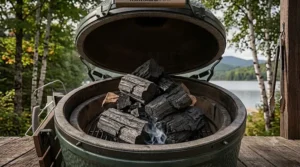
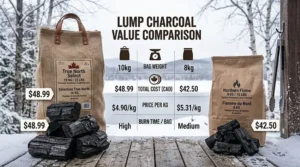
Sticker price is the least useful number on any charcoal bag. What actually matters is cost per pound, and it flips the budget-versus-premium narrative more often than people expect. A 15.4 lb bag of Royal Oak at roughly C$28 works out to about C$1.82 per pound. A 20 lb bag of B&B Charcoal at C$33 lands closer to C$1.65 per pound — cheaper per pound despite a higher sticker price, purely because of bag size.
Density complicates the math further. Jealous Devil‘s 10 lb bag might run C$40-plus, putting per-pound cost noticeably above the budget tier — but if its density genuinely lets you use 20-30% less charcoal per cook compared to lighter lump, the effective cost per cook can end up comparable or even lower. This is the calculation most price-range comparisons skip entirely: cost per pound tells you what you paid, but cost per cook tells you what you actually spent.
Practical takeaway: when comparing bags, divide sticker price (using the range you find “at the time of research,” since exact prices shift) by bag weight to get a baseline, then weight that number against how dense the lump feels in hand and how long a similar-sized fire holds heat. It’s a rougher calculation than a spreadsheet, but it’s far more honest than comparing sticker prices alone.
Burn Time Explained: What the Bag Won’t Tell You
Burn time claims on charcoal packaging are notoriously inconsistent between brands, partly because there’s no standardized testing method and partly because burn time depends enormously on variables the bag can’t control — ambient temperature, wind, vent management, and how tightly the coals are packed.
That said, some patterns hold up across real-world use. Denser hardwoods like the quebracho in Jealous Devil burn measurably longer per pound than lighter oak blends, simply because there’s more stored carbon energy per lump. Reusable options like Kamado Joe Big Block XL effectively extend burn time across multiple sessions rather than a single one, since partially-burned chunks can be relit. Meanwhile, budget bags with more small, fragmented lumps burn hot and fast initially, then fade — great for a quick sear, less ideal for a four-hour smoke where you’d rather add fuel once than three times.
The practical upshot: if a recipe calls for “maintain 225°F for six hours,” pick a bag on the denser end of this list and expect to top up once partway through rather than constantly. If you’re searing steaks for fifteen minutes, burn time barely matters — light speed and peak heat do.
Charcoal Grill Efficiency: Getting More Heat From Less Charcoal
Charcoal grill efficiency isn’t purely about the bag you buy — airflow management does as much work as lump density, and it’s free. Opening the bottom vents wider increases oxygen flow and raises temperature; closing them gradually chokes the fire down for lower, slower cooks. Most efficiency complaints (“my charcoal burns out too fast”) actually trace back to over-venting a fire that didn’t need to run that hot in the first place.
Lump arrangement matters more than most grillers assume, too. A loosely piled mound with gaps for airflow lights and burns more evenly than a tightly packed pile, which can smother itself in the centre. For longer cooks, the “snake method” — arranging unlit coals in a curved line with a few lit coals at one end — dramatically improves fuel efficiency by letting the fire creep along gradually rather than burning everything simultaneously.
Denser charcoal like Jealous Devil or Kamado Joe Big Block XL genuinely improves efficiency in insulated kamado-style grills, where retained heat compounds fuel savings. In an open kettle grill, efficiency gains from denser charcoal are more modest, since heat escapes regardless of what’s burning — which circles back to matching product to grill type rather than chasing the “best” charcoal in the abstract.
Common Mistakes When Buying Lump Charcoal
Chasing the biggest bag for the lowest price per pound. A 20 lb bag looks efficient on paper, but if you only grill occasionally, half of it can absorb moisture and degrade before you use it. Buy the size you’ll realistically burn through in a reasonable window.
Ignoring lump size distribution. Bags heavy on small fragments and dust burn less predictably, produce more airborne ash, and are genuinely harder to control temperature with. If a listing or in-store bag looks mostly like gravel, it’s probably a lower-quality batch regardless of brand name.
Assuming “natural” and “premium” always justify the price. Marketing language isn’t regulated the way food labelling is — always cross-check wood type, bag weight, and aggregated review themes rather than trusting adjectives on the packaging.
Overlooking storage conditions before purchase. Charcoal stored in humid warehouse conditions or displayed outdoors for months can already have absorbed moisture by the time it reaches your cart, regardless of how good the brand normally is.
Buying dense, long-burn charcoal for quick weeknight cooks. Jealous Devil and Kamado Joe Big Block XL are excellent products, but they’re wasted — and needlessly expensive — for a 15-minute burger session that a bag of Cowboy or Royal Oak would handle just as well.
✨ Ready to Stock Up on the Right Bag?
🔍 Take your next cookout up a notch with a bag that actually matches how you grill. Click on any highlighted pick above to check current pricing and availability on amazon.ca. The right charcoal makes every burger, brisket, and backyard evening a little better.
Lump Charcoal vs Charcoal Briquettes
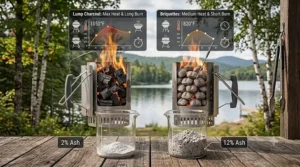
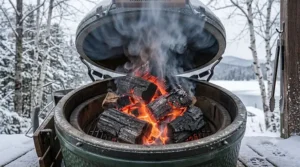
The lump-versus-briquette debate comes up in every grilling forum eventually, and the honest answer is that both have a legitimate place. Lump charcoal — everything on this list — is pure charred hardwood with no binders, and it lights faster, burns hotter, and produces noticeably less ash than briquettes. Briquettes, by contrast, are compressed charcoal dust mixed with binders and sometimes additives, which makes them burn more uniformly and predictably over long periods, but at a lower peak temperature and with a chemical smell during initial lighting that some grillers find off-putting.
For searing steaks or anything where peak heat and clean flavour matter most, lump charcoal like FOGO or Jealous Devil has a clear edge. For extremely long, low-and-slow cooks where absolute temperature consistency over many hours matters more than peak heat — think competition-style overnight briskets on an offset smoker — some pitmasters actually prefer briquettes precisely because of their uniform burn rate, sometimes blending the two. Cost-wise, briquettes are often marginally cheaper per pound, but lump charcoal’s lower ash output and cleaner burn frequently offset that gap in real-world value, especially for anyone who grills often enough to notice the difference in flavour and cleanup time.
Safety, Storage & Canadian Regulations
This is the section that matters most, even though it’s the least fun to write about. Carbon monoxide poisoning from charcoal is a genuine and ongoing risk in Canada — federal data shows CO poisoning is responsible for an estimated hundreds of deaths and hospitalizations across the country each year, and barbecues remain a recurring source of exposure, particularly when people move a lit or smouldering grill indoors during power outages or cold weather. Never burn charcoal indoors, in a garage, tent, or any enclosed or semi-enclosed space, even briefly — carbon monoxide is odourless and colourless, so there’s no early warning without a detector.
A sobering real-world reminder came from an incident in Ottawa where eleven people from a single household were hospitalized after using a charcoal barbecue indoors for heat during a power outage — a pattern fire officials say tends to spike during storms and extended outages. If your power goes out, charcoal is for cooking outdoors only, never for indoor heating, no matter how tempting it feels in the moment.
On the storage side, keep bags in a dry, ventilated space, away from direct sunlight and ground moisture — a lidded bin or shelf works better than a bag left on a garage floor. Let ash fully cool for at least 48 hours in a metal container before disposal, since coals can retain enough heat to reignite or damage plastic bins even when they look completely spent. Provincial and municipal fire bylaws around outdoor burning and grill placement near structures vary, so it’s worth a quick check with your local municipality if you’re setting up a grill on a balcony or near a property line.
Frequently Asked Questions
❓ Is hardwood lump charcoal better than briquettes?
❓ How much does hardwood lump charcoal cost in Canada?
❓ How long does a bag of lump charcoal last?
❓ Can I reuse leftover lump charcoal?
❓ Why does my lump charcoal spark and pop when lighting?
Conclusion
Hardwood lump charcoal under $50 CAD covers a surprisingly wide range once you actually compare bags side by side — from Royal Oak‘s no-nonsense weeknight reliability to Jealous Devil‘s genuinely premium density and Kamado Joe Big Block XL‘s purpose-built kamado efficiency. None of these seven is objectively “the best”; each earns its spot for a specific kind of griller, and the real skill is matching bag to cook rather than chasing a single winner.
If you take one thing away from all this cost-per-pound and burn-time math, let it be this: the cheapest bag on the shelf and the best value bag for your grilling habits are rarely the same thing. Buy for how you actually cook — frequency, session length, and grill type — and the rest tends to sort itself out. Whichever bag you land on, light it outdoors, store it dry, and let the coals fully cool before you tuck them away. That’s really all it takes to get consistent, honest heat out of a $30-C$50 bag of hardwood, cookout after cookout.
✨ Found the right bag for your grill? Grab it before the good batches sell out, and get that first chimney going this weekend. 🔥🍖
Recommended for You
- Lump Charcoal vs Charcoal Briquettes: 7 Ultimate Picks (2026)
- Lump Charcoal for BBQ: 7 Top Picks Canadians Trust in 2026
- Portable Pizza Oven for Camping: 7 Real Picks for 2026
Disclaimer: This article contains affiliate links. As an Amazon Associate, I earn from qualifying purchases. If you purchase products through these links, we may earn a small commission at no additional cost to you.
✨ Found this helpful? Share it with your friends! 💬🤗
