
In This Article
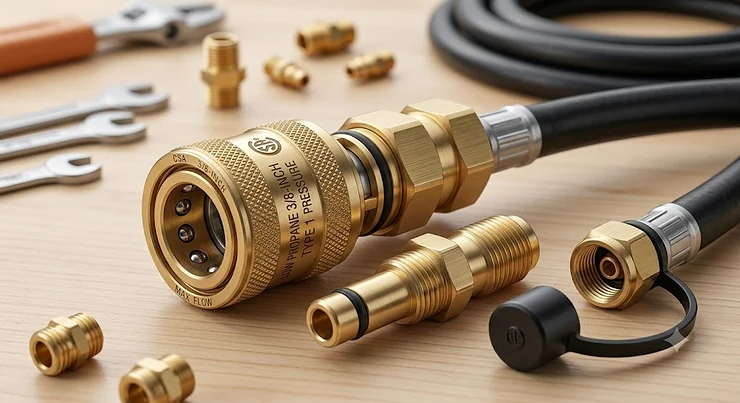
There’s a very specific kind of frustration that only shows up at exactly the wrong moment: your guests are on the deck, the coals-versus-gas debate has already been won (gas, obviously, or you wouldn’t be reading this), and you’re on your knees behind the grill wrestling a wrench onto a hose fitting that hasn’t budged since the Harper administration. Quick connect propane fittings for BBQ setups exist precisely to end that scene. They swap a threaded, wrench-dependent connection for a push-and-lock coupling you can disconnect one-handed, in the dark, slightly distracted by the fact that the burgers are already on.
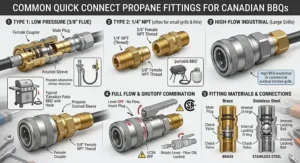
This guide digs into seven real, currently available fittings and adapters sold on amazon.ca, sorted across budget, mid-range, and premium tiers, so you can match the right part to your grill, your RV, or your increasingly ambitious backyard cooking station. Every product mention below is grounded in real specifications and aggregated review sentiment — never invented testimonials, and never a rewritten spec sheet pretending to be an opinion.
Along the way we’ll also cover the practical stuff that actually determines whether your purchase works: a propane adapter for grill use is not automatically compatible with your regulator thread, multi-appliance setups need more planning than a single Y-splitter purchase, and ease of installation varies wildly between a two-piece brass adapter and a full quick disconnect propane fitting kit with a built-in shut-off valve. By the end, you’ll know exactly which of these fittings fits your situation — literally and figuratively.
Quick Comparison Table
| Product | Type | Thread/Size | Best For |
|---|---|---|---|
| Camco Propane Quick-Connect Kit | Full kit with shut-off valve | 1/4″ NPT x Quick-Connect | Best all-round RV-to-grill setup |
| Mr. Heater 3/8″ Quick Connector | Single fitting | 3/8″ NPT | Best for Weber and PGS-style grills |
| GASPRO 20ft Quick Connect Hose | Extension hose | 1/4″ M/F Quick-Connect | Best for distance from tank to grill |
| GASPRO 3-Way Y Splitter | Multi-appliance splitter | 1/4″ Quick-Connect x3 | Best for multi-appliance setups |
| Stanbroil Brass Adapter | Single adapter | Full Flow Plug x 1/4″ NPT | Best budget single fitting |
| BlueStars Fittings Kit | Kit, two thread options | 1/4″ NPT & 3/8″ Flare | Best fitting compatibility for mixed gear |
| Flame King Y Splitter | Tank-side splitter | QCC1/Type1 | Best for running two appliances off one tank |
Looking at the spread above, the pattern that jumps out is thread size, not brand. A 1/4″ quick-connect fitting and a 3/8″ one are not interchangeable, no matter how similar they look in a thumbnail photo, and this single detail is responsible for more one-star reviews across this category than any manufacturing defect. Budget shoppers gravitate toward the Stanbroil Brass Adapter and the BlueStars Fittings Kit, while anyone running a griddle, a fire pit, and a grill off the same RV tank should be looking hard at the GASPRO 3-Way Y Splitter or the Flame King Y Splitter instead of buying three separate single adapters.
💬 Just one click — help others make better buying decisions too!😊
Top 7 Quick Connect Propane Fittings for BBQ: Expert Analysis
1. Camco Propane Quick-Connect Kit — most complete RV-to-grill solution
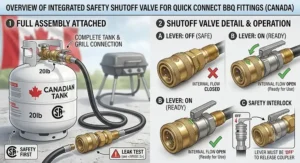
The standout here isn’t the fitting itself — it’s that Camco bundles the shut-off valve, the plug, and the NPT adapter into a single kit instead of making you hunt down three separate parts.
Specs-wise, you’re looking at a 1/4″ Male NPT connection paired with a full-flow male quick-connect plug, built from solid brass and rated for low-pressure propane systems. That full-flow design matters in practice: cheaper quick-connect fittings sometimes restrict gas flow enough to weaken a grill’s high-heat burner, and Camco’s full-flow rating is specifically built to avoid that bottleneck. Based on the spec comparison against the other kits here, this is the one engineered by a company that has made RV propane hardware since 1966, and that pedigree shows in the fit and finish more than the price tag does.
Reviewers consistently report that the built-in shut-off valve is the feature they didn’t know they needed — it lets you cut gas flow at the grill instead of walking back to the tank every time. A common thread in aggregated feedback is that the brass housing resists the pitting and corrosion that plagues cheaper pot-metal alternatives after a season or two outdoors.
Pros:
- ✅ Full-flow design avoids gas-pressure bottlenecks
- ✅ Includes shut-off valve for on-grill control
- ✅ Solid brass resists corrosion long-term
Cons:
- ❌ Pricier than single-piece adapters
- ❌ 1/4″ thread won’t fit 3/8″ grill regulators
Priced in the C$40-C$55 range at the time of research, the Camco Propane Quick-Connect Kit earns its premium slot through completeness — you’re paying for a finished system, not a single component you’ll need to supplement later.
2. Mr. Heater 3/8″ Quick Connector — best for Weber and PGS-thread grills
Mr. Heater’s standout is thread size: this one’s built around the 3/8″ NPT standard that many mid-size and full-size gas grills actually use, rather than the 1/4″ size that dominates the RV accessory market.
The fitting pairs a 3/8″ quick connector with a full-flow male plug, in painted brass construction designed to resist corrosion on an outdoor-mounted part. What most buyers overlook about thread size is that it’s not a matter of preference — a 1/4″ fitting simply will not thread onto a 3/8″ regulator port, full stop, so checking your grill’s existing hose end before ordering saves a return shipping label. Mr. Heater has built its reputation on propane hoses, fittings, and regulators specifically, which is a narrower and arguably more trustworthy specialty than general outdoor-goods brands that also sell fittings as a side line.
Aggregated reviewer sentiment describes the connector as straightforward to install on grills using the Ducane, Weber, and PGS-style gas-mate systems, with the most common complaint being that Mr. Heater’s own product lineup includes several visually similar parts, so double-checking the model number before buying is worth the extra thirty seconds.
Pros:
- ✅ Matches the 3/8″ thread on many full-size grills
- ✅ Painted brass resists outdoor corrosion
- ✅ Specialist propane-hardware brand
Cons:
- ❌ Not usable with 1/4″ RV-standard fittings
- ❌ Model lineup can be confusing to shop
At around C$20-C$30, the Mr. Heater 3/8″ Quick Connector is the pick for anyone whose grill already uses the less common thread size — trying to force a 1/4″ fitting into that setup is a recipe for a stripped connection.
3. GASPRO 20ft RV Propane Quick Connect Hose — best for extra reach
This one’s standout feature is length: 20 feet of hose gives you room to physically separate the grill from the RV or tank, which matters more than most buyers expect until they’ve actually tried grilling four feet from an open flame source.
Both ends terminate in 1/4″ quick-disconnect fittings — one male, one female — with an inline shut-off valve built into the hose assembly itself, and the whole thing is rated specifically for low-pressure systems (this is not a high-pressure hose, and using it as one would be a genuine safety issue). On paper, this means you get the flexibility of a long run without sacrificing the quick-disconnect convenience at either end. Reviewers report that it plays nicely with Camco’s Olympian 5100 and 5500 tabletop grills specifically, along with griddles and fire pits sharing the same low-pressure standard.
A recurring theme in aggregated feedback is that 20 feet is genuinely useful for keeping a grill away from an RV awning or a trailer wall, though a few users note the hose retains some coiled memory out of the box and benefits from being laid flat in the sun for a few minutes before first use.
Pros:
- ✅ 20-foot length allows real separation from the tank
- ✅ Built-in shutoff valve on the hose itself
- ✅ Compatible with popular tabletop grill models
Cons:
- ❌ Low-pressure only — not for high-pressure appliances
- ❌ Extra length means more storage space needed
Expect a price in the mid-C$30s to mid-C$40s range. For anyone whose current setup puts the grill uncomfortably close to the propane source, the GASPRO 20ft RV Propane Quick Connect Hose solves a spacing problem that a shorter fitting simply can’t.
4. GASPRO 3-Way Propane Y Splitter — best for multi-appliance setups
The headline feature is right there in the name: three 1/4″ quick-connect ports off a single male quick-connect plug, letting you run a grill, a griddle, and a camp stove off one propane source simultaneously.
Constructed from solid brass for corrosion resistance, the splitter is designed so gas pressure doesn’t meaningfully drop across the three outlets — a legitimate engineering concern any time you’re dividing one gas line into multiple appliance loads. Here’s what to weigh before buying one of these: a Y-splitter multiplies your outlets, but it doesn’t multiply your tank’s total output, so running three high-BTU appliances flat-out on one 20lb cylinder will drain it faster and can, in cold weather, cause the tank itself to frost over from the accelerated vaporization demand. That’s physics, not a manufacturing flaw, but it’s worth planning around for anyone building genuine multi-appliance setups.
Aggregated review sentiment points to campground and tailgate use as the most common real-world application, with reviewers specifically praising the “no more swapping connections mid-cook” convenience. A minority of feedback flags that the plastic disconnect tool sometimes included for initial setup is a one-time-use item, easy to lose.
Pros:
- ✅ Three simultaneous quick-connect outlets
- ✅ Solid brass construction resists corrosion
- ✅ No tools needed for daily connect/disconnect
Cons:
- ❌ Doesn’t increase total available gas volume
- ❌ Heavy simultaneous use can outpace a small tank
At roughly C$20-C$28, the GASPRO 3-Way Propane Y Splitter is the single best-value pick here for anyone juggling more than one propane appliance at a campsite or backyard station.
5. Stanbroil Propane Brass Quick Connect Fitting Adapter — best budget single fitting
Stanbroil’s standout is simplicity: one full-flow male quick-connect plug on one end, a 1/4″ male NPT thread on the other, and nothing else to configure.
It’s a single-purpose brass adapter meant to convert a standard threaded propane appliance connection into a quick-connect-compatible one, without the added parts of a full kit. What the spec sheet won’t tell you, but user reports suggest, is that this style of single adapter is the easiest of any product in this roundup to install incorrectly on a first attempt, simply because there’s no shut-off valve or visual cue to confirm a secure connection — you’re relying entirely on the audible click and a soapy-water leak check. That’s not a flaw specific to Stanbroil so much as a category-wide characteristic of bare adapters versus full kits.
Reviewers consistently describe it as functional and inexpensive, essentially a “does exactly what it says” purchase, with the most common complaint being the lack of an included wrench or thread sealant, both of which are typically needed for a proper first install on NPT threads.
Pros:
- ✅ Low price point for a solid-brass fitting
- ✅ Simple single-purpose design
- ✅ Fits most low-pressure grill and RV appliances
Cons:
- ❌ No shut-off valve included
- ❌ Requires separate thread sealant and wrench
Priced under C$18 in most listings, the Stanbroil Propane Brass Quick Connect Fitting Adapter is the entry point for anyone who just needs one conversion and doesn’t want to pay kit prices for it.
6. BlueStars 1/4″ RV Propane Quick Connect Fittings Kit — best for fitting compatibility
BlueStars earns its spot for versatility: the kit includes both a 1/4″ Male NPT option and a 3/8″ Male Flare option, covering two of the most common thread standards in one package.
That dual-thread approach directly addresses the single biggest headache in this whole category — fitting compatibility — since it means a household with a Camp Chef stove using one thread standard and a Blackstone griddle using another doesn’t need two separate purchases. Based on the spec comparison, this kit trades some of the shut-off convenience found in the Camco kit for broader out-of-the-box compatibility, which is arguably the smarter bet for a first-time buyer who isn’t yet certain which thread size their gear actually uses.
A common thread in aggregated review sentiment is that the solid brass construction outlasts the plated alternatives that show rust within a season of outdoor storage, though a handful of reviewers note the included instructions assume some familiarity with NPT versus flare terminology.
Pros:
- ✅ Covers two major thread standards in one kit
- ✅ Solid brass resists seasonal rust
- ✅ Good starter kit for mixed appliance households
Cons:
- ❌ No integrated shut-off valve
- ❌ Instructions assume some prior fitting knowledge
Landing in the C$15-C$22 range, the BlueStars 1/4″ RV Propane Quick Connect Fittings Kit is the pragmatic choice when you’re not 100% sure which thread standard you’ll need.
7. Flame King Propane Tank Y Splitter Adapter — best for splitting straight off the tank
Flame King’s standout is where the split happens: instead of dividing a quick-connect line downstream, this adapter splits directly at the tank’s QCC1/Type1 valve, with an independent on/off valve on each of the two outlets.
That tank-side placement is a meaningful design difference from the GASPRO splitter above — because each outlet has its own shutoff, you can run one appliance while the other stays closed, rather than an all-or-nothing quick-connect system downstream. On paper this means more granular control, which matters if you’re alternating between, say, a 20lb-tank-fed grill and a low-pressure fire pit table without wanting both live at once. Solid brass construction is again the norm here, consistent with every quality fitting in this category — plastic components simply don’t hold up to repeated outdoor thermal cycling.
Reviewers report that the independent valves are the feature that gets mentioned most often, specifically for fire pit and grill combinations where one appliance runs far longer than the other during a given evening.
Pros:
- ✅ Independent shutoff valve on each outlet
- ✅ Splits directly at the tank’s QCC1 valve
- ✅ Solid brass build for outdoor durability
Cons:
- ❌ Bulkier than a downstream quick-connect splitter
- ❌ Requires QCC1/Type1 tank valve compatibility
At around C$25-C$35, the Flame King Propane Tank Y Splitter Adapter rounds out this list as the best choice for anyone who wants tank-side control rather than downstream splitting.
What Is a Quick Connect Propane Fitting?
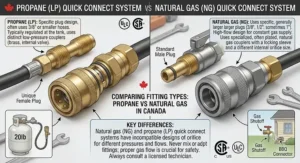
A quick connect propane fitting is a two-part brass coupling — a plug and a socket — that lets you attach or detach a low-pressure propane appliance without tools, replacing a threaded connection that would otherwise require a wrench and thread sealant every single time.
The mechanism is almost embarrassingly simple once you’ve used one: push the plug into the socket until it clicks, and an internal check valve in the socket automatically seals against gas flow the instant you disconnect it. This same basic idea shows up across countless industries — quick connect fittings are used everywhere from pneumatic tools to underwater equipment, and the BBQ version is simply a low-pressure, propane-rated adaptation of that broader engineering concept. For grillers, the appeal is speed: connecting a tank, an RV supply line, or a secondary appliance takes seconds instead of the minute-plus fumble of a threaded fitting, and there’s no risk of over-tightening a brass thread and cracking it.
How to Choose Quick Connect Propane Fittings for BBQ
Picking the right fitting comes down to a handful of concrete checks rather than brand loyalty. Work through these in order:
- Confirm your existing thread size first. Check whether your grill or hose ends in a 1/4″ or 3/8″ NPT thread before adding anything to your cart — this single detail eliminates most compatibility problems before they start.
- Decide if you need a full kit or a single adapter. A kit like the Camco option bundles a shut-off valve and adapter together; a single piece like the Stanbroil adapter assumes you already have the rest of the hardware.
- Match capacity to your setup, not just your grill. If you’re feeding more than one appliance, plan around a Y-splitter’s shared gas volume rather than assuming each outlet performs like a dedicated line.
- Prioritize solid brass over plated alternatives. Reviewers across every product in this category consistently flag corrosion as the first failure point on lower-quality parts.
- Check for an included shut-off valve if you’ll disconnect often. It’s a small feature that meaningfully speeds up daily use, especially for RV owners moving between a grill and other appliances.
- Look at hose length needs before fitting needs. A short adapter is pointless if your real problem is that the grill physically can’t sit far enough from the tank.
- Read the aggregated review sentiment for leak reports specifically. A handful of negative reviews mentioning general dissatisfaction is normal; a pattern of leak complaints on the same model is a genuine red flag worth avoiding.
Fitting Compatibility Guide: Matching Threads, Sizes, and Brands
Fitting compatibility is, without exaggeration, the single most common reason these products get returned. The propane accessory market runs on at least three overlapping standards — 1/4″ NPT, 3/8″ NPT, and 3/8″ flare — and manufacturers rarely make the distinction obvious in a product thumbnail.
Here’s the practical breakdown: RV-focused quick-connect systems, including most of the hoses and splitters covered above, standardize almost universally on 1/4″. Full-size backyard grills, particularly those built on Weber, Ducane, or PGS platforms, more often use 3/8″ NPT threading, which is exactly why the Mr. Heater 3/8″ Quick Connector exists as a distinct product rather than a redundant one. Camp stoves and portable griddles are the wildcard category — some use 1/4″, some use 3/8″ flare, and a few use proprietary threading that no universal adapter will solve.
| Thread Standard | Typical Use Case | Compatible Products |
|---|---|---|
| 1/4″ NPT | RVs, tabletop grills, splitters | Camco Kit, GASPRO Hose, GASPRO Y Splitter, Stanbroil Adapter |
| 3/8″ NPT | Full-size grills (Weber, Ducane, PGS) | Mr. Heater Connector |
| 3/8″ Flare | Mixed camp appliances | BlueStars Kit |
| QCC1/Type1 | Tank-side connections | Flame King Splitter |
The takeaway from this table is straightforward: buy for your thread standard first, and let brand reputation be the tiebreaker second. A brass fitting that’s beautifully made but threaded wrong for your grill is simply a paperweight, however good its reviews are. The Canadian Propane Association offers useful general guidance on propane BBQ setup that’s worth a skim before you commit to a particular combination of parts.
Propane Adapter for Grill vs Direct Hookup: What’s the Real Difference
A propane adapter for grill use and a direct hookup solve the same fundamental problem — getting gas from the tank to the burner — but they trade convenience against simplicity in opposite directions.
A direct hookup is the factory-standard threaded connection most grills ship with: a hose that screws directly onto the regulator, full stop, no quick-connect anywhere in the chain. It’s simpler, has one fewer point of potential failure, and is what most casual backyard grillers never think twice about. A quick-connect adapter inserts a plug-and-socket coupling somewhere in that chain — either at the tank, mid-hose, or at the appliance — specifically to make disconnection fast and tool-free.
The real-world difference shows up in frequency of use. Someone who fires up one grill in one fixed spot all season has little to gain from adding a quick-connect adapter; the threaded hookup they already have works fine and adds no extra brass joints (each joint is, technically, one more potential leak point, however small). Someone who moves a grill between a garage and a deck, swaps a griddle in and out, or runs an RV-based setup gains real time and convenience from the adapter, and the trade-off of one additional connection point is well worth it for that flexibility. Neither approach is objectively better — it depends entirely on how static or mobile your propane setup actually is.
Ease of Installation: A Practical Setup Guide
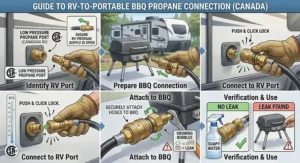
Installing a quick connect propane fitting is genuinely one of the more approachable weekend tasks in outdoor equipment maintenance, provided you follow a sequence instead of winging it.
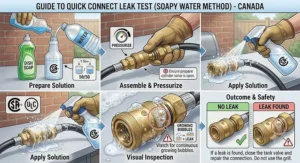
Start by confirming the tank valve is fully closed — this isn’t optional, it’s the first line in nearly every manufacturer’s installation sheet, including Mr. Heater’s own documentation. Next, thread the NPT side of your fitting onto the appliance or hose end by hand first, then finish with a wrench, using thread sealant rated for propane (standard plumber’s tape works, but propane-rated paste is the safer bet for anything permanent). Once threaded, connect the quick-connect plug to its socket — you should hear and feel a distinct click, not just a loose push-fit.
The step people skip, and the one that causes the most first-week problems, is the leak test. Mix a 50/50 solution of dish soap and water, apply it generously to every new connection, then slowly open the tank valve and watch for bubbles. If you see any, close the valve immediately, retighten or reseat the connection, and retest before lighting anything. A common mistake in the first 30 days is over-tightening the NPT thread in an attempt to stop a leak that’s actually caused by a misaligned quick-connect socket rather than the threaded joint — check the quick-connect end first if bubbles persist after retightening the threads. For ongoing maintenance, a quick visual and soap-test check at the start of each grilling season catches the seasonal wear that comes from freeze-thaw cycles and UV exposure on rubber seals.
Building Multi-Appliance Setups: Real-World Scenarios
Multi-appliance setups sound simple in theory — add a splitter, connect everything, done — but the right configuration depends heavily on who’s actually cooking and how.
Consider a family that tows a travel trailer most summer weekends and wants to run a griddle alongside their existing propane grill at the campsite. For this profile, a Y-splitter like the GASPRO 3-Way Propane Y Splitter attached downstream of the RV’s existing quick-connect port makes the most sense: both appliances get independent quick-connect access, installation takes minutes, and neither appliance needs modification. The trade-off, as covered earlier, is shared gas volume — running both a griddle and a grill flat-out simultaneously will draw down a small onboard tank noticeably faster than running one appliance alone.
Now consider a backyard host who wants a fixed fire pit table and a grill both fed from the same 20lb tank, but rarely runs them at the exact same time. Here, the Flame King Propane Tank Y Splitter Adapter is the better fit precisely because of its independent valves — the host can leave the fire pit connected permanently and toggle it on only when needed, without disturbing the grill’s own connection at all.
Finally, picture a tailgater who brings a stove, a small grill, and a portable heater to different games depending on the weather, and doesn’t want to permanently commit any one appliance to a splitter port. For this more improvisational use case, a single adapter like the Stanbroil Propane Brass Quick Connect Fitting Adapter, kept in a toolbox and swapped between appliances as needed, is more practical than a fixed multi-outlet splitter that assumes a consistent setup.
Common Mistakes When Buying Quick Disconnect Propane Fittings
Even experienced grillers trip over a short list of recurring errors in this category, and most of them are avoidable with five extra minutes of research before checkout.
The most frequent mistake is ordering based on the product photo rather than the listed thread size — a 1/4″ and a 3/8″ fitting can look nearly identical at thumbnail size, and mismatched threads are the number one cause of returns in this product category. A close second is assuming a splitter increases total gas capacity rather than just adding outlets; as covered above, dividing one line three ways doesn’t triple your tank’s output, it just triples where that output can go. Buyers also frequently skip the leak test after installation, treating the audible “click” of a quick-connect as proof of a safe connection when it only confirms mechanical engagement, not gas-tight sealing. Another overlooked detail is storage: leaving brass fittings exposed to winter freeze-thaw cycles without a protective cap accelerates the corrosion that shows up in negative reviews within a season. Finally, some buyers purchase a hose-only product expecting it to include the NPT adapter needed at the appliance end, when many hose listings sell that adapter separately — always read the “what’s included” section closely rather than assuming.
What to Expect: Real-World Performance
Specs on a listing page describe potential; day-to-day use tells you what actually matters. In practice, a well-matched quick-connect fitting adds roughly two to five seconds to hookup time compared to a threaded connection — but subtracts the minute-plus of wrench-turning that a threaded joint demands, which nets out as a genuine convenience gain for anyone connecting and disconnecting regularly.
Gas flow through a quality full-flow fitting is, in typical backyard use, indistinguishable from a direct threaded hookup; the “full flow” designation specifically exists to avoid the throttling that cheaper, narrow-bore quick-connects can introduce on high-BTU burners. Reviewers across nearly every product in this roundup describe the click-lock mechanism holding securely through normal handling, including the occasional accidental tug on a hose — though a small minority of complaints mention a socket wearing looser after roughly a season of heavy daily connect-disconnect cycles, which tracks with expected mechanical wear on any repeatedly-actuated part. Cold-weather performance is worth a specific mention for Canadian buyers: brass fittings themselves handle cold fine, but rubber O-rings inside quick-connect sockets can stiffen in sub-zero temperatures, making that first connection of a winter camping trip feel slightly firmer than it would in July.
Long-Term Cost & Maintenance
The upfront price gap between a C$15 single adapter and a C$50 full kit looks larger than it actually is once you account for total cost of ownership over several grilling seasons.
A bare adapter without a shut-off valve typically requires you to keep other hardware — a separate valve, a length of appropriate hose — on hand to build a complete usable system, and replacing a corroded plated part every season or two adds up faster than buying one solid-brass kit that lasts five-plus seasons with basic care. Maintenance costs are modest across this entire category: a bottle of dish soap for annual leak testing, an occasional dab of propane-rated thread sealant, and a protective cap or indoor storage location for the off-season are the entirety of what’s needed to keep any of these fittings performing well. Where cost genuinely diverges is in multi-appliance setups — buying three single adapters piecemeal to solve a three-appliance problem typically costs more in total than one purpose-built Y-splitter, while also leaving you with three separate points of potential wear instead of one engineered assembly.
Safety & Regulations: What Canadians Need to Know
Propane BBQ safety in Canada isn’t just common sense — it’s actively regulated, and understanding the basics protects both your household and, frankly, your insurance coverage in the event something goes wrong.
Provincially, bodies like Ontario’s Technical Standards and Safety Authority actively publish seasonal guidance, and the TSSA’s own BBQ safety recommendations include a simple three-step start-of-season check: clean the burner ports, inspect the hose for cracking, and soap-test every connection for leaks before the first light of the season. That soap test applies just as much to a quick-connect fitting as to a threaded one — the click of a quick-connect only confirms mechanical engagement, not a gas-tight seal, so skipping the soap test on a new fitting is a mistake regardless of connector type. Nationally, propane cylinders are classified as dangerous goods for transport purposes, though a standard exemption allows Canadians to transport a typical-sized barbecue cylinder without a special permit, provided it’s kept upright, secured, and out of an enclosed vehicle trunk.
Regardless of which fitting you choose, keep spare or disconnected cylinders outdoors and upright, never store them in a garage or shed, and never test for leaks with an open flame — soapy water is the standard, safe method every regulator and manufacturer recommends. If you ever smell propane during or after a fitting swap, close the tank valve immediately and don’t attempt to relight anything until the leak is located and resolved, ideally with the help of a qualified technician for anything beyond a simple connection recheck.
Problem → Solution Guide
Problem: My grill won’t stay lit after switching to a quick-connect fitting. This is almost always a partial connection rather than a fitting defect — disconnect fully, confirm you hear the click on reconnection, and soap-test before relighting.
Problem: The quick-connect socket feels loose after a season of use. Some wear on the internal seal is normal after repeated actuation; if disconnection now happens without deliberate pressure, replace the socket half rather than the whole assembly if your kit allows it.
Problem: I bought a hose but it doesn’t have the fitting I need at the appliance end. Many hose-only listings sell the NPT adapter separately — check the compatible accessories section of the listing rather than assuming a universal fit.
Problem: I want to run two appliances but only have one quick-connect port. A Y-splitter solves this cleanly, but budget your expectations around shared gas volume rather than expecting two full-power appliances simultaneously on a small tank.
Problem: My fitting shows surface corrosion after one winter. Solid brass resists this far better than plated alternatives; a light coating of food-safe silicone grease on threads before winter storage, plus a protective cap, meaningfully slows this process. Community discussion on CBC’s coverage of BBQ propane safety reinforces the same seasonal-check habits that prevent both corrosion and safety issues alike.
Frequently Asked Questions
❓ What is the difference between a quick connect and quick disconnect propane fitting?
❓ Can I use a 1/4 inch quick connect fitting on a 3/8 inch grill regulator?
❓ Are quick connect propane fittings safe for everyday grilling?
❓ How many appliances can I run off one propane Y splitter?
❓ Do quick connect fittings work in cold Canadian winters?
Conclusion
Choosing among quick connect propane fittings for BBQ setups really comes down to answering three questions honestly: what thread size does your gear actually use, how many appliances do you genuinely need to run at once, and how often are you connecting and disconnecting compared to leaving one hookup permanently in place. Get those three answers right, and the rest of this guide is just matching numbers to a product page.
For most single-grill households upgrading from a threaded hookup, the Camco Propane Quick-Connect Kit offers the most complete, install-once-and-forget solution. Multi-appliance campers and tailgaters are better served by the GASPRO 3-Way Propane Y Splitter or the Flame King Propane Tank Y Splitter Adapter, depending on whether they want shared downstream access or independent tank-side control. And anyone still uncertain about their exact thread standard should start with the BlueStars 1/4″ RV Propane Quick Connect Fittings Kit, which hedges against that uncertainty better than any single-thread product on this list.
Whichever fitting ends up in your cart, the fundamentals don’t change: confirm compatibility before buying, soap-test after installing, and store brass parts properly through the off-season. Do that, and your next backyard cookout starts with a click instead of a wrench.
✨ Ready to Upgrade Your Grill Setup? 🔥
🔍Take the guesswork out of your next propane connection. Click through to check current pricing and availability on any of these picks, and get back to what actually matters — the food.
Recommended for You
- Propane Hose and Regulator Kit Review 2026: 7 Top Picks Ranked
- 20 lb vs 30 lb Propane Tank for Grilling: 7 Top Picks (2026)
- 20 lb Propane Tank for BBQ: 7 Best Picks for Canada (2026)
Disclaimer: This article contains affiliate links. As an Amazon Associate, I earn from qualifying purchases. If you purchase products through these links, we may earn a small commission at no additional cost to you.
✨ Found this helpful? Share it with your friends! 💬🤗
