In This Article
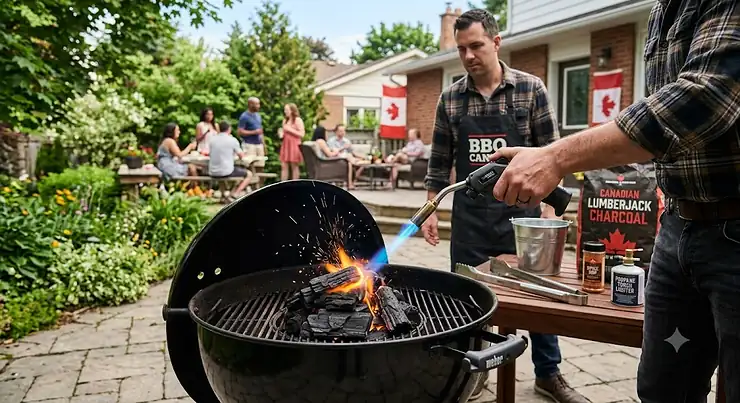
Here’s a confession every backyard cook eventually makes: matches are for birthday cakes, not charcoal chimneys standing three feet from your face on a windy patio. That’s usually the exact moment someone starts Googling a propane torch lighter for grilling, and honestly? Good instinct. A proper torch turns “please, please catch” into a confident two-second blast of blue flame, whether you’re lighting a kettle grill, torching the last stubborn coals in a smoker, or finishing a ribeye with a crackling brown crust that a regular gas grill just can’t deliver.
This guide walks through seven real, currently available options — from no-frills utility torches under C$35 to high-output trigger-start models that plumbers and pitmasters both reach for. Every pick here is grounded in actual product specifications and aggregated Amazon review patterns, not marketing copy dressed up as advice. What is a propane torch lighter for grilling, in plain terms? It’s a handheld tool that attaches to a small propane cylinder and produces a controlled, adjustable flame — typically between 1,800°F and 3,600°F — used to ignite charcoal, ignite pellet and wood fires, and sear meat directly.
We’ll cover flame temperature science, refillable versus disposable fuel debates, Canadian propane safety rules, and exactly which torch fits which kind of griller. Grab a coffee — this one’s thorough.
Quick Comparison Table
| Torch | Ignition Type | Max Flame Temp | Best For |
|---|---|---|---|
| Sondiko L8010 | Trigger/piezo | up to 1,800°C (3,272°F) | Best all-round value |
| Bernzomatic TS8000 | Trigger-start | up to ~3,600°F | Hottest, most powerful |
| Mag-Torch MT535 Kit | Push-button self-light | ~1,900°F | Budget starter kit |
| ThermoMaven Torch Gun | One-touch max fire | up to ~2,500°F | Safest for beginners |
| KOACKL CSA Torch | Piezo ignition | up to 1,800°C (3,272°F) | CSA-certified safety |
| FunOwlet Culinary Torch | Piezo ignition | up to 1,800°C (3,272°F) | Precise flame control |
| TBTEEK Cooking Torch | Trigger, safety lock | up to ~2,500°F | Lightest, one-handed use |
A quick scan of that table tells most of the story: the Bernzomatic TS8000 wins on raw heat output and durability, while the Mag-Torch MT535 Kit wins on price because it actually bundles a propane cylinder instead of leaving you shopping for fuel separately. If safety features matter more to you than flame temperature, the KOACKL CSA Torch and ThermoMaven Torch Gun both build in extra protection that the bare-bones options skip. None of these numbers are exact retail prices — Amazon pricing shifts by the week, so treat every figure here as a starting point for your own research, not a quote.
💬 Just one click — help others make better buying decisions too!😊
Top 7 Propane Torch Lighters for Grilling: Expert Analysis
Coverage below spans budget, mid-range, and premium torches, plus a couple of lesser-known but genuinely capable alternatives most “best of” lists skip entirely.
1. Sondiko L8010 — best all-round value pick
The Sondiko L8010 is the torch most Canadian home cooks land on, and for good reason: it doesn’t specialize in one job, it does five reasonably well. Its adjustable fuel control lets the flame swing from a soft, wide fan (great for lighting a bed of charcoal evenly) up to a needle-thin jet pushing roughly 1,800°C (3,272°F), hot enough for a legitimate steak sear.
At around 0.9 lbs, it’s light enough for a one-handed grilling session, and the trigger-plus-piezo ignition means you’re not fumbling with a separate lighter every time the flame goes out mid-cook. Based on the spec comparison against similarly priced torches, the L8010’s flame stability in light wind is a genuine step up from cheaper no-name imports, which matters more than the headline temperature number once you’re actually standing on a windy deck.
Aggregated Amazon review sentiment for this model skews positive on ignition reliability and flame adjustability; a recurring theme across listings for this style of torch is frustration that the propane cylinder is sold separately, so budget for that add-on before checkout.
Pros:
- ✅ Adjustable flame from wide fan to precision jet
- ✅ Lightweight one-handed trigger design
- ✅ Reaches genuinely sear-capable temperatures
Cons:
- ❌ Propane cylinder not included, adds to true cost
- ❌ Piezo igniters on this class of torch can wear out over seasons
Expect a price in the C$30-C$45 range for the torch head alone. For casual grillers who want one tool that handles charcoal, searing, and campfire duty, this is hard to beat on value.
2. Bernzomatic TS8000 — hottest flame for searing power
The Bernzomatic TS8000 isn’t marketed as a grilling accessory first — it’s a trade-grade soldering and brazing torch that happens to be a phenomenal charcoal lighter and steak-searing tool, which is exactly why so many serious backyard cooks own one. The trigger-start ignition and pressure-regulated burn mean it lights instantly and burns evenly even when tilted sideways to get under a chimney starter.
Here’s what most buyers overlook about this model: the “swirl flame” design concentrates heat into a tighter, hotter cone than most kitchen-marketed torches, which is why it’s the go-to pick among people who reverse-sear thick cuts. Cast aluminum construction also means it survives years of outdoor use where plastic-bodied torches crack.
Historically, this torch has carried a rating in the high 4-star range across thousands of Amazon reviews, with buyers frequently praising the trigger ignition and durability, and the most common complaint being that it’s designed for MAP-Pro or propane cylinders sold separately, not included in the box.
Pros:
- ✅ Trigger-start ignition works instantly, even tilted
- ✅ Cast aluminum body built for years of outdoor use
- ✅ Hottest, most concentrated flame of this group
Cons:
- ❌ No propane tank included, extra purchase required
- ❌ Overkill flame size for quick, light charcoal touch-ups
Price typically sits in the C$55-C$75 range for the torch head. If you want one tool that outlives your grill, this is the premium pick.
3. Mag-Torch MT535 Utility Torch Kit — easiest budget starter kit
The Mag-Torch MT535 Utility Torch Kit takes a completely different approach from the trigger-torches above: it’s a simple, self-lighting torch that ships as a complete kit, including a 14.1 oz disposable propane cylinder, so there’s no separate fuel purchase before your first cookout.
Its flame output is modest by comparison — roughly 3,900 BTU/hr at a maximum temperature near 1,900°F — which sounds unimpressive next to the TS8000’s numbers until you remember that lighting charcoal briquettes doesn’t actually require a blowtorch-grade flame. Based on the spec sheet, this is a torch built for reliability and simplicity over raw power, and that’s exactly the audience it serves well: renters, apartment-balcony grillers, and anyone who wants to skip the assembly-required feeling of a trigger torch.
Reviewers commonly describe this model as dependable for its intended jobs — lighting grills, thawing pipes, loosening stuck bolts — while noting that the modest flame size means it’s slower than a trigger torch for large searing jobs.
Pros:
- ✅ Complete kit, includes propane cylinder in the box
- ✅ Regulated flame stays consistent at any angle
- ✅ Simple push-button operation, no learning curve
Cons:
- ❌ Lower flame temperature limits serious searing use
- ❌ Disposable cylinder means recurring replacement cost
This kit generally runs in the C$25-C$40 range, making it the cheapest true entry point on this list, cylinder included.
4. ThermoMaven Propane Torch Gun — safest one-touch trigger lock
The ThermoMaven Propane Torch Gun is built around a one-touch “max fire” trigger with an integrated safety lock, a detail that matters more than it sounds on paper. What most buyers overlook about this model is that the lock isn’t just a child-safety gimmick — it prevents the accidental full-blast ignition that happens when a torch gets bumped in a storage drawer, a genuine safety improvement over torches with an exposed adjustment dial.
Flame output tops out around 2,500°F, comfortably enough for charcoal ignition, sous vide searing, and creme brûlée finishing, though it falls short of the TS8000’s professional-grade heat. The gun-style grip and pistol trigger also make it noticeably easier to aim precisely than wand-style torches, which matters when you’re trying to hit the underside of a chimney starter without scorching your knuckles.
Aggregated review sentiment on Amazon.ca tends to praise the ergonomic grip and safety lock specifically, with the most frequent gripe being that the flame, while adjustable, doesn’t reach quite as high a temperature as dedicated welding-style torches.
Pros:
- ✅ Integrated safety lock prevents accidental ignition
- ✅ Pistol-grip design improves aim and control
- ✅ Versatile across grilling, sous vide, and dessert use
Cons:
- ❌ Lower max temperature than trigger-start welding torches
- ❌ Tank sold separately, adding to total cost
Expect roughly C$35-C$50 for this model. Families with kids around the patio should weight the safety lock heavily in their decision.
5. KOACKL CSA Certified Propane Torch — top pick for safety-conscious buyers
For Canadian buyers specifically, the KOACKL CSA Certified Propane Torch deserves a closer look because it carries CSA certification, the same standards body referenced throughout provincial and federal barbecue safety guidance. That’s a meaningfully different claim than “meets safety standards” marketing language on uncertified competitors — CSA testing is administered by an accredited, independent organization, not a manufacturer’s own assertion.
Functionally, it lands close to the Sondiko L8010 on paper: adjustable flame reaching roughly 1,800°C (3,272°F), piezo ignition, and an ergonomic grip. On paper this means near-identical performance to the L8010, but the certification premium is worth paying for households that prioritize verified safety compliance over saving a few dollars, particularly if your home insurance or condo bylaws reference certified appliances.
Reviewers most often mention the certification badge and instant piezo ignition as standout strengths, with occasional notes that the longer wand versions can feel front-heavy during extended one-handed use.
Pros:
- ✅ CSA certification, independently verified safety standard
- ✅ Instant piezo ignition, no separate lighter needed
- ✅ Reaches full searing-capable flame temperature
Cons:
- ❌ Longer wand models can feel front-heavy over time
- ❌ Premium pricing versus uncertified equivalents
Pricing generally falls in the C$30-C$45 range. If Canadian certification matters to you, this is the clearest pick on the list.
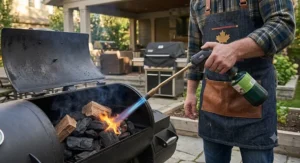
6. FunOwlet Powerful Cooking Propane Torch — most precise flame control
The FunOwlet Powerful Cooking Propane Torch leans into culinary use cases specifically, marketing itself for creme brûlée and baking alongside grilling and charcoal lighting, and the flame-length adjustment reflects that dual purpose. Reviewers and the spec sheet both point to a genuinely wide range between a tight precision flame and a broader fan, useful for anyone who wants one torch that handles both fine kitchen work and rougher outdoor jobs.
The spec sheet won’t tell you this, but user reports suggest the narrower nozzle profile makes it slightly easier to direct flame into tight spaces, like between charcoal briquettes stacked in a chimney starter, compared to wider-nozzle torches designed purely for weed burning or plumbing. Maximum flame temperature is again rated near 1,800°C (3,272°F), putting it in the same performance tier as the Sondiko and KOACKL models.
Aggregate feedback tends to highlight flame-length versatility as the standout feature, while the most common criticism echoes the rest of this category: the propane tank is a separate purchase.
Pros:
- ✅ Wide flame-length adjustment for precision and power
- ✅ Doubles well for kitchen torch duties, not just grilling
- ✅ Narrow nozzle reaches tight spaces in a chimney starter
Cons:
- ❌ Propane tank not included in the box
- ❌ Best suited to lighter-duty jobs than the TS8000
Typical pricing sits around C$30-C$45. Home cooks who also do occasional dessert work get the most mileage from this pick.
7. TBTEEK Propane Cooking Torch — lightest for one-handed use
Rounding out the list, the TBTEEK Propane Cooking Torch is built around a genuinely refillable design with a heat-resistant alloy nozzle and a non-slip ABS handle, plus a rated maximum around 2,500°F. It’s marketed specifically toward searing and charcoal lighting rather than heavier-duty trade work, and the continuous-flame mode (as opposed to a trigger you must hold constantly) is a small but real comfort improvement during longer lighting sessions.
Based on the spec comparison, the integrated safety lock puts it in the same protective tier as the ThermoMaven, while its lighter overall build makes it a comfortable choice for anyone who finds heavier trigger-torches fatiguing to hold at arm’s length over hot coals.
Review patterns commonly cite the non-slip grip and continuous-flame convenience as strengths, alongside occasional notes that the moderate flame temperature means it takes a bit longer than the TS8000 to fully engage a large chimney starter.
Pros:
- ✅ Continuous-flame mode, no trigger fatigue
- ✅ Refillable design with heat-resistant alloy nozzle
- ✅ Lightweight build reduces arm fatigue over long sessions
Cons:
- ❌ Lower max temperature than professional trigger-start torches
- ❌ Takes longer on large chimney starters than higher-output models
Expect a price in the C$25-C$40 range. It’s a solid, comfortable mid-pack choice for anyone prioritizing ease of handling over peak heat.
Practical Usage Guide: Setting Up and Maintaining Your Torch
Getting the most out of any propane torch lighter for grilling starts before you ever strike the ignition. First, always attach the cylinder outdoors, in an upright, well-ventilated space — never in a garage or enclosed porch, per guidance consistently repeated across Canadian municipal fire-safety resources. Hand-tighten the regulator connection, then run a light soap-and-water test across the fitting; bubbling means a leak, and you should not proceed until it’s resolved.
During the first 30 days of ownership, the most common mistake is over-tightening the gas valve or forcing the connector, which can damage the O-ring seal and cause slow leaks that aren’t obvious until your cylinder runs out faster than expected. A quick monthly maintenance habit — wiping the nozzle free of grease residue after searing use, and checking the connector’s O-ring for cracking each spring before the grilling season starts — extends the working life of any torch on this list significantly.
Optimization tip: for charcoal ignition, hold the flame at the base of the coal pile for 20-30 seconds rather than sweeping across the surface. This concentrates heat where it matters and catches faster than a wide, shallow pass. For finishing sears, keep the torch moving in slow, steady passes 2-3 inches from the meat’s surface rather than holding it stationary, which avoids scorching one spot while the rest stays pale.
Real-World Scenarios: Which Torch Fits Your Grilling Life
Picture three different Canadian households, each shopping for the same category of tool with completely different priorities.
The first is a downtown condo dweller with a small balcony grill, cooking two or three times a week in warmer months. Budget matters, storage space is tight, and simplicity beats raw power every time. The Mag-Torch MT535 Kit fits this profile well — it’s compact, ships with fuel included, and doesn’t demand a learning curve.
The second is a suburban family that hosts weekend cookouts most of the summer, grilling everything from burgers to the occasional reverse-seared tomahawk steak. They want reliable ignition, a bit of safety margin for kids running around the yard, and enough flame temperature to actually finish a proper sear. The ThermoMaven Torch Gun or KOACKL CSA Torch both suit this household nicely, balancing safety features with real searing capability.
The third is a competition-adjacent backyard pitmaster running a offset smoker most weekends, lighting large batches of charcoal and occasionally needing a hot, sustained flame for stubborn logs. For this frequency and intensity of use, the Bernzomatic TS8000 earns its higher price tag through sheer output and durability under repeated heavy use.
Problem → Solution: Common Torch Issues
Problem: The flame sputters or won’t stay lit. This is almost always a fuel-flow issue — either the cylinder is nearly empty, or the regulator connection isn’t fully seated. Reconnect the fitting, confirm the cylinder valve is fully open, and test again.
Problem: The torch won’t ignite at all. Piezo igniters, common on the Sondiko L8010, KOACKL CSA Torch, and FunOwlet Culinary Torch, can wear out after repeated seasons of use. Keep a standalone striker or long-reach lighter as backup so a dead igniter doesn’t end your cookout.
Problem: Uneven charcoal ignition. Holding the flame too far from the coals, or sweeping across the surface instead of concentrating at the base, is the usual culprit. Reposition briquettes into a tighter pile before lighting rather than a flat spread.
Problem: Torch feels unstable or tips over easily. Lighter, top-heavy wand torches like the FunOwlet Culinary Torch are more prone to this than gun-style grips. Set the torch down on its side, never standing upright, between uses.
Problem: Inconsistent sear on meat. This usually means the flame is held too close (scorching before browning develops) or too far (never reaching searing temperature). Aim for roughly 2-3 inches of clearance and keep the torch moving continuously.
How to Choose a Propane Torch Lighter for Grilling
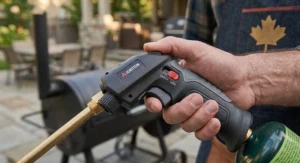
- Match flame temperature to your primary use. Charcoal lighting only needs roughly 1,900°F; serious searing benefits from torches rated closer to 3,000°F and above.
- Decide between kit and head-only. Kits like the Mag-Torch MT535 include fuel; torch-head-only models like the Bernzomatic TS8000 require a separate cylinder purchase.
- Weigh ignition type. Piezo and trigger-start ignition both work well, but piezo components are more prone to long-term wear than mechanical trigger sparks.
- Check for safety locks. Households with children benefit meaningfully from a locking trigger, like the ThermoMaven Torch Gun or TBTEEK Propane Cooking Torch.
- Look for CSA certification if it matters to you. The KOACKL CSA Torch is the clearest example on this list of independently verified compliance.
- Consider weight and grip. Longer cookout sessions favour lighter, gun-style torches over heavier wand designs.
- Budget for fuel separately. Most torch heads exclude the propane cylinder, so factor that recurring cost into your real total spend.
BBQ Torch Lighter vs Traditional Ignition Methods
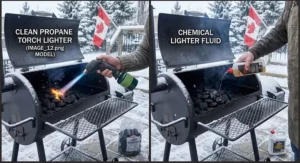
Comparing a bbq torch lighter against lighter fluid and matches isn’t really close once you look past the sticker price. Lighter fluid works, but it introduces a genuine flavour risk — incompletely burned accelerant can leave a chemical taste on food if you add meat to the grill before the fluid has fully combusted, a concern echoed by food-safety commentary across BBQ publications for decades. Matches, meanwhile, demand you get uncomfortably close to an open flame repeatedly, which is neither fast nor especially safe in windy conditions.
A torch sidesteps both problems: no chemical residue, no repeated match-striking, and a flame you can control precisely. Chimney starters paired with newspaper solve some of these issues too, but they’re slower — often 15-20 minutes to full ignition versus a couple of minutes with direct torch contact — and newspaper ignition can be unreliable in damp conditions. Where a torch genuinely underperforms is cost per use for occasional grillers; if you fire up the grill twice a summer, a C$5 box of matches is hard to beat economically, even if it’s slower and less pleasant to use.
Propane Torch for Charcoal Ignition: What to Expect
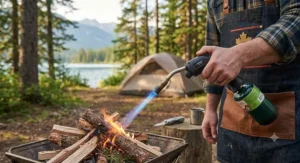
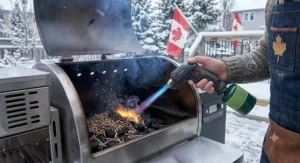
Using a propane torch for charcoal ignition looks straightforward and mostly is, but the technique matters more than raw flame temperature. Hold the flame at the base of a tightly packed pile of briquettes or lump charcoal for roughly 20-30 seconds per section, working around the pile rather than trying to light it all in one sweep. You’re aiming to get the bottom layer glowing red and producing its own sustained heat, at which point natural convection carries the fire upward through the stack.
What the spec sheet won’t tell you is that lump charcoal generally catches faster than compressed briquettes, since it has more irregular surface area and fewer binding agents to burn through first. A torch rated in the 1,800°C-plus range, like the Sondiko L8010 or KOACKL CSA Torch, will fully engage a chimney starter’s worth of charcoal in roughly 60-90 seconds of direct contact time, versus several minutes for a lower-output kit torch like the Mag-Torch MT535.
Torch Flame Temperature Explained
Torch flame temperature numbers on product listings can be genuinely confusing, partly because manufacturers report them in different units and under different testing conditions. In practice, propane’s theoretical maximum flame temperature in open air sits around 1,980°C (3,600°F), which is why the Bernzomatic TS8000‘s rating sits near the top of what’s physically achievable with this fuel type. Most consumer-grade torches on this list top out closer to 1,800°C (3,272°F) or lower, which reflects nozzle design and burn-tube geometry rather than a different fuel.
Here’s what actually matters in practice: for lighting charcoal, temperature above roughly 1,900°F offers diminishing returns, since the limiting factor becomes contact time and airflow, not raw heat. For searing meat, however, higher temperatures genuinely shorten the time needed to develop a browned crust before the interior overcooks — the chemistry behind that crust is the Maillard reaction, a well-documented browning reaction between amino acids and sugars that occurs faster and more completely at higher surface temperatures.
Refillable vs Disposable Propane: Which Should You Choose
The refillable vs disposable question comes down almost entirely to how often you grill. Disposable 14.1 oz cylinders, like the one bundled with the Mag-Torch MT535 Kit, are convenient and require zero extra equipment, but the cost per use climbs steadily for frequent grillers, since each empty canister gets tossed rather than refilled.
Refillable options, whether that’s a small camping-style cylinder you top up at a local propane retailer or an adapter that connects your torch to a standard 20 lb barbecue tank, cost more upfront but drop the long-run cost per light dramatically for anyone grilling multiple times a week. On paper this means occasional grillers — a handful of cookouts per summer — usually come out ahead sticking with disposable cylinders, while frequent users recoup the cost of a refillable setup within a single season. There’s also an environmental angle worth weighing: refillable systems generate meaningfully less metal waste over a multi-year ownership period than a steady stream of single-use disposables.
Searing Use: Getting Restaurant-Quality Crust at Home
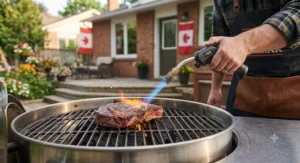
Searing use is where a propane torch lighter for grilling earns its keep beyond just charcoal ignition. The technique that separates an even, appetizing crust from a patchy, scorched one is movement: keep the torch tip roughly 2-3 inches from the meat’s surface and move it continuously in slow passes, rather than holding it stationary over one spot.
Reverse-searing — cooking meat low and slow first, then finishing with intense direct heat — is where torches genuinely outperform a standard grill grate, since you get precise, targeted heat exactly where and when you want it, without waiting for an entire grill surface to reach searing temperature. The Bernzomatic TS8000‘s higher output shines here, developing a deep crust in under a minute per side on a thick steak, while lower-output models like the ThermoMaven Torch Gun still work well but need a bit more patience. Pat meat fully dry before searing; surface moisture has to evaporate before browning can begin, so a wet steak wastes torch time and fuel before the actual crust-building starts.
Common Mistakes When Buying a Propane Torch Lighter for Grilling
Expert commentary on this category consistently points to a handful of avoidable buying mistakes. The first is assuming the listed price includes fuel — most torch heads on Amazon.ca, including the Sondiko L8010, Bernzomatic TS8000, and FunOwlet Culinary Torch, explicitly exclude the propane cylinder, so budget accordingly before checkout.
The second mistake is prioritizing maximum flame temperature over practical handling. A torch rated at 3,600°F sounds impressive, but if it’s heavy, poorly balanced, or lacks a safety lock, it’s a worse everyday tool than a slightly cooler, better-designed alternative like the ThermoMaven Torch Gun. The third mistake is skipping CSA certification entirely when it’s readily available at a comparable price point, as with the KOACKL CSA Torch — certification costs little extra and provides independently verified peace of mind. Finally, buyers frequently overlook igniter type; piezo ignition is convenient until it wears out, so keeping a backup striker on hand avoids a frustrating mid-cookout surprise.
Safety, Regulations & Compliance Guide for Canadian Grillers
Propane torches and barbecue cylinders fall under the same general safety framework across Canada, and a few rules apply nationwide regardless of province. Cylinders must be stored and transported upright, never inside a sealed vehicle or indoors, and federal fire-safety guidance for barbecue season specifically recommends checking hose connections for leaks with a soap-and-water test before each season’s first use. Cylinders themselves require re-certification every 10 years in Canada, with the qualification date stamped on the collar.
CSA Group maintains the national standards governing propane installation and appliance safety that provinces reference in their own fire codes, which is why certification badges on torches like the KOACKL CSA Torch carry real regulatory weight rather than being a marketing flourish. It’s also worth knowing that Health Canada has previously issued national warnings over specific utility lighter models found to pose fire or explosion risk, a reminder that not every product on the market meets the same safety bar, and that checking for recalls before purchase is a genuinely useful five-minute habit. Always keep torches and cylinders away from children, store them outdoors even when not in use, and never store a spare cylinder underneath or beside an active grill.
Long-Term Cost & Maintenance
Total cost of ownership varies more than the sticker price suggests. A budget kit torch like the Mag-Torch MT535 costs less upfront, but relying on disposable 14.1 oz cylinders means recurring fuel purchases that add up over a multi-year ownership period for frequent grillers. Trigger-torches like the Bernzomatic TS8000 or Sondiko L8010, paired with a refillable propane setup, front-load the cost but flatten out considerably cheaper per use over several seasons.
Maintenance costs stay low across this entire category as long as basic care is followed: an annual O-ring check, keeping the nozzle free of grease buildup, and storing torches indoors during winter months to protect seals from temperature-cycling damage. Piezo igniters are the most common failure point industry-wide and aren’t typically user-serviceable, so factor eventual igniter replacement or full torch replacement into your multi-year cost expectations, particularly for daily or near-daily users.
Features That Actually Matter (And Those That Don’t)
Marketing copy across this category loves to lead with peak flame temperature, but based on the spec comparison across all seven products here, ignition reliability and grip ergonomics matter more day-to-day than an extra few hundred degrees you’ll rarely use at full blast. A safety lock, genuinely useful for households with kids or pets on the patio, matters more than nozzle length in almost every real-world scenario.
What doesn’t matter nearly as much as listings suggest: exotic nozzle shapes marketed for “professional culinary use.” Unless you’re genuinely working a restaurant kitchen, a standard adjustable nozzle handles searing, brûlée, and charcoal lighting equally well across every model reviewed here.
Frequently Asked Questions
❓ What is the best propane torch lighter for grilling?
❓ How hot does a BBQ torch lighter get?
❓ Can I use a propane torch for charcoal ignition?
❓ Is refillable propane cheaper than disposable cylinders long-term?
❓ Do I need a special torch for searing use?
Conclusion
Choosing a propane torch lighter for grilling really comes down to matching flame output and safety features to how often you actually cook outdoors. Casual weekend grillers get excellent value from the Mag-Torch MT535 Kit or Sondiko L8010, families with kids on the patio benefit most from the locking safety features on the ThermoMaven Torch Gun, and anyone chasing restaurant-grade sears or lighting large batches of charcoal regularly will get the most mileage from the Bernzomatic TS8000‘s professional-grade output. Canadian buyers who want independently verified compliance have a clear standout in the KOACKL CSA Torch.
Whichever model you land on, remember that price ranges shift regularly, so always check current listings before buying, and never skip the basic safety habits — upright storage, leak testing, and keeping cylinders away from heat sources — that keep this genuinely useful tool safe across years of backyard cookouts.
✨ Ready to upgrade your grilling setup? Browse today’s listings and pick the torch that matches how you actually cook! 🔥
Recommended for You
- Natural Fire Starters vs Fire Starter Cubes: 7 Best Picks (2026)
- Fire Starter Cubes for BBQ and Camping: 7 Best Picks (2026)
- Propane Leak Detector for Home BBQ: 7 Safest Picks for 2026
Disclaimer: This article contains affiliate links. As an Amazon Associate, I earn from qualifying purchases. If you purchase products through these links, we may earn a small commission at no additional cost to you.
✨ Found this helpful? Share it with your friends! 💬🤗
