
In This Article
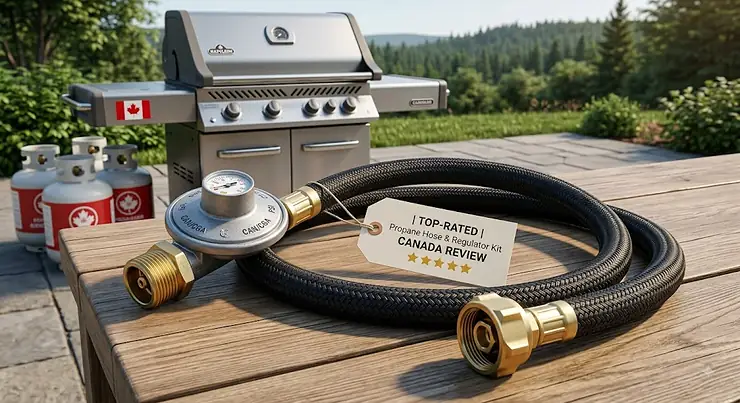
A propane hose and regulator kit is not the part of your grill setup you think about — until the flame sputters mid-cookout or you catch a faint rotten-egg smell drifting from the tank. What is a propane hose and regulator kit? It’s the assembly that connects a propane cylinder to a grill, heater, or fire pit, combining a pressure-reducing regulator with a length of certified hose so gas arrives at a safe, consistent flow rate. Get the wrong one and you’re either stuck three feet from your tank or, worse, running a connection that isn’t rated for the appliance on the other end.
This propane hose and regulator kit review exists because most buying guides just regurgitate spec sheets. We went the other direction: real products, real listed specifications, and honest analysis of where each one earns its keep. Whether you’re replacing a cracked OEM hose on a Weber Genesis, extending a fire pit table across the patio, or setting up a dual-tank RV system for a fall trip, the right kit comes down to three things — length, connector compatibility, and pressure rating — and getting any one of them wrong turns a five-minute hookup into a Saturday-afternoon hardware store run.
Canadian shoppers face an extra wrinkle most American guides skip entirely: propane appliances here fall under CSA B149.2, the Propane Storage and Handling Code, and the Department of National Defence’s own BBQ fire safety guidance reflects the same core rules every household should follow. That’s not a reason to panic — it’s a reason to buy a hose that’s actually certified rather than the cheapest one in the search results. Below, we break down seven real kits across budget, mid-range, and premium tiers, then dig into hose length math, connector types, and the safety habits that keep a propane setup boring in the best possible way.
Quick Comparison Table
| Kit | Hose Length | Connector | Best For |
|---|---|---|---|
| Weber 7627 QCC1 Kit | 30 in (76 cm) | QCC1 → 5/16″ | Genesis 300-series OEM replacement |
| GasOne 2120-012 | 12 ft (3.7 m) | QCC1 → 3/8″ flare | Fire pits, heaters, PSI monitoring |
| DOZYANT 12 ft Braided | 12 ft (3.7 m) | QCC1 → 3/8″ flare | Long-reach grill/appliance hookups |
| Flame King KT12ACR-2 | 2× 12 in pigtails | 1/4″ SAE flare | Dual-tank RV auto-changeover |
| Camco 15″ Pigtail | 15 in (38 cm) | ACME → 1/4″ flare | Short RV tank-to-regulator link |
| Mr. Heater F271239 | 22 in (56 cm) | 1/2″ flare/pipe | Fixed indoor-rated appliance hookup |
| DOZYANT 4 ft Adjustable | 4 ft (1.2 m) | QCC1 → 3/8″ flare | Turkey fryers, high-BTU burners |
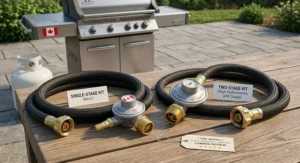
Looking at the spread above, hose length is really the first filter that should narrow your search: anything under two feet is built for a fixed connection point, while the 12-foot options exist specifically so your tank can sit off to the side or below deck level. The Flame King KT12ACR-2 stands apart because it isn’t a single hose at all — it’s an auto-changeover regulator built for people running two tanks who never want to think about switching mid-meal. Notice also that connector type isn’t universal: QCC1 (the modern “hand-tight” type-1 fitting) dominates BBQ-side connections, while ACME and SAE flare fittings show up on the RV and appliance side of the equation.
💬 Just one click — help others make better buying decisions too!😊
Top 7 Propane Hose and Regulator Kits: Expert Analysis
1. Weber 7627 QCC1 Hose and Regulator Kit — genuine OEM fit for Genesis grills
The Weber 7627 is the manufacturer-made replacement Weber itself sells for Genesis 300-series grills, and that pedigree is really the whole pitch. It ships as a 30-inch rubber hose (5/16-inch inside diameter) paired with a regulator, a threaded brass fitting, and a QCC1 coupling nut — the same hand-tight, overfill-protected connector every propane cylinder sold in North America since the mid-2000s has used. Because it’s a genuine Weber part, it’s built to the exact pressure and flow specs the Genesis burner system expects, which matters more than it sounds: a mismatched aftermarket regulator can under- or over-deliver gas, leading to weak flames or a hissing, hard-to-light burner.
Based on the spec comparison with universal kits, the trade-off here is obvious — 30 inches is short, full stop, and this kit was never designed to let your tank wander away from the cart. What most buyers overlook about OEM parts like this is that the resale and warranty logic favours them too; if something goes wrong with ignition performance, a Weber-branded regulator removes one variable from the troubleshooting chain. Reviewers consistently report that the fit is exact — no wiggling a slightly-wrong hose into a housing it wasn’t built for — and that the coupling nut threads on without cross-threading, a common complaint with off-brand QCC1 fittings.
Pros:
- ✅ Exact OEM fit for Genesis 300-series burner assemblies
- ✅ QCC1 coupling threads on without cross-threading issues
- ✅ Regulator pressure matched precisely to Weber’s burner spec
Cons:
- ❌ 30-inch length keeps the tank right next to the grill
- ❌ Premium OEM pricing versus universal aftermarket kits
At the time of research, the Weber 7627 sits in the mid-C$40s to low-C$50s range — check current price before ordering, since Weber parts pricing shifts with availability. For anyone who already owns a Genesis and just needs a factory-correct replacement, this is close to a no-brainer purchase; for anyone wanting reach or flexibility, keep reading.
2. GasOne 2120-012 — 12-foot reach with a built-in PSI gauge
The GasOne 2120-012 solves the exact problem the Weber kit doesn’t: distance. At 12 feet (144 inches) with a QCC1 tank connection and 3/8-inch female flare nut on the appliance end, it’s designed to let a 20 lb cylinder sit on the ground, in a shed, or tucked behind a patio wall while the appliance stays wherever makes sense for your layout. The standout feature is the inline PSI gauge, which reads output pressure directly — useful for anyone running a fire pit table or turkey fryer where “is gas actually flowing at the rate I expect” isn’t always obvious from the flame alone.
Here’s what to weigh: this is a low-pressure regulator, which means it’s built for grills, patio heaters, and fire pit tables — not high-BTU burners that need adjustable high-pressure output. The gauge is a nice-to-have rather than a must-have for most backyard grillers, but for anyone troubleshooting an intermittent weak-flame issue, being able to glance at a needle instead of guessing saves real time. Reviewers consistently note the 12-foot length as the single biggest upgrade over a stock grill hose, particularly for anyone whose deck layout puts the natural tank spot several feet from the burner intake.
Pros:
- ✅ Built-in PSI gauge shows live output pressure
- ✅ 12-foot length reaches awkward tank placements easily
- ✅ QCC1 tool-less tank connection, no wrench required
Cons:
- ❌ Low-pressure only — not for high-BTU burner appliances
- ❌ Gauge accuracy varies slightly across review reports
Priced around C$30-C$40 at the time of research, the GasOne 2120-012 delivers strong value for anyone whose main complaint with a stock hose is simply “it’s too short.”
3. DOZYANT 12 Feet Stainless Steel Braided Hose — durability-focused long-reach kit
Where the GasOne kit leans on its gauge, the DOZYANT 12 Feet Stainless Steel Braided regulator leans on build quality. The 12-foot hose is wrapped in a stainless steel braid rather than left as bare rubber, which matters in a Canadian context specifically — braided sheathing resists abrasion from being dragged across concrete patios or gravel, and it holds up better through freeze-thaw storage cycles than unprotected rubber. The QCC1 tank connector and 3/8-inch female flare nut on the appliance side make it a drop-in match for the same wide range of grills, heaters, and fire pits that fit the GasOne kit.
On paper this means you’re paying a small premium for abrasion resistance you may never test, and that’s a fair characterization — if your hose lives coiled in a dry shed, the braiding is nice-to-have rather than essential. But what the spec sheet won’t tell you, but user reports suggest, is that the braided exterior also resists the kind of UV-driven surface cracking that eventually turns bare rubber hoses brittle after a few Canadian summers. A common complaint in user reviews of unbraided competitors is exactly this cracking after 18-24 months of full sun exposure; braided models report fewer of these failures.
Pros:
- ✅ Stainless steel braid resists abrasion and UV cracking
- ✅ 12-foot length matches high-reach GasOne alternative
- ✅ Compatible with Weber Spirit, Genesis, and most universal grills
Cons:
- ❌ No pressure gauge included, unlike some 12-ft competitors
- ❌ Braided exterior adds slight bulk versus smooth rubber hose
At around C$35-C$45, the DOZYANT 12 Feet Stainless Steel Braided kit is a reasonable step up for anyone who stores their setup outdoors year-round rather than in a garage.
4. Flame King KT12ACR-2 — automatic dual-tank changeover for RVs
This is where the article shifts from backyard grilling into RV territory, and the Flame King KT12ACR-2 is a genuinely different category of product. Rather than a single hose, it’s a two-stage, UL-listed auto-changeover regulator with two 12-inch pigtail hoses (1/4-inch SAE inverted flare), rated for 345,200 BTU, that automatically switches from a depleted primary tank to a full reserve tank without interrupting gas flow. A colour-changing indicator flips to signal when the empty tank needs refilling — a detail that turns “did I check both tanks before this trip” into a five-second glance.
Based on the spec comparison with single-hose kits above, this product solves a problem those simply can’t: continuity of supply. Reviewers consistently report the changeover mechanism working smoothly in practice, though a common maintenance note is that the lever needs to be manually reset to the fresh tank once the depleted one is swapped, rather than resetting itself. What most buyers overlook is that this regulator outputs a fixed 11 inches water column — the standard RV appliance pressure — so it isn’t adjustable the way a high-pressure burner regulator is, and it’s not intended for BBQ-style QCC1 tank connections without additional adapters.
Pros:
- ✅ Automatic switchover between two tanks, no gas interruption
- ✅ UL-listed, rated for 345,200 BTU total appliance draw
- ✅ Visual indicator flags when a tank needs refilling
Cons:
- ❌ Requires manual lever reset after swapping the empty tank
- ❌ Not QCC1-compatible without separate BBQ-side adapters
Expect a price in the C$70-C$90 range for the full kit — check current price, as RV-specific regulators fluctuate more than standard grill hoses. For dual-tank trailer or camper setups, this is the single biggest quality-of-life upgrade on this entire list.
5. Camco 15-Inch Pigtail Propane Hose Connector — budget RV extension piece
Not every propane line extension for grill or RV needs to be a full regulator kit — sometimes you just need a short connector, and the Camco 15-Inch Pigtail is exactly that. It’s a single hose with an ACME nut on one end and a 1/4-inch inverted male flare on the other, rated for 200,000 BTU per hour, designed to link a 20 lb or 30 lb refillable cylinder to an RV regulator or a 4-port brass tee. Safety features include thermal protection in case of fire and excess-flow protection if the line downstream breaks.
Here’s what to weigh honestly: at 15 inches, this isn’t a reach solution — it’s a connector piece, most useful for adding a second or third tank to an existing multi-port setup rather than extending distance. What most buyers overlook is that “pigtail” length options (typically 12, 15, and 18 inches) exist specifically to match tank spacing in different RV tank-box configurations, so measuring your existing setup before ordering saves a return trip. Reviewers consistently flag the ACME threading as a common friction point for first-time RV owners unfamiliar with the fitting — it’s a different thread pattern than QCC1 and needs to be started by hand, not forced.
Pros:
- ✅ Thermal and excess-flow protection built into the fitting
- ✅ Straightforward ACME-to-flare connector for RV tank tees
- ✅ Compact size fits tight RV tank-box installations
Cons:
- ❌ Only 15 inches — not a distance-extension solution
- ❌ ACME threading trips up buyers used to QCC1 fittings
At roughly C$15-C$25, the Camco 15-Inch Pigtail is one of the cheapest items on this list, and it earns its spot as a targeted fix rather than an all-purpose kit.
6. Mr. Heater F271239 One-Stop Universal Gas-Appliance Hook-Up Kit — fixed-line appliance connector
The Mr. Heater F271239 targets a different use case entirely: connecting a gas appliance — think a garage heater, gas fireplace insert, or unvented wall heater — to an existing gas line rather than a portable cylinder. The five-piece kit includes a 22-inch stainless steel flexible gas connector with 1/2-inch female flare fittings on both ends, a brass shut-off valve, and three adapter fittings covering 1/2-inch male flare to 1/2-inch male pipe, 1/2-inch male flare to 3/8-inch male pipe, and 1/2-inch male flare to 3/8-inch female pipe.
Based on the spec comparison with portable-tank kits above, this product’s whole value proposition is adaptability to whatever thread size the appliance on the other end happens to use — a real headache with older or imported heating appliances that don’t match modern flare standards. Reviewers consistently note the built-in shut-off valve as the standout feature, since it lets you isolate the appliance for servicing without shutting off gas to the rest of the structure. What the spec sheet won’t tell you, but installer experience suggests, is that stainless flex connectors like this one are far more forgiving of slightly misaligned appliance ports than rigid pipe, which matters when retrofitting an older heater.
Pros:
- ✅ Three adapter fittings cover most common thread mismatches
- ✅ Integrated shut-off valve for isolated appliance servicing
- ✅ Stainless flex line tolerates minor port misalignment
Cons:
- ❌ Not designed for portable BBQ or QCC1 tank connections
- ❌ Installation may call for a licensed gas technician in Ontario
Priced around C$40-C$50, the Mr. Heater F271239 is a specialty pick — genuinely excellent for fixed appliance hookups, and genuinely the wrong choice if what you actually need is a grill hose.
7. DOZYANT 4 FT 0-30 PSI Adjustable High-Pressure Regulator — built for turkey fryers and high-BTU burners
Every kit above this one is a low-pressure regulator, and that’s a meaningful limitation for anyone running a turkey fryer, forge, or high-output burner. The DOZYANT 4 FT 0-30 PSI Adjustable kit flips that — it’s a high-pressure regulator with a stainless-braided 4-foot hose, a QCC1 tank connector, and a 3/8-inch flare fitting on the appliance side, with inlet pressure rated 25-250 PSIG and a maximum flow capacity around 136,000 BTU. A red adjustment knob lets you dial output between 0 and 30 PSI depending on what the burner demands.
What most buyers overlook about high-pressure regulators is that they are explicitly not interchangeable with the low-pressure kits earlier on this list — running a high-pressure regulator into an appliance designed for low-pressure input can overwhelm the burner orifice and create an unsafe flame pattern, so matching regulator type to appliance type isn’t optional. Reviewers consistently report the adjustable dial as genuinely useful for dialing in flame intensity on turkey fryers, where too much heat too fast is a real hazard around hot oil, and CSA certification on this model adds a layer of documented safety testing beyond generic overseas hardware.
Pros:
- ✅ Adjustable 0-30 PSI dial for precise high-heat control
- ✅ CSA certified with excess-flow automatic shutoff
- ✅ Stainless braided hose rated for demanding outdoor burners
Cons:
- ❌ Only 4 feet — short reach for a high-pressure application
- ❌ Incompatible with low-pressure grill and heater appliances
Expect roughly C$30-C$40 at the time of research. For turkey fryer season or a backyard forge project, this is the kit on this list actually engineered for the job.
Practical Usage Guide: Setup, First Use, and Maintenance
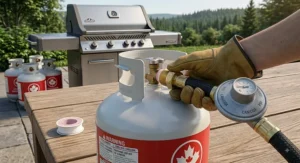
Getting a propane hose and regulator kit running safely takes about ten minutes, but the details matter. Start by inspecting both ends of the hose for cracks, especially near the fittings, before your first connection — a kit that sat in a warehouse for months can develop stress points nobody caught. Thread the QCC1 (or ACME) connector onto the tank by hand until snug; these fittings are designed to be hand-tight, and forcing them with a wrench risks stripping the nylon seal inside. Turn the tank valve on slowly, listen for a hiss (which usually means an improperly seated connection), and do the soap-and-water bubble test on every joint before lighting anything.
A common mistake in the first 30 days is coiling excess hose tightly against a hot grill body — heat exposure accelerates rubber degradation, so route hose away from direct flame contact and let it hang in a loose loop rather than a tight coil. For maintenance, inspect the hose every time you swap or refill a tank, checking specifically for brittleness, discoloration, or soft spots. One optimization trick Amazon listings rarely mention: keep the female flare nut lightly finger-tightened even during off-season storage, which prevents insects from nesting in the open threading — a surprisingly common cause of blocked venturi tubes and weak spring ignition.
✨ Don’t Miss These Exclusive Deals!
🔍 Take your outdoor cooking setup to the next level with these carefully selected hose and regulator kits. Click on any highlighted item above to check current pricing and availability. The right connection keeps your flame steady and your family safely enjoying every cookout.
Real-World Scenarios: Matching a Kit to Your Setup
Consider three different households and how the math actually plays out. A condo balcony griller with a compact two-burner unit and a 1 lb propane canister has almost no need for a 12-foot hose — a short, low-pressure kit like the base included with most portable grills, or the Weber 7627-style OEM replacement, keeps the footprint tight and avoids excess coiled hose becoming a tripping hazard on a small balcony. A backyard family running a full-size grill with the tank tucked behind a privacy screen ten feet away is the textbook case for the GasOne 2120-012 or DOZYANT 12 Feet Stainless Steel Braided — both give enough slack to route the tank out of sight without pulling the hose taut.
Then there’s the RV or trailer owner running dual 20 lb or 30 lb tanks for a multi-week trip, where reliability matters more than convenience — this is where the Flame King KT12ACR-2 genuinely changes the experience, because nobody wants to discover a dead tank mid-dinner on the road. Budget matters across all three groups too: the condo griller and the RV owner are working with fundamentally different cost tolerances, and matching kit tier to actual use frequency (weekend griller versus full-time RVer) avoids both overspending and under-provisioning.
Problem → Solution: Common Propane Hose Issues
Weak or yellow flame despite a full tank is one of the most common complaints, and it’s frequently a regulator issue rather than a tank issue — a kinked hose or an incorrectly matched low/high-pressure regulator restricts flow even when the cylinder itself is fine; swapping to a properly matched kit like the GasOne 2120-012 or DOZYANT 4 FT 0-30 PSI Adjustable (depending on appliance type) usually resolves it. A hissing sound at the tank connection almost always means the QCC1 nut isn’t fully hand-tightened, or the tank’s overfill protection device hasn’t engaged properly — reseat the connection and retry rather than assuming a faulty hose.
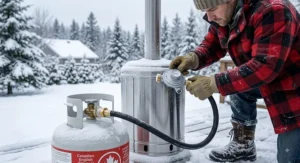
Cracked or brittle hose after a Canadian winter is a seasonal classic; UV and freeze-thaw cycling are hard on unprotected rubber, which is exactly the problem braided options like the DOZYANT 12 Feet Stainless Steel Braided kit are built to resist — the practical solution is simply replacing the hose annually if it’s stored outdoors rather than waiting for visible damage. Running out of gas mid-cook with no backup is a frustration unique to single-tank setups; the fix isn’t a bigger tank, it’s a dual-tank system like the Flame King KT12ACR-2, which eliminates the failure mode entirely rather than just delaying it. Finally, mismatched threading between an older appliance and a modern QCC1 hose is common with legacy grills — the Mr. Heater F271239 kit’s adapter fittings solve exactly this kind of thread-standard mismatch.
How to Choose a Propane Hose and Regulator Kit
- Confirm your tank connector type first. Nearly all propane cylinders sold in Canada since the mid-2000s use QCC1 (also called Type 1), but older tanks and some RV setups use POL or ACME fittings — check your tank’s collar before shopping.
- Match pressure type to your appliance. Grills, patio heaters, and fire pit tables almost always need low-pressure regulators; turkey fryers, forges, and high-BTU burners need adjustable high-pressure units like the DOZYANT 4 FT 0-30 PSI Adjustable.
- Measure the actual distance you need. Add at least two feet of slack to your tank-to-appliance measurement so the hose isn’t pulled taut, which stresses the fittings over time.
- Check for CSA or UL certification. In Canada, this isn’t optional guidance — it’s the practical way to confirm a hose meets CSA B149.2 material and pressure-rating expectations.
- Decide if you need a gauge. A built-in PSI gauge like the one on the GasOne 2120-012 adds diagnostic value but isn’t essential for straightforward backyard grilling.
- Consider your storage environment. Hoses stored outdoors year-round benefit meaningfully from braided or UV-resistant construction over bare rubber.
- For RVs, count your tanks. A single-tank setup needs a straightforward pigtail; dual-tank setups are dramatically improved by an auto-changeover regulator.
Common Mistakes When Buying a Propane Hose and Regulator Kit
The single biggest mistake is buying by length alone without checking pressure rating — a 12-foot low-pressure hose bolted onto a high-BTU turkey fryer will either restrict flow or, worse, fail to regulate properly under load. A close second is ignoring connector type: shoppers frequently order a QCC1 kit for an RV setup that actually uses ACME or POL fittings, then discover the mismatch only after the box arrives. Buyers also commonly underestimate how much slack they need, ordering a hose that’s technically long enough on paper but leaves no room for the natural bend and stretch of daily use.
Skipping the CSA/UL certification check is a mistake with real consequences in a Canadian context specifically, since uncertified imports sold through third-party marketplace listings don’t always meet the standards enforced by provincial authorities like TSSA. Finally, a subtler mistake: assuming any hose fits any grill brand. While QCC1 fittings are broadly universal on the tank side, appliance-side thread sizes (3/8-inch flare versus 1/2-inch flare versus proprietary quick-connects) vary enough between manufacturers that a “universal” hose still needs a five-second thread-size check against your specific grill or heater.
Propane Hose and Regulator Kits vs Built-In OEM Grill Hoses
A detailed comparison here actually cuts both ways. Built-in OEM hoses — like the Weber 7627 — are pressure-matched exactly to the burner system they ship for, which removes guesswork around ignition performance and flame consistency; that precision is hard for a universal kit to beat on a specific model. Universal kits like the DOZYANT 12 Feet Stainless Steel Braided or GasOne 2120-012, on the other hand, win decisively on flexibility and reach — they work across brands, extend well beyond OEM hose lengths, and are typically far cheaper to replace when worn out.
| Factor | OEM Hose (e.g. Weber 7627) | Universal Kit (e.g. GasOne/DOZYANT) |
|---|---|---|
| Fit precision | Exact match to burner spec | Generally compatible, rarely exact |
| Hose length | Short (typically 24-36 in) | Long (typically 6-15 ft) |
| Price | Higher, brand premium | Lower, broader competition |
| Best For | Direct factory replacement | Reach, RVs, fire pits, heaters |
Interpreting the table above: if your only goal is restoring a Genesis grill to factory condition, the OEM route removes variables and is worth the premium. If your goal is repositioning a tank, extending reach for a fire pit table, or setting up a multi-appliance propane line extension for grill and heater combined, a universal kit is the more practical and often more economical choice.
What to Expect: Real-World Performance
Specs on a box rarely translate directly into lived experience, so here’s the translation. A 12-foot hose in practice means your tank can sit comfortably behind a privacy screen, on a lower deck level, or tucked against a house wall — roughly the reach of a standard extension cord, which is a helpful mental benchmark. A properly matched low-pressure regulator produces a flame that responds predictably to the control knob; if you’re seeing a flame that surges or dies unpredictably, that’s a stronger signal of a regulator mismatch than a tank problem.
Braided stainless hoses feel noticeably stiffer to coil than bare rubber, which some users initially read as a downside — in practice it means the hose holds a loop shape rather than kinking, which is actually a functional advantage during storage. Auto-changeover regulators like the Flame King KT12ACR-2 are close to invisible in daily use when working correctly; the entire point is that you shouldn’t notice the switchover happening, only the indicator light confirming it did.
Long-Term Cost & Maintenance
A propane hose and regulator kit is a low-cost, replace-rather-than-repair category of hardware, which changes the total cost of ownership math compared to something like a full regulator assembly on an RV furnace. Budget hoses in the C$15-C$25 range are reasonable to replace every one to two seasons if stored outdoors, while braided or higher-tier kits in the C$35-C$50 range often last three to four seasons under the same conditions, meaning the cost-per-use gap narrows considerably over a multi-year horizon. RV auto-changeover regulators like the Flame King KT12ACR-2, priced higher upfront, typically outlast several cheaper single-hose replacements over the life of a trailer, which is worth factoring in if you’re outfitting a camper you plan to keep for years.
Maintenance costs are close to zero beyond the hose itself — no lubrication, no internal parts to service on the consumer-facing units covered here. The real long-term cost driver is neglect: a hose left cracked and unreplaced doesn’t just risk a gas leak, it can also damage the more expensive components downstream, like a grill’s burner valve or an RV furnace’s regulator input, turning a C$20 replacement into a C$150+ repair.
Gas Line Safety and Canadian Regulations
Gas line safety is where this category stops being about convenience and starts being about genuine risk, so it deserves direct treatment. In Canada, propane appliances and connections fall under CSA B149.2, the Propane Storage and Handling Code, with provincial authorities enforcing compliance — Ontario’s Technical Standards and Safety Authority is one example of a provincial regulator overseeing propane storage, handling, and use. The Canadian Propane Association publishes practical BBQ safety guidance built around this framework, including the standard soap-and-water leak test: apply a light soap-and-water solution to every connection point and watch for bubbles, which indicate a leak that needs tightening or hose replacement before use.
A few non-negotiable habits: always store and use propane cylinders upright and outdoors, never in a garage or enclosed space, since propane combustion produces carbon monoxide. Never modify, force, or attempt to repair a regulator or fitting yourself — if a connection won’t thread properly, the fix is a replacement part, not force. Turn the tank valve off before the appliance’s burner controls when you’re finished cooking, so no residual gas sits pressurized in the hose. And if you ever smell gas — often described as similar to rotten eggs — leave the area immediately and don’t attempt to troubleshoot on-site. The City of Toronto’s barbecue safety guidance reinforces the same clearance and ventilation rules, and it’s worth a read even if you don’t live in the GTA, since most municipal fire services echo near-identical guidance.
Hose Length and Connector Compatibility Explained
Hose length and connector compatibility are the two specs that generate the most buyer confusion, so it’s worth untangling them separately. Length is straightforward math: measure tank-to-appliance distance, then add roughly two feet of slack so the hose can flex without stress on the fittings — a hose pulled taut across a deck railing is under constant tension that shortens its working life. Connector compatibility is where things get more nuanced, because there are effectively two connection points on every kit, and they don’t have to match.
| Fitting Type | Where It’s Used | Common On |
|---|---|---|
| QCC1 / Type 1 | Tank-side, hand-tight | Modern BBQ propane cylinders |
| ACME | RV tank-side, threaded | RV cylinder-to-regulator |
| 3/8″ Female Flare | Appliance-side | Grills, fire pits, heaters |
| 1/2″ Flare/Pipe | Appliance-side | Fixed indoor gas appliances |
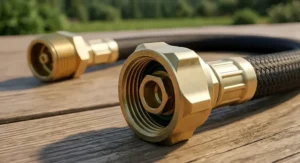
The table above explains why a hose can be “universal” on the tank side while still being wrong for your specific appliance — a DOZYANT or GasOne kit’s QCC1 tank connector fits nearly every modern cylinder, but the appliance-side 3/8-inch flare fitting needs to physically match your grill or heater’s inlet thread. Before ordering, check both ends against your actual hardware rather than assuming “propane hose” means one universal standard.
Propane Line Extension for Grill Setups: When and How
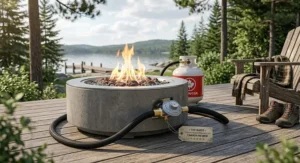
A propane line extension for grill setups solves a specific, common problem: your tank’s natural resting spot — beside a cart, behind a screen, on a lower step — is farther from the burner inlet than the stock hose allows. The fix isn’t complicated, but it does require picking the right extension type. If your existing hose and regulator are working fine and you just need more distance, an extension hose that threads between the two (rather than replacing the whole regulator) is the simpler fix; if your current hose shows any cracking or age, replacing the entire kit with a longer option like the GasOne 2120-012 or DOZYANT 12 Feet Stainless Steel Braided solves both problems in one purchase.
A practical tip Amazon listings rarely mention: route extended hose along the ground or against a wall rather than letting it hang in open space, which reduces trip hazards and keeps the hose out of direct sun exposure that accelerates rubber aging. For anyone building a fire pit table setup where the tank lives inside a cabinet base, measure the internal cabinet depth plus the external run to the burner — it’s easy to underestimate how much length gets “used up” just routing through the cabinet itself.
Buyer’s Decision Framework
If you’re replacing a factory-original hose on a specific grill model and want guaranteed fit, choose an OEM kit like the Weber 7627 because manufacturer parts remove pressure-matching guesswork entirely. If your tank needs to sit more than a few feet from your appliance, choose a 12-foot universal kit like the GasOne 2120-012 or DOZYANT 12 Feet Stainless Steel Braided because reach is the deciding factor and both offer comparable length at different price points. If you’re running an RV or trailer with two tanks, choose the Flame King KT12ACR-2 because uninterrupted supply outweighs the higher upfront cost. If you’re cooking with high-BTU equipment like a turkey fryer, choose an adjustable high-pressure kit like the DOZYANT 4 FT 0-30 PSI Adjustable, since low-pressure kits simply aren’t rated for that load — this single distinction matters more than any other spec on this list.
Frequently Asked Questions
❓ How long can a propane hose be before it affects pressure?
❓ Can I connect a propane hose and regulator kit to any grill?
❓ How often should I replace my propane hose?
❓ What's the difference between a low-pressure and high-pressure regulator?
❓ Is it safe to use a propane hose and regulator kit indoors?
Conclusion
The right propane hose and regulator kit review ultimately comes down to matching three specs to your actual setup: connector type, hose length, and pressure rating. The Weber 7627 wins on exact OEM fit for Genesis owners; the GasOne 2120-012 and DOZYANT 12 Feet Stainless Steel Braided both solve the reach problem for backyard grillers with different construction trade-offs; the Flame King KT12ACR-2 is the clear choice for dual-tank RV reliability; the Camco 15-Inch Pigtail handles targeted short-connector needs; the Mr. Heater F271239 covers fixed appliance hookups with mismatched threading; and the DOZYANT 4 FT 0-30 PSI Adjustable is the only kit here built for genuinely high-pressure demands like turkey fryers.
None of these choices is universally “best” — that’s the honest answer this whole category deserves. What matters is checking your tank connector, measuring your actual distance need, confirming CSA or UL certification, and matching pressure type to your appliance before you check out. Get those four things right and the hose becomes exactly what it should be: the boring, reliable part of your setup that nobody ever has to think about again.
📌 Always confirm current availability, verify CSA or UL certification on the listing, and check current price before purchasing — propane hardware specs and pricing shift often.
Recommended for You
- 20 lb vs 30 lb Propane Tank for Grilling: 7 Top Picks (2026)
- 20 lb Propane Tank for BBQ: 7 Best Picks for Canada (2026)
- Natural Hardwood Briquettes for Smokers: 7 Best Picks for 2026
Disclaimer: This article contains affiliate links. As an Amazon Associate, I earn from qualifying purchases. If you purchase products through these links, we may earn a small commission at no additional cost to you.
✨ Found this helpful? Share it with your friends! 💬🤗
