In This Article
There’s a very specific kind of heartbreak that happens at 5:45 p.m. on a Saturday: guests are due at six, the grill is empty, and the bag of charcoal in your hand feels like it’s making promises it might not keep. Kingsford charcoal briquettes review searches spike every spring for exactly this reason — Kingsford is the name most Canadians reach for without thinking twice, the blue-and-white bag that’s been sitting on hardware store shelves since before most of us owned a barbecue at all. But “the one everybody buys” and “the one that’s actually best for your grill” aren’t always the same product, and that gap is worth closing before you’re standing in the briquette aisle squinting at bags.
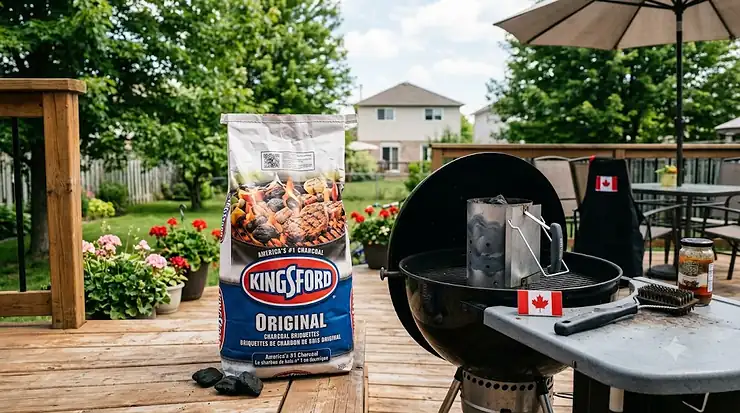
Charcoal briquettes are compressed, pillow-shaped fuel pieces made from charred wood byproducts, coal dust, and a binder, engineered to burn more predictably than raw lump charcoal. That predictability is the whole appeal — and also where brands genuinely differ. Some briquettes light in ten minutes and taper off quickly; others take longer to catch but hold a rock-steady temperature for half a day. This guide breaks down Kingsford’s core lineup alongside six real competitors you can actually find and buy, so you know exactly what you’re loading into the chimney starter before the guests show up.
Quick Comparison Table
| Product | Type | Approx. Price Range (CAD) | Best For |
|---|---|---|---|
| Kingsford Original | Standard briquette | C$18-C$26 (large bag) | Everyday grilling, beginners |
| Kingsford Professional | All-natural competition | C$24-C$32 | High-heat searing |
| Kingsford Match Light | Instant-light | C$20-C$28 | No-fuss quick starts |
| Royal Oak Super Size | Large standard briquette | C$16-C$23 | Long, budget-friendly cooks |
| B&B Competition Oak | All-natural | C$26-C$35 | Low-ash, purist grilling |
| Cowboy Charcoal | All-natural | C$22-C$30 | Value-conscious smoking |
| Stubb’s Bar-B-Q Briquets | All-natural | C$25-C$33 | Long low-and-slow smokes |
Even from this snapshot, a pattern emerges: the standard Kingsford-style briquettes trade a bit of ash and odour for speed and convenience, while the all-natural competitors — B&B, Cowboy, and Stubb’s — trade a slower start for a cleaner burn. Royal Oak sits in between as the budget-friendly middle ground, and Kingsford Professional tries to have it both ways by going all-natural under a familiar brand name. None of these is objectively “the best” — the right pick depends on whether you value convenience, cost, or the cleanest possible smoke, which is exactly what we’ll unpack product by product below.
💬 Just one click — help others make better buying decisions too!😊
Top 7 Charcoal Briquettes for Every Grilling Style: Expert Analysis
1. Kingsford Original Charcoal Briquettes — the default for a reason
The Sure Fire Grooves cut into every briquette aren’t just a marketing flourish; they genuinely increase the surface area that catches flame first, which is why this bag lights noticeably faster than a flat-sided competitor of the same density. Bags typically run 16 lb (about 7.3 kg), made from compressed wood byproducts and a starch-and-mineral binder, and Kingsford advertises a cook-ready window of roughly 15 minutes from lighting. In practice that means you can go from “empty chimney” to “first burger on the grate” in under half an hour, which matters a lot on a weeknight. Reviewers consistently describe this as the reliable, no-drama choice — easy to load, easy to light, and forgiving if your vent management isn’t perfect yet, which is exactly why it’s the default pick for anyone newer to charcoal grilling. A recurring theme in aggregated Home Depot customer feedback is that Kingsford Original delivers a steady, even cooking temperature across long sessions, though a fair number of the same reviewers have flagged that bag sizes quietly shrank from 20 lb to 16 lb while shelf prices barely moved — worth factoring into your cost-per-cook math. Independent ash-content testing by charcoal reviewers has also put Kingsford Original‘s ash residue north of 20% of starting weight, higher than several all-natural rivals, which is the trade-off for that fast, hot ignition.
Pros:
- ✅ Fastest, most forgiving ignition for charcoal beginners
- ✅ Sold in virtually every Canadian hardware and grocery store
- ✅ Consistent, well-documented heat curve across long cooks
Cons:
- ❌ Higher ash output than most all-natural competitors
- ❌ Shrinking bag sizes have quietly reduced value per dollar
At around C$18-C$26 for a large bag depending on retailer promotions, Kingsford Original remains a solid value pick if convenience and predictability matter more to you than shaving every gram of ash off your cleanup routine.
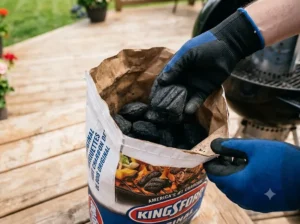
2. Kingsford Professional Briquettes — the competition-grade middle child
Marketed as an all-natural, restaurant-style briquette, Kingsford Professional (sometimes labelled Competition) drops the starch binder found in the Original line in favour of a denser, lump-like compression. The practical effect: a hotter initial burn that’s genuinely useful for reverse-searing a steak or getting a pizza stone up to temperature fast, since the briquette burns closer to raw hardwood than a standard filler-bound product. Side-by-side ash tests from independent grill reviewers found this line produced noticeably less ash residue than Kingsford’s own Original bag, and it also burned out measurably faster in a timed chimney test — a real trade-off, not a bonus. That combination makes it a genuinely different product from its blue-bag sibling rather than just a premium label slapped on the same charcoal. Aggregated reviewer sentiment across BBQ forums frames this as the pick for people who already know their grill’s airflow well enough to compensate for a shorter burn window with a properly banked coal bed. Retail availability is patchier than Original in Canada, so treat “in stock” as a bonus, not a guarantee.
Pros:
- ✅ Genuinely hotter, cleaner burn than the standard Kingsford line
- ✅ Lower ash residue in independent side-by-side testing
- ✅ Ideal for searing and high-heat, short cooks
Cons:
- ❌ Burns out faster, so long smokes need more frequent reloading
- ❌ Less consistently stocked than Original across Canadian retailers
Expect to pay a modest premium over Original, roughly C$24-C$32 per bag, and treat that extra cost as the price of a faster, hotter, cleaner burn rather than a straightforward upgrade.
3. Kingsford Match Light Instant Charcoal Briquettes — zero lighter fluid required
Kingsford Match Light briquettes are pre-treated with a quick-igniting compound baked into the charcoal itself, so a single match or long-reach lighter gets the whole pile going in roughly ten minutes — no separate can of lighter fluid, no waiting for vapours to settle before you strike a flame. That matters more than it sounds for anyone grilling on a condo balcony or a shared cottage deck where storing flammable fluid isn’t practical or, in some buildings, allowed at all. The trade-off is baked in, literally: the accelerant is petroleum-based, and reviewers who grill delicate proteins like fish or thin-cut chicken breast often report a faint chemical note during the first few minutes of cooking if food touches the grate too early. Letting the briquettes burn until they’re uniformly ash-grey — not just glowing — solves most of that complaint, and it’s a step this product genuinely requires more patience with than Original, ironically, given its “instant” branding. For hearty cuts like burgers, sausages, or ribs, most reviewers report no detectable difference in flavour once the coals are properly ashed over.
Pros:
- ✅ No lighter fluid to buy, store, or spill
- ✅ Fastest true convenience option in this lineup
- ✅ Great for apartment balconies and fire-restricted sites
Cons:
- ❌ Faint accelerant taste possible if food hits the grill too early
- ❌ Costs more per pound than non-treated briquettes
At C$20-C$28 a bag, this is the convenience tax you pay for skipping a whole extra product category — and for a lot of casual grillers, that’s a fair trade.
4. Royal Oak Super Size Charcoal Briquettes — biggest briquette, longest burn per load
Royal Oak Super Size takes the opposite approach to solving burn time: rather than reformulating the charcoal itself, it simply makes each briquette bigger, with ridged edges designed to pull more airflow into the coal bed as it burns. Independent grill testers running a 12-hour low-and-slow cook on a Weber kettle with a Slow ‘N Sear insert reported the temperature holding steady in the 275-300°F range for the full session without any vent adjustment, which is a genuinely impressive result for a briquette in this price bracket. Home Depot’s aggregated customer reviews echo that pattern, repeatedly describing even heat distribution and burn times “over an hour” per load in casual backyard use, plus notably intact bags with very little dust or shard, meaning less wasted product at the bottom of the bag. The honest caveat: a few of the same reviewers who praised its performance for searing described the smoke flavour as slightly overpowering when used for longer barbecue-style smoking, so it may suit direct grilling better than delicate, extended smoke sessions.
Pros:
- ✅ Longest per-briquette burn time in this roundup
- ✅ Among the lowest prices per pound in the lineup
- ✅ Minimal shards or dust — most of the bag is usable
Cons:
- ❌ Smoke flavour can read as strong on delicate, long smokes
- ❌ “Natural Organic” variant availability is inconsistent by region
Priced around C$16-C$23 for a comparable bag, Royal Oak Super Size is arguably the best value-per-hour-of-heat option here, especially for anyone doing weekend-long low-and-slow cooks on a tight budget.
5. B&B Charcoal Competition Oak Briquettes — the low-ash purist’s pick
B&B Competition Oak briquettes lean hard into the “all-natural” positioning, using oak char with minimal starch as a binding aid rather than the heavier chemical fillers found in mass-market bags. An independent side-by-side ash test — weighing residue after a full chimney burn — found B&B produced roughly 38% less ash by weight than a comparable Kingsford Original burn, a meaningful difference if you’re the one scraping out the kettle afterward. That lower filler content is also almost certainly why aggregated reviewer sentiment across Walmart and BBQ forum threads consistently describes this product as slower to catch than Kingsford, often recommending a chimney starter or a few pieces of lump charcoal mixed in to get things going reliably. Once lit, though, the same reviewers report a notably clean-burning, low-odour session with minimal off-smell compared to additive-heavy briquettes — several describe switching permanently away from Kingsford Original after trying it for exactly that reason. It’s a briquette built for people who already own a chimney starter and don’t mind an extra five to ten minutes at the front end of the cook.
Pros:
- ✅ Roughly 38% less ash than Kingsford Original in testing
- ✅ Minimal synthetic binders — closer to pure charred hardwood
- ✅ Strong loyalty among dedicated backyard and competition grillers
Cons:
- ❌ Noticeably slower to light without a chimney starter
- ❌ Harder to find on Canadian shelves than mainstream brands
Expect to pay a premium for that cleaner burn, typically C$26-C$35 per bag, which puts it firmly in “buy this once you already love charcoal grilling” territory rather than a first purchase for a beginner.
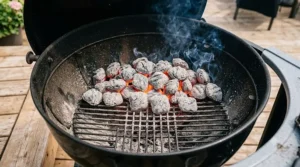
6. Cowboy Charcoal Briquettes — the value-focused all-natural option
Cowboy Charcoal briquettes occupy an interesting niche: an all-natural, filler-light formulation priced closer to mainstream briquettes than to premium competition charcoal. Forum-based community feedback across grilling communities repeatedly ranks Cowboy ahead of standard Kingsford and Royal Oak on ash output and burn length, with several longtime users specifically noting less leftover ash and a longer effective burn per load at a clearance or sale price that regularly undercuts Kingsford Professional for a comparable bag size. That value proposition is the honest selling point here — it’s not trying to out-perform B&B or Stubb’s on purity, but it consistently beats mainstream briquettes on cost-per-hour-of-heat while still avoiding the heaviest synthetic fillers. The catch is retail footprint: Cowboy tends to show up at warehouse clubs and farm-supply retailers rather than every grocery store, so Canadian availability can be spottier depending on your region, and a handful of reviewers note some batch-to-batch variation in briquette size and shape.
Pros:
- ✅ Strong ash and burn-time performance for the price bracket
- ✅ All-natural formulation without the premium-brand markup
- ✅ Frequently on sale at warehouse and farm-supply retailers
Cons:
- ❌ Less consistent retail availability across Canada
- ❌ Some reported variation in briquette size between bags
At roughly C$22-C$30 per bag when in stock, Cowboy Charcoal rewards anyone willing to shop around a little for a genuinely strong price-to-performance ratio.
7. Stubb’s Bar-B-Q All-Natural Briquets — built for the long, slow cook
Stubb’s briquettes are made without the fillers found in standard briquettes, and aggregated feedback from long-time charcoal smokers repeatedly praises their staying power on extended low-and-slow sessions — multiple reviewers describe 12- to 14-hour cooks holding a steady low temperature without needing to top up the coal bed, alongside a noticeably milder smell during the initial lighting phase compared to Kingsford’s standard line. That said, an independent timed comparison test pitting Stubb’s against Kingsford Competition found it produced more ash residue and burned out somewhat faster than that specific rival, though it still outlasted a couple of other briquettes in the same test — a reminder that “all-natural” doesn’t automatically mean “longest burning” in every matchup, and results shift depending on exactly what you’re comparing it to. Where Stubb’s consistently wins in reviewer sentiment is temperature stability during long smokes rather than raw burn-time or lowest-ash bragging rights, which makes it a strong pick specifically for brisket, pulled pork, and other patience-required cooks rather than a quick weeknight grill session.
Pros:
- ✅ Excellent temperature stability across long smoking sessions
- ✅ Milder odour at lighting than standard filler-based briquettes
- ✅ All-natural ingredient list with no synthetic binder complaints
Cons:
- ❌ Produced more ash than Kingsford Competition in direct testing
- ❌ Limited Canadian retail presence compared to Kingsford or Royal Oak
Priced around C$25-C$33 per bag where available, Stubb’s earns its keep specifically on smoker duty rather than as an everyday backyard-burger briquette.
Getting the Most From Your Charcoal Briquettes: A Practical Usage Guide
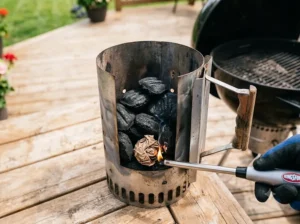
Buying good briquettes is only half the equation — how you light, arrange, and maintain them changes the outcome as much as brand choice does. Start with a chimney starter instead of lighter fluid whenever you can; it’s faster, it avoids any petroleum aftertaste, and it works identically well whether you’re using Kingsford Original or B&B Competition Oak. Fill the chimney, light a couple of sheets of newspaper or a natural fire starter underneath, and wait until the top layer of coals is glowing orange with a light coating of grey ash — that’s roughly 15-20 minutes for standard briquettes and closer to 20-25 for all-natural options like Cowboy or Stubb’s.
For your first thirty days with a new bag, the most common mistake is dumping the whole load in unlit and hoping for the best; uneven ignition leads to hot spots and cold zones that ruin a good sear. Instead, bank lit coals to one side for a two-zone fire, leaving the other side empty for indirect cooking — this single habit fixes more grilling frustration than any product swap. Keep your bag sealed tight and stored somewhere dry between uses, since briquettes that absorb humidity light more slowly and burn less predictably regardless of brand; a lidded bin in a garage or shed works far better than the original paper bag once it’s been opened. Clean out cooled ash after every two or three cooks so airflow through the vents stays unrestricted, and check your grill’s bottom vents before every session — a clogged vent will make even premium briquettes like Kingsford Professional perform like a budget bag.
Real-World Scenarios: Which Briquettes Actually Fit Your Grilling Life
Picture a university student in a shared house with a small charcoal grill on the back patio, cooking for two or three people twice a week on a tight budget: Royal Oak Super Size makes the most sense here, since its low price per pound and long per-briquette burn stretch a single bag across several meals without demanding much technique. Now picture a family of five hosting weekend cookouts where reliability under time pressure matters more than saving a few dollars — Kingsford Original or Kingsford Match Light are the better fit, because both prioritize speed and forgiveness over marginal ash-content gains, which matters when kids are hungry and the clock is ticking.
Finally, consider a dedicated backyard pitmaster smoking a full brisket every other weekend, tracking internal temperature for eight to twelve hours at a stretch: Stubb’s or B&B Competition Oak earn their higher price tag here, since both are built around temperature stability and low filler content rather than fast ignition — exactly the trade-off a long smoke rewards. None of these three profiles is wrong to choose differently than suggested; the point is matching your actual cooking frequency, patience level, and budget to the product’s real strengths rather than defaulting to whichever bag is closest to the cash register.
✨ Ready to stock up for the season? Compare current listings and grab the bag that matches your grilling style before your next cookout.
Briquettes for Charcoal Grills: Matching Fuel to Your Setup
Not every charcoal grill handles every briquette the same way, and this is where a lot of buyers get tripped up. A kettle-style grill with adjustable top and bottom vents — think a classic Weber-style unit — can handle virtually any briquette on this list, since you control airflow directly and can compensate for a faster or slower burn by adjusting vent openings. Offset smokers and drum smokers, by contrast, reward briquettes with strong per-piece burn time and consistent shape, which is exactly where Royal Oak Super Size and Stubb’s tend to outperform smaller, denser competition briquettes that burn hot but fast.
Compact portable grills — the kind popular for camping trips or small condo balconies across Canada — generally do best with Kingsford Match Light or another instant-light option, since there’s less airflow to manage and less patience required from whoever’s cooking. If your charcoal grill has a small firebox, oversized briquettes like Royal Oak’s Super Size line can be awkward to fit; breaking a few in half before loading solves this without sacrificing burn time meaningfully. The core lesson: match briquette size and burn profile to your grill’s airflow and capacity, not just to brand reputation, and you’ll get noticeably more consistent results out of any bag on this list.
Kingsford Briquettes vs Generic Briquettes: What Actually Changes
“Generic” is doing a lot of work in that phrase, since store-brand and off-brand briquettes vary wildly in quality — but the honest comparison worth making is between Kingsford’s formulation and the no-name bags often priced a few dollars cheaper on the same shelf. Kingsford’s Sure Fire Grooves and consistent briquette density are the product of over a century of manufacturing refinement, and that consistency shows up as a more predictable burn curve — you can reasonably estimate cook time and temperature because the briquettes themselves are uniform in size and composition from bag to bag.
Generic or store-brand briquettes frequently save cost by using more filler material or less consistent wood-char ratios, which can mean more variability in burn time and a chalkier, more mineral-heavy ash residue. That doesn’t automatically make them worse for every use case — a generic bag can be perfectly fine for a quick weeknight grill where minor inconsistency barely registers — but it does mean the margin for error shrinks. If you’re cooking on a tight schedule, hosting guests, or attempting a longer smoke where temperature stability actually matters, brand consistency (whether that’s Kingsford or one of the all-natural competitors reviewed above) buys you predictability that a genuinely unknown generic bag can’t reliably promise. The honest takeaway: Kingsford’s premium over true generic briquettes is buying consistency and reputation, not necessarily raw performance superiority over every all-natural alternative on this list — those, as shown above, can outperform Kingsford on ash and burn time while costing more themselves.
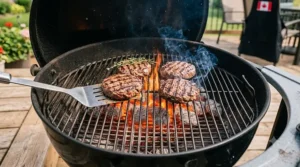
Briquette Additives: What’s Really Binding Your Charcoal Together
Every briquette on a shelf is charcoal dust and wood byproduct held together by something, and that “something” is where Kingsford’s standard line and the all-natural competitors genuinely diverge. Mass-market briquettes like Kingsford Original typically use a starch-based binder along with a small amount of mineral additive to help the briquette hold its shape and light consistently — additives that are standard across the industry and considered safe for outdoor cooking use once the briquettes have ashed over, a point reinforced by the Wikipedia entry on charcoal, which outlines the general composition of manufactured briquette fuel.
All-natural competitors — B&B, Cowboy, and Stubb’s among them — market themselves specifically on minimizing that binder content, often using just enough starch to hold the shape together without heavier fillers. The measurable trade-off, confirmed by the independent ash-weight test referenced earlier in this guide, is that lower-filler briquettes leave meaningfully less residue behind, since more of what you’re burning is actual charred wood rather than binding agent. Instant-light products like Kingsford Match Light add one more layer: a quick-igniting compound baked directly into the briquette, which is why letting those specific coals ash over fully before cooking matters more than it does with any other product on this list. None of these additives pose a safety concern once properly lit and ashed over according to manufacturer instructions — the difference between them is really about ash volume, ignition speed, and, for some grillers, peace of mind about ingredient simplicity rather than any meaningful safety gap.
Consistent Burn: What to Expect From Real-World Performance
What is a consistent burn? In practical terms, a consistent burn means your coal bed holds a steady, predictable temperature for the length of your cook without unexpected spikes, dips, or the need for constant vent fiddling — the single quality that separates a relaxed cookout from a stressful one.
On paper, spec sheets rarely tell you what a consistent burn actually feels like standing at the grill. In real use, Kingsford Original‘s steady, well-documented heat curve means you can largely set your vents once at the start of a cook and leave them alone, which is exactly the forgiving quality that makes it popular with newer grillers. Royal Oak Super Size and Stubb’s, by contrast, reward a bit more patience up front but repay it with genuinely impressive multi-hour stability — the 12-hour, vent-untouched test result for Royal Oak mentioned earlier is a good example of what “consistent” looks like when a briquette is built for endurance rather than speed.
Where things get less consistent, honestly, is at the fast end of the spectrum: high-heat, low-filler options like Kingsford Professional trade some of that long-haul stability for a hotter, more aggressive initial burn that tapers off sooner than a standard bag. That’s not a flaw so much as a different design goal — it simply means “consistent” needs to be matched to what you’re cooking. A two-hour weeknight grill session and a twelve-hour brisket smoke have genuinely different definitions of what a good, steady burn looks like, and the right briquette depends on which one you’re actually planning.
How to Choose Charcoal Briquettes
Picking the right bag doesn’t have to be complicated once you know what to weigh. Here’s the shortlist that actually matters:
- Match burn time to cook length. Quick weeknight grilling favours fast-lighting options like Kingsford Original or Match Light; long smokes favour endurance picks like Stubb’s or Royal Oak Super Size.
- Decide how much you care about ash volume. If cleanup time bothers you, all-natural options like B&B or Cowboy measurably reduce residue versus standard briquettes.
- Account for your patience level. Instant-light and standard briquettes forgive impatience; all-natural options generally reward (and often require) a chimney starter and a few extra minutes.
- Check real availability, not just online listings. A briquette that’s technically “available” but constantly out of stock near you isn’t a realistic weekly choice — factor in how often you’ll actually be able to buy it.
- Price per cook, not per bag. A cheaper bag that burns out fast or leaves more waste in the bottom can cost more per actual grilling session than a pricier, denser option.
- Think about your grill type. Kettles handle any briquette on this list well; offset smokers and small portable grills each favour different burn profiles, as covered above.
- Weigh flavour preference. Some briquettes, like Royal Oak, produce a stronger smoke character that suits direct grilling better than delicate, extended smokes.
Common Mistakes When Buying Charcoal Briquettes
The single most common mistake is buying based purely on brand recognition without matching the product to the actual cook planned — grabbing Kingsford Match Light for a twelve-hour brisket, for instance, wastes the product’s biggest strength (convenience) on a cook where it isn’t the deciding factor. A close second is ignoring bag size creep: several briquette lines, Kingsford included per aggregated Home Depot reviews, have quietly reduced bag weight over time while shelf prices held steady, so a “cheaper” bag on the shelf can actually cost more per pound than it did a couple of years ago.
Another frequent misstep is storing an opened bag loosely in a garage or shed without sealing it, which lets briquettes absorb ambient moisture and light far less reliably regardless of brand — this single storage habit undoes the benefit of buying a premium product in the first place. Buyers also commonly assume “all-natural” automatically means “better” across every metric, when in reality it typically means a trade-off: less ash and fewer additives, yes, but usually a slower, more effort-dependent ignition. Finally, plenty of shoppers skip reading unit pricing altogether, comparing sticker price instead of price-per-pound, which is the single easiest way to accidentally overpay for a smaller bag dressed up with newer packaging.
Brand Reputation in the Charcoal Aisle: Does It Still Matter?
Kingsford’s brand reputation is built on more than a century of manufacturing history and near-universal retail distribution, and that reputation buys real, tangible value: you can walk into almost any Canadian hardware store or grocery chain and know exactly what burn profile you’re getting, bag after bag, season after season. That kind of consistency is genuinely hard for a smaller or regional brand to match, since it depends on manufacturing scale as much as formulation quality.
That said, brand reputation and product superiority aren’t the same thing, and this guide’s own side-by-side comparisons make that clear — B&B, Cowboy, and Stubb’s all outperform standard Kingsford Original on at least one measurable metric, whether that’s ash residue or burn stability on long cooks, despite having far smaller marketing budgets and name recognition. A well-known brand earns trust through consistency and availability, which matters enormously for weekly grillers who can’t afford unpredictable results, but a lesser-known brand with genuinely strong independent test results shouldn’t be dismissed just because it’s less familiar. The smart approach is treating brand reputation as one input among several — alongside ash output, burn time, and price per cook — rather than the deciding factor on its own.
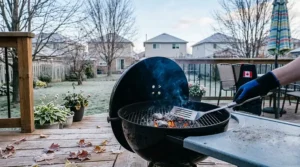
Long-Term Cost & Maintenance: What You’re Really Paying For
Total cost of ownership for charcoal briquettes isn’t just the sticker price divided by bag weight — it’s price per pound, multiplied by how much of that pound actually converts into usable heat versus ash and waste. On that basis, Royal Oak Super Size and Cowboy Charcoal tend to offer the strongest long-term value, since both combine a relatively low per-pound cost with efficient, low-waste burn characteristics reported across aggregated reviews. Premium all-natural options like B&B and Stubb’s cost more upfront, but the roughly 38% ash reduction demonstrated in independent testing means a larger share of each bag is actually converting into heat rather than leftover residue — worth factoring in if you grill frequently enough for that efficiency gap to add up over a season.
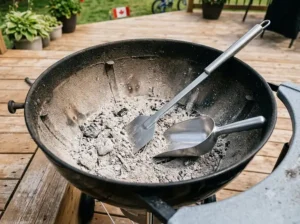
Maintenance costs matter here too: briquettes that produce more ash mean more frequent grate scraping and ash-bin emptying, which is a real time cost even if it’s not a dollar one. Storage matters for long-term value as well — a sealed, moisture-proof bin extends the usable life of any briquette bag, while leftover charcoal left in its original paper packaging in a damp shed will underperform regardless of brand, effectively shrinking the value you originally paid for. Buying in bulk during end-of-season sales, when many retailers discount charcoal ahead of colder months, is one of the more reliable ways to lower your effective cost per bag without switching products at all.
Safety, Storage, and Regulations for Grilling in Canada
Charcoal grills, regardless of brand, produce carbon monoxide as a byproduct of combustion, and Canadian fire authorities are consistent on this point: barbecues of any fuel type are approved for outdoor use only, since carbon monoxide poisoning from indoor or enclosed-space grilling has sent entire families to hospital during past storm-related power outages, a risk that has nothing to do with which briquette brand is being used and everything to do with ventilation. Never light or use a charcoal grill in a garage, tent, breezeway, or any enclosed space, even briefly, and keep the grill positioned at least three metres away from windows, doors, and combustible siding whenever possible.
Provincial and municipal rules on charcoal grilling also vary more than most Canadians realize — some jurisdictions restrict or outright prohibit solid-fuel barbecues on multi-unit apartment balconies, so it’s worth confirming your local fire code before assuming a charcoal grill is allowed where you live, a detail the City of Toronto’s official barbecue safety guidance covers in useful detail for anyone in a shared building. Always let ashes cool completely — ideally overnight — before disposing of them, since briquette ash can retain enough heat to smoulder for hours even when it looks fully spent, and never use gasoline as a starter fluid substitute regardless of how slow a bag is lighting. Following manufacturer lighting instructions, keeping a stocked fire extinguisher nearby, and respecting local fire codes will keep any of the seven products in this guide safe to use all season.
🔥 Stocked up and ready to grill safely? Check current listings for the pick that matches your setup and get your next cookout on the calendar.
Frequently Asked Questions
❓ Is Kingsford charcoal better than other brands?
❓ How long do Kingsford charcoal briquettes burn?
❓ Do charcoal briquettes have chemicals in them?
❓ Are generic or store-brand briquettes as good as Kingsford?
❓ What briquettes are best for a long smoke like brisket?
Conclusion
There’s no single “best” charcoal briquette, and honestly, that’s good news — it means the right choice comes down to how you actually grill rather than which bag has the flashiest label. Kingsford Original earns its place as the default for a reason: it’s fast, forgiving, and available everywhere, which counts for a lot on a busy weeknight. Kingsford Professional and the all-natural trio of B&B, Cowboy, and Stubb’s all trade some convenience for measurably cleaner burns and, in several cases, genuinely better temperature stability over long cooks, while Royal Oak Super Size quietly delivers some of the strongest value-per-hour in this entire lineup. Kingsford Match Light remains the right call whenever convenience and fire-restricted spaces matter more than anything else.
Whichever bag ends up in your cart, the biggest performance gains in this guide came from technique, not brand: proper chimney lighting, two-zone fire setups, dry storage, and matching burn profile to cook length will improve your results more than any single product swap. Use the comparisons above as a starting point, keep an eye on price-per-pound rather than sticker price, and you’ll land on a briquette that actually fits how — and how often — you grill.
Recommended for You
- Pizza Oven for Beginners: 7 Foolproof Picks for 2026
- Pizza Oven for Small Backyard: 7 Compact Picks for 2026
- 7 Best Pizza Ovens for Canadian Winter in 2026 (Cold-Proof Picks)
Affiliate disclosure: This article contains affiliate links. As an Amazon Associate, I earn from qualifying purchases. If you purchase products through these links, we may earn a small commission at no additional cost to you.
✨ Found this helpful? Share it with your friends! 💬🤗
